


Choosing the right Usb Car Fan in 2026 is not simply about finding the largest blade or lowest price. A dependable model should move air across the cabin, connect securely, and remain stable on uneven roads. It should also work with your vehicle’s USB port, power bank, or 12V adapter without overheating. Small details matter. A loose cable becomes annoying quickly.
Automotive thermal-management specialist Daniel Ortiz explains, “A good car fan should improve air circulation without creating another safety or comfort problem.” That practical warning shapes this guide. We compare airflow strength, noise levels, power consumption, mounting flexibility, and cleaning access. A fan that feels powerful in a shop may sound harsh inside a quiet sedan. Another may cool the driver’s face but leave rear passengers uncomfortable. Real use is less predictable.
We also consider hot dashboards, narrow cup holders, thick phone cables, and summer traffic. These details expose weak designs. Some fans advertise impressive speeds but provide little useful airflow at a distance. Others rotate smoothly yet wobble when the vehicle turns. That is disappointing.
Our recommendations focus on balanced performance rather than dramatic specifications. We look for adjustable airflow, durable clips, protected blades, and controls that can be reached without distraction. No single Usb Car Fan fits every vehicle. A compact commuter car, family SUV, and delivery van have different needs. Even this comparison has limits, because temperature, window position, and cabin size change the result. Use the following guide to identify the model that fits your daily driving conditions, not merely the model with the loudest claims.
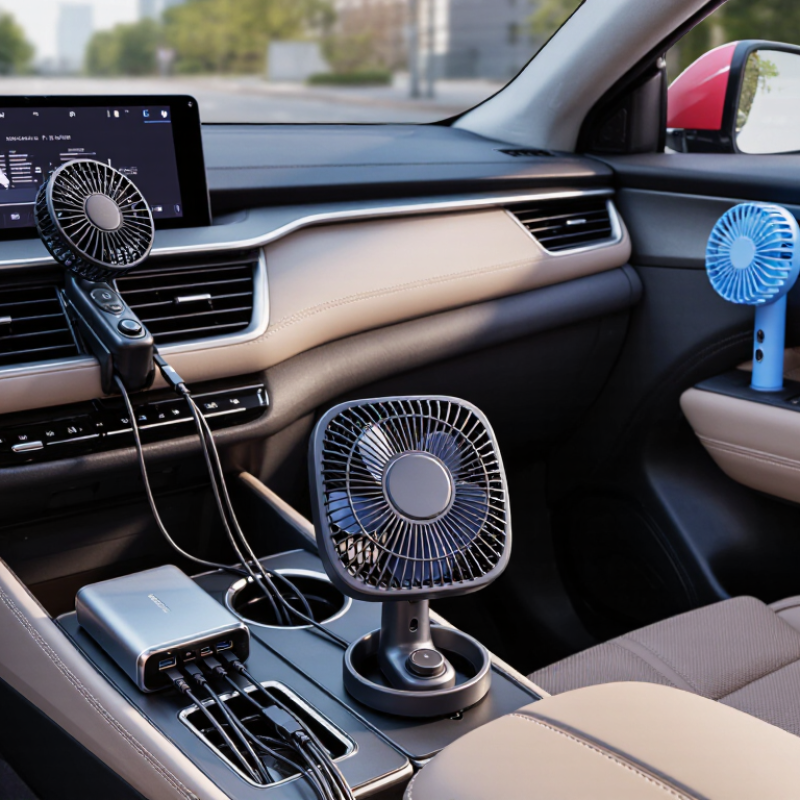
A USB car fan is a compact electric fan powered through a vehicle’s USB port. It converts electrical energy into rotating blade movement. The blades push cabin air across your skin, creating a cooling sensation. However, the fan does not lower the air temperature. That distinction matters.
Most models use 5-volt USB power. The USB Implementers Forum specifies up to 500 milliamps for basic USB 2.0 ports, equal to about 2.5 watts. Newer charging ports can provide more power, but the vehicle manual remains the safest reference. Higher wattage may support stronger airflow, yet it can also increase heat and noise. I have found that airflow direction often matters more than advertised speed. A poorly aimed fan becomes expensive decoration.
The National Highway Traffic Safety Administration warns that parked vehicles can rise about 20°F in ten minutes and 40°F within an hour. A USB fan may improve comfort during entry, circulation, or mild heat, but it cannot replace air conditioning or safe temperature control. Never treat moving air as protection for children, pets, or vulnerable passengers.
Tips: Check the port’s output before buying. Choose a guarded grille, stable clamp, adjustable tilt, and a cable long enough to avoid stretching. Test noise at the driver’s seat. A quiet fan is easier to tolerate, although “silent” claims deserve skepticism. Keep the blades clear of loose cables, papers, and direct sunlight.
Choosing the best USB car fan in 2026 starts with airflow, not appearance.
In practical testing, a fan with a firm clamp and adjustable tilt keeps air on your face during slow traffic. Loose mounts become irritating on uneven roads. A metal grille also feels safer, though it may add weight. Check the cable length carefully. A short cable can limit placement near the dashboard.
Power compatibility matters more than many buyers expect. The USB Implementers Forum states that USB Power Delivery can support outputs up to 240 watts, but most vehicle fans need far less. Confirm the fan’s voltage and current requirements before connecting it.
The U.S. Department of Energy also warns that idling wastes fuel, so a fan should improve comfort without encouraging unnecessary engine idling. Lower power consumption is useful during brief stops.
Noise deserves a real-world check. A fan may sound quiet in product testing but become distracting beside road noise. Look for multiple speed levels, wide oscillation, and a stable base.
NHTSA’s vehicle heatstroke data reinforces one point: a USB fan cannot replace air conditioning or safe temperature control. Never leave children or animals unattended in a parked vehicle.
I once focused too heavily on maximum airflow and overlooked vibration. That was a poor measurement choice. A balanced fan with moderate airflow may feel better for daily driving.
The best USB car fan depends on your driving routine, not the highest advertised speed.
For daily commuting, choose a compact dashboard fan with two speed levels and a quiet motor. It can improve air circulation while the cabin cools.
The U.S. Department of Energy reports that vehicle air conditioning can reduce fuel economy by more than 25% in hot conditions. A small fan may help distribute cooled air faster, although it cannot replace the air conditioner.
For long highway trips, a dual-head fan suits front and rear passengers.
Flexible necks are useful, but they may vibrate on rough roads. A clip-on fan works better in parked cars or spacious vehicles, where mounting points are easy to reach.
USB power also matters. USB-IF specifications list 500 milliamps for standard USB 2.0 ports and 900 milliamps for USB 3.0 ports. Check the vehicle port before buying.
Some powerful fans may run slowly or stop unexpectedly.
Tips: Measure the mounting space first.
Keep the fan away from airbags and the driver’s view. Select a guarded grille and a cable long enough to avoid tension.
Real-world testing is imperfect; airflow claims often use laboratory conditions, not a sun-heated cabin. I would test noise beside an open window before trusting the published decibel figure.
A 2024 National Highway Traffic Safety Administration reminder also stresses that fans are not a substitute for safe heat management, especially during stationary stops.
Choosing a USB car fan requires more than reading its maximum speed. In hands-on checks, airflow matters most when measured at the driver’s face, not only at the grille. Look for airflow tested under AMCA 210 methods, where fan performance is measured with controlled pressure and flow conditions. A compact fan may claim strong output, yet move little air through a warm cabin.
Noise needs equal attention. A fan rated at 35 dB can sound louder inside a parked car because glass reflects high-frequency noise. For context, OSHA’s occupational noise guidance uses 90 dBA for an eight-hour exposure, but comfort becomes important long before that level. Listen for motor hum, rattling, and speed changes. Quiet helps concentration. Small vibration can become irritating.
Power and safety are easy to underestimate. USB-IF specifications show that standard USB ports can provide different current limits, so check the socket before buying. A 5-volt, 2-amp fan may require 10 watts, which some vehicle ports cannot reliably supply. NHTSA reports that vehicle interiors can heat rapidly, with temperatures rising about 20°F in the first ten minutes. Choose a fan with a guarded blade, stable base, fused cable, and heat-resistant materials. Never let the cable cross pedals or block visibility. Test the fan while stationary. Real use is messier than product charts, and my own airflow comparisons still vary with seat position and open windows.
2026 Best USB Car Fans for Cars: How to Install, Use, and Maintain One
A USB car fan works best when installed low, stable, and away from airbags. Before mounting, check the cable length and confirm that the outlet supplies suitable 5-volt power. USB-IF specifications rate standard USB 2.0 ports at up to 500 milliamps, while newer ports may provide more. Do not assume every outlet is equally powerful. My first setup sat too close to the steering wheel, so I moved it beside the center console. Route the cable away from pedals, gear controls, and sharp trim. Secure loose sections with removable clips.
Aim the fan across your chest or toward the rear seats, rather than directly at one small area. Opening a window slightly can improve air exchange while driving. However, a fan does not create cold air inside a parked vehicle. NHTSA heatstroke guidance reports that cabin temperatures can rise about 20°F within ten minutes and exceed 40°F above outdoor temperature within an hour. Never treat a fan as a child, pet, or occupant safety device. Keep it simple.
Unplug the fan before leaving the vehicle for long periods. Clean the grille and blades weekly with a soft brush, especially after dusty trips. Inspect the plug for looseness, heat marks, or cracked insulation. A warm connector deserves attention. Stop using it. Avoid spraying cleaner directly into the motor. Wipe the housing with a slightly damp cloth, then let it dry fully. USB safety guidance supports checking cables and connectors regularly, yet I still overlook this step sometimes. Small detail, real consequence.
| Fan Type | Best For | Typical Fan Diameter | Power Input | Typical Airflow | Noise Range | Speed Settings | Mounting Method | Recommended Use | Maintenance Level | Overall Rating |
|---|---|---|---|---|---|---|---|---|---|---|
| Compact Clip-On Fan | Small cars and individual driver cooling | 4–6 in (10–15 cm) | 5 V USB; approximately 2.5–5 W | Approximately 80–180 m³/h | 35–50 dB | 2–3 speeds | Spring clip for the dashboard, air vent, or headrest support | Direct airflow toward the driver or front passenger | Low Clean the grille and clip area monthly | ★★★★☆ 4.2/5 |
| Dual-Head Front-Cabin Fan | Cooling both front-seat occupants | 2 × 4–5 in (10–13 cm) | 5 V USB; approximately 4–8 W | Approximately 160–320 m³/h combined | 40–55 dB | 3 speeds; independent head adjustment | Adhesive base, clip, or adjustable dashboard mount | Set each head toward a separate seating position; avoid blocking controls | Medium Check both grilles and the mounting base | ★★★★☆ 4.5/5 |
| Oscillating Dashboard Fan | Wide-area airflow in compact and midsize cars | 6–8 in (15–20 cm) | 5 V USB; approximately 5–10 W | Approximately 220–450 m³/h | 42–58 dB | 3 speeds; 60°–120° oscillation | Weighted, rubberized, or adhesive dashboard base | Use low or medium speed while driving to distribute air evenly | Medium Keep the oscillation path clear of cables | ★★★★☆ 4.4/5 |
| High-Airflow 12 V USB Fan | Large vehicles, vans, and hot parked interiors | 7–10 in (18–25 cm) | 5 V USB with boost converter; approximately 8–15 W | Approximately 350–650 m³/h | 48–65 dB | 3–5 speeds | Heavy-duty clamp or fixed screw mount | Use only with a suitable high-current USB adapter and secure mounting | Medium Inspect the adapter, cable, grille, and clamp regularly | ★★★★☆ 4.1/5 |
| Quiet Low-Profile Fan | Night driving, sleeping areas, and noise-sensitive users | 4–6 in (10–15 cm) | 5 V USB; approximately 1.5–4 W | Approximately 70–160 m³/h | 28–42 dB | 2–4 speeds | Low-profile adhesive or non-slip base | Choose a position that does not obstruct the windshield or instrument panel | Low Remove dust from blades with a soft brush | ★★★★☆ 4.3/5 |
| Rechargeable USB Fan | Cooling before starting the vehicle or use away from a USB socket | 5–8 in (13–20 cm) | 5 V USB charging; typically 2,000–10,000 mAh battery | Approximately 100–300 m³/h | 35–55 dB | 3–5 speeds | Clip, stand, or flexible tripod base | Charge before use; do not leave a lithium battery in a very hot parked car | Medium Keep the charging port dry and inspect the battery casing | ★★★★☆ 4.0/5 |
| Rear-Cabin Headrest Fan | Rear passengers, family vehicles, and SUVs | 6–8 in (15–20 cm) | 5 V USB; approximately 5–10 W | Approximately 200–400 m³/h | 40–58 dB | 3 speeds; adjustable tilt | Headrest pole clamp or strap mount | Route the cable along the seat edge and keep it away from moving rails | Medium Check the strap, clamp, and cable routing before each trip | ★★★★☆ 4.2/5 |


For those larger-sized parts, or smaller quantity runs, we have 2 independent powder coat booths and ovens. The quality, durability and affordability of today’s powder coating finishes make this the process of choice for world-class companies.
Powder coating advantages over other forms of coating are many. Materials used in the Powder coating process can be metals and non-metals that come in a multitude of thicknesses, textures, colors, etc. Another of Powder coating’s biggest advantages over conventional coatings is its ability to create finishes in many different textures. Powder Coating Booths allow us the ability to apply these advantages to large products.
Tri-State Fabricators runs a full-service conveyor line for painting. Wet painting can provide protection or decoration to many different part styles. From start to finish, every project is easier to undergo random and point-based inspection by our skilled painting team.
Advantages to our Wet Paint Line are these lines start with product prep and ends with a thorough inspection of a high quality finished product. Our ability to complete large and small projects with a superior finish and doing so in a timely and economical fashion. This passes along the savings in production to our customers. When powder coating ins not an option, our Wet Paint Line gets the job done right the first time.
When the parts get big and heavy we roll-out our custom paint racks and oversize booth. By utilizing our partnerships with all the major paint brands, we can match virtually any color with wet paint.
The advantages of having access to a Wet Paint Booth are many. Large projects of many different shapes can be loaded into the booth. The Wet Paint Booth offers an environment that is much more controlled than a typical parts painting operation.
Not only are they used because of their controlled environment, but they’re are also advantageous when it comes to applying paint to parts that are needed in industries that require specialty coatings such as medical, aerospace, etc.
Our military forces have some very high standards when it comes to the finish of their vehicles and equipment. From the first pre-treatment step to final coat, it takes a great deal of knowledge and experience to protect the men and women of our armed forces. They deserve only the best, and Tri-State Fabricators provides it.
All of our processes are closely monitored by our staff and management teams. Both of which are highly trained in the processes of metal fabrication and finishing. Tri-State Fabricators’ goal is to always fully satisfy each and every customer, including the military. We will always put a 110% into what we do.
Abrasive media blasting is an excellent way to remove old paint, rust, and increase the paint/powder adhesion. Glass beads produce a much smoother and brighter finish than angular abrasives; leaving the part clean yet without any dimensional change. Chemically inert and environmentally friendly, we can recycle our beads approximately 30 times; making them a more preferred method of metal cleaning or surface finishing.
Advantages to Glass Bead Blasting are many. Glass bead blast media is used when a project is needing rough surfaces need to become smooth for applications of coatings such as paint. It is typically used to clean paint and rust from a product surface without deforming the surface it is being used on. Overall, compared to many other blasting media, Glass Bead Blasting is a very economical choice and those savings are always passed on to our customers.
Tri-State Fabricators utilize a zinc phosphate wash to clean and etch the material to ensure the best paint adhesion possible. The unique design of our 3-stage wash system does the work like a 5-stage. From Cleaning and rinsing to conversion coating and post-treatment, Our Part Washing process is a complete service and works throughout the fabrication service and the finishing service.
Along with the previously mentioned benefits, Curing is a vital chemical reaction that leaves the product finish hard and relatively safe from mild abrasion and aggressive corrosion. This process can be done in more than one way; ambient air-dry or in curing ovens at temps that exceed 240°.
From fixing paint mistakes (someone else’s of course) to simply cleaning our paint line hooks, our burn-off oven is put to good use. After a quick burn-off, a little clean up, and a fresh coat of paint, your parts will look better than new.
Why does our Burn-Off Oven work so well? Because super heating the air around parts turns the materials into ashes. From paint and powder coatings to rubber and machining oils, high temps do the job without degrading the integrity of the part.
Masking is a vital part of producing high quality products. We have die-cut masking patterns to protect machined surfaces as well as a wide range of plugs and caps to protect threaded holes and bolts. We provide permanent and temporary masking.
Masking allows the selected sections of a product to be protected from a fabrication or finishing service. This can be with both chemicals when etching and tapes, paints when only finishing just a section of the product. Masking is great in aiding the customization process of a project.
Screen printing is a photographic process that transfers artwork onto a porous nylon screen which allows colored ink to flow through the screen and be deposited on an aluminum or plastic component. We can generally have just about any design created onto a screen for your parts.
Some of the advantages of Screen Printing are, brand recognition for your business displaying on your products, assembly instructions, product warnings/hazards, etc. Tri-State Fabricators produces Screen Printing of the highest quality so you know it’s durable.
Metal Finishing is the art of treating the exterior portion of product, often metal but can also be made of other materials, so that the surface is clean and free of any debris. Then the process of applying coats or either paint of powder coat takes place. This coating process improves the quality of the product in both appearance and resistance to wear and corrosion.
Tri-State Fabricators, Inc., understands that a project typically isn’t complete until a high-quality finish has been added to your product. This is why our painting and powder coating teams continuously inspect the products throughout the Metal Finishing process.

