

Repairing Car Ac Compressor problems can turn a cool morning drive into a hot, distracting journey. In 2026, repair costs may range from a relatively small clutch or electrical fix to a major compressor replacement. The final price depends on your vehicle, compressor type, labor rates, refrigerant, and related component damage.
This guide explains the warning signs, diagnostic steps, and realistic cost factors behind car AC compressor repairs. A mechanic may begin by checking pressure readings, belt condition, electrical signals, and refrigerant leaks. They may also inspect the condenser and expansion valve, especially when metal debris has entered the system. A failed compressor can contaminate other parts, making a simple replacement estimate incomplete.
Listen for grinding, rattling, or clicking near the serpentine belt. Notice weak airflow, warm air, or an oily mark around an AC connection. Small details matter. They can change the diagnosis.
Repair prices vary widely between a compact sedan and a luxury SUV. Factory parts often cost more, while aftermarket units may offer savings with different warranty terms. Labor access also matters; some compressors sit beneath crowded engine components. Ask whether evacuation, vacuum testing, refrigerant charging, new seals, and system flushing are included.
A neat estimate can still be wrong. I have seen symptoms blamed on the compressor when a pressure switch or wiring fault caused the problem. That is why a documented diagnosis matters more than a quick guess. Use this guide to compare estimates, understand necessary work, and choose a qualified technician with verifiable experience.
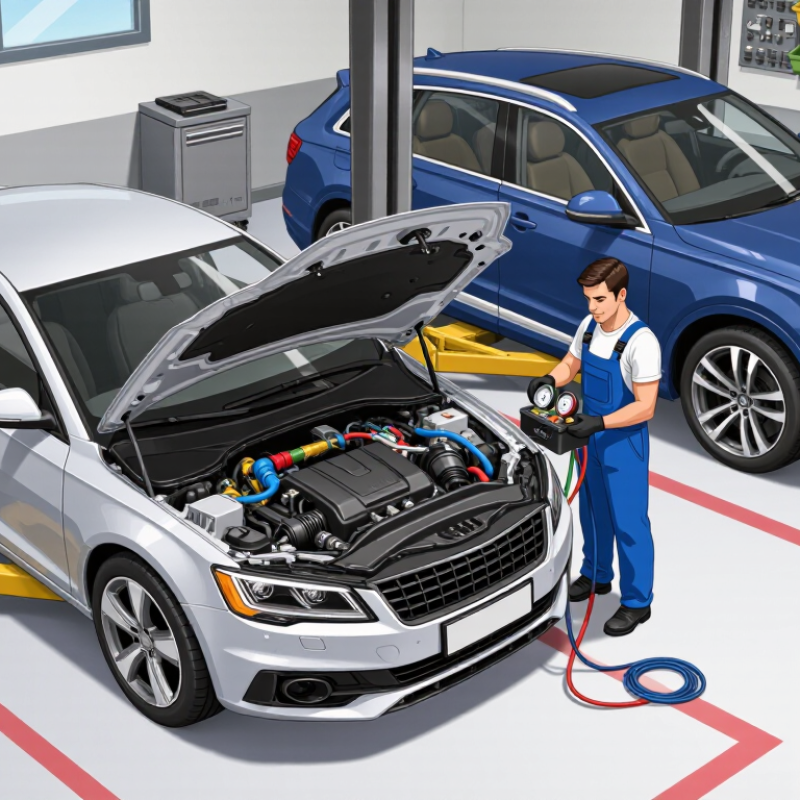
A failing AC compressor often announces itself through weak cooling, unusual noise, or short cycling. Warm air from the vents does not prove compressor failure. An ASE-based diagnosis checks the entire system before replacement. With the engine running, a technician compares low-side and high-side pressures using approved gauges. Vent temperature should also be measured near the center outlet. A large pressure imbalance may indicate internal compressor damage, restricted airflow, or an incorrect refrigerant charge.
Electrical checks matter too. Inspect the fuse, relay, wiring, and clutch connector before condemning the compressor. Battery voltage should reach the clutch when cooling is requested. If voltage is present but the clutch does not engage, measure coil resistance and inspect the clutch gap. Listen for grinding or metallic knocking. Metal debris can contaminate the system and increase the repair cost. I have seen pressure readings mislead technicians when airflow was restricted by a dirty cabin filter. Diagnosis is rarely one test.
Tips: Record vent temperature, engine temperature, and pressure readings together. Do not release refrigerant into the atmosphere. Use certified recovery equipment and verify leaks with approved methods. Compressor replacement may require flushing, a new filter-drier, vacuum testing, and the correct oil charge. Prices vary with labor access, contamination, refrigerant type, and related component damage. A written estimate should separate testing, parts, refrigerant, and labor.
In 2026, replacing a failed car air-conditioning compressor commonly costs $930–$1,223, according to a widely cited RepairPal benchmark. This figure usually reflects parts and labor, but local pricing can vary sharply. A compact car may cost less, while limited access or a larger system can raise the bill. Diagnosis matters. A noisy pulley does not always prove internal compressor failure.
A trained technician should test system pressure, electrical signals, clutch operation, and refrigerant leaks. If the compressor has scattered metal debris, the condenser, expansion valve, and lines may also need cleaning or replacement. Otherwise, the new compressor could fail early.
The estimate may include refrigerant recovery, evacuation, fresh oil, and recharging. Ask for each item in writing. I have seen low quotes become expensive after hidden labor appeared. Still, some estimates include unnecessary parts, so a second inspection can be worthwhile.
Request a pressure-test result and the compressor’s warranty. Confirm whether refrigerant and shop supplies are included. Ask why replacement is advised instead of repair. Keep the old part for inspection. Compare labor hours, not only the final price. A weak cooling system may need a simple leak repair, not a compressor. Prices are benchmarks, not promises. Your vehicle’s age, location, and damage history can change the final number.
A two-to-four-hour estimate for car AC compressor repair is usually reasonable when access is straightforward. Labor covers diagnosis, belt removal, compressor replacement, system evacuation, leak testing, and refrigerant charging. Diagnosis comes first. A technician should confirm compressor failure instead of replacing a working unit.
Labor commonly represents a large portion of the bill, with local shop rates affecting the final amount. Parts costs depend on the compressor, seals, oil, and possible expansion valve or dryer replacement. Refrigerant also adds expense, especially if the system requires a full recovery and recharge. The correct refrigerant amount matters. Too little reduces cooling, while too much can raise system pressure.
A careful inspection may reveal metal debris inside the lines. That problem can require flushing and additional parts, extending the visit beyond four hours. A blocked condenser can create similar symptoms, which makes rushed estimates risky. I have seen repair plans change after pressure readings exposed a separate leak. Estimates are useful, but they are not promises.
Ask for separate labor, refrigerant, diagnostic, and parts charges. Confirm whether leak testing and warranty coverage are included. Keep the old compressor if possible. It may help explain the failure. Small details matter. A low quote can become expensive when hidden contamination appears. A higher quote may reflect necessary cleaning rather than unnecessary work.
A 2026 car AC compressor repair often costs $900–$1,800 including parts, labor, refrigerant, and oil service. Regional labor rates change the figure. The U.S. Bureau of Labor Statistics reported median automotive technician pay of about $27 per hour in its May 2024 wage data. Customer labor rates are higher because shops cover equipment, training, and compliance. Diagnosis matters.
A pressure test should compare static and running readings, vent temperature, and compressor cycling. High pressure with weak cooling may indicate airflow trouble or overcharge. Low pressure can suggest leakage, restriction, or insufficient refrigerant. A DTC scan adds context, but a code does not automatically condemn the compressor. PAG-oil contamination deserves attention. Dark oil, metal flakes, or a burnt odor can damage a replacement unit. Flushing may not be enough when debris has traveled through the condenser or expansion device. I have seen pressure readings look acceptable while contaminated oil quietly shortened compressor life. That mistake is expensive.
Tips: Ask for measured pressures, vent temperature, recovered refrigerant weight, and oil quantity. The 2024 Auto Care Association Factbook valued the U.S. aftermarket at over $500 billion, showing how widely service quality can vary. Request a written repair plan. A compressor-only quote may exclude flushing, a filter-drier, leak testing, or refrigerant recovery. If the clutch engages, do not assume the compressor is healthy. That assumption fails.
In 2026, car air conditioning compressor repairs should include more than parts and labor. EPA Section 609 certification matters whenever a technician services a motor vehicle air conditioning system. Certified technicians understand refrigerant recovery, recycling, and safe equipment use. They should also use approved recovery machines and prevent refrigerant from escaping during service.
Ask for certification before approving work. Request a written estimate showing diagnosis, compressor replacement, refrigerant charges, labor, and additional parts. A proper inspection may reveal a clogged condenser, damaged clutch, leaking hose, or contaminated refrigerant. Replacing the compressor alone may not solve the problem. That detail can change the final cost significantly.
Warranty terms deserve careful attention. Some warranties require installation by a qualified or certified technician. Others exclude damage caused by incorrect oil, debris, poor flushing, or unresolved leaks. Keep the invoice, refrigerant record, test results, and replaced-part information. These documents can support a later warranty claim. Read the exclusions closely.
Small print matters.
A low estimate may omit recovery, evacuation, leak testing, or system flushing. Those missing steps can become expensive later. I would question any shop that promises a firm price without testing the system first. Even experienced technicians can misdiagnose intermittent compressor noise or weak cooling. That possibility deserves honest discussion before payment. EPA certification does not guarantee perfect workmanship, so evaluate both compliance and the shop’s documented repair process.


For those larger-sized parts, or smaller quantity runs, we have 2 independent powder coat booths and ovens. The quality, durability and affordability of today’s powder coating finishes make this the process of choice for world-class companies.
Powder coating advantages over other forms of coating are many. Materials used in the Powder coating process can be metals and non-metals that come in a multitude of thicknesses, textures, colors, etc. Another of Powder coating’s biggest advantages over conventional coatings is its ability to create finishes in many different textures. Powder Coating Booths allow us the ability to apply these advantages to large products.
Tri-State Fabricators runs a full-service conveyor line for painting. Wet painting can provide protection or decoration to many different part styles. From start to finish, every project is easier to undergo random and point-based inspection by our skilled painting team.
Advantages to our Wet Paint Line are these lines start with product prep and ends with a thorough inspection of a high quality finished product. Our ability to complete large and small projects with a superior finish and doing so in a timely and economical fashion. This passes along the savings in production to our customers. When powder coating ins not an option, our Wet Paint Line gets the job done right the first time.
When the parts get big and heavy we roll-out our custom paint racks and oversize booth. By utilizing our partnerships with all the major paint brands, we can match virtually any color with wet paint.
The advantages of having access to a Wet Paint Booth are many. Large projects of many different shapes can be loaded into the booth. The Wet Paint Booth offers an environment that is much more controlled than a typical parts painting operation.
Not only are they used because of their controlled environment, but they’re are also advantageous when it comes to applying paint to parts that are needed in industries that require specialty coatings such as medical, aerospace, etc.
Our military forces have some very high standards when it comes to the finish of their vehicles and equipment. From the first pre-treatment step to final coat, it takes a great deal of knowledge and experience to protect the men and women of our armed forces. They deserve only the best, and Tri-State Fabricators provides it.
All of our processes are closely monitored by our staff and management teams. Both of which are highly trained in the processes of metal fabrication and finishing. Tri-State Fabricators’ goal is to always fully satisfy each and every customer, including the military. We will always put a 110% into what we do.
Abrasive media blasting is an excellent way to remove old paint, rust, and increase the paint/powder adhesion. Glass beads produce a much smoother and brighter finish than angular abrasives; leaving the part clean yet without any dimensional change. Chemically inert and environmentally friendly, we can recycle our beads approximately 30 times; making them a more preferred method of metal cleaning or surface finishing.
Advantages to Glass Bead Blasting are many. Glass bead blast media is used when a project is needing rough surfaces need to become smooth for applications of coatings such as paint. It is typically used to clean paint and rust from a product surface without deforming the surface it is being used on. Overall, compared to many other blasting media, Glass Bead Blasting is a very economical choice and those savings are always passed on to our customers.
Tri-State Fabricators utilize a zinc phosphate wash to clean and etch the material to ensure the best paint adhesion possible. The unique design of our 3-stage wash system does the work like a 5-stage. From Cleaning and rinsing to conversion coating and post-treatment, Our Part Washing process is a complete service and works throughout the fabrication service and the finishing service.
Along with the previously mentioned benefits, Curing is a vital chemical reaction that leaves the product finish hard and relatively safe from mild abrasion and aggressive corrosion. This process can be done in more than one way; ambient air-dry or in curing ovens at temps that exceed 240°.
From fixing paint mistakes (someone else’s of course) to simply cleaning our paint line hooks, our burn-off oven is put to good use. After a quick burn-off, a little clean up, and a fresh coat of paint, your parts will look better than new.
Why does our Burn-Off Oven work so well? Because super heating the air around parts turns the materials into ashes. From paint and powder coatings to rubber and machining oils, high temps do the job without degrading the integrity of the part.
Masking is a vital part of producing high quality products. We have die-cut masking patterns to protect machined surfaces as well as a wide range of plugs and caps to protect threaded holes and bolts. We provide permanent and temporary masking.
Masking allows the selected sections of a product to be protected from a fabrication or finishing service. This can be with both chemicals when etching and tapes, paints when only finishing just a section of the product. Masking is great in aiding the customization process of a project.
Screen printing is a photographic process that transfers artwork onto a porous nylon screen which allows colored ink to flow through the screen and be deposited on an aluminum or plastic component. We can generally have just about any design created onto a screen for your parts.
Some of the advantages of Screen Printing are, brand recognition for your business displaying on your products, assembly instructions, product warnings/hazards, etc. Tri-State Fabricators produces Screen Printing of the highest quality so you know it’s durable.
Metal Finishing is the art of treating the exterior portion of product, often metal but can also be made of other materials, so that the surface is clean and free of any debris. Then the process of applying coats or either paint of powder coat takes place. This coating process improves the quality of the product in both appearance and resistance to wear and corrosion.
Tri-State Fabricators, Inc., understands that a project typically isn’t complete until a high-quality finish has been added to your product. This is why our painting and powder coating teams continuously inspect the products throughout the Metal Finishing process.