


Choosing the best Aluminum Hanging Door is not a simple matter of appearance. Global buyers must examine weight, track strength, corrosion resistance, glass safety, sealing, and installation quality. A door that slides beautifully in a showroom may struggle in coastal wind, tropical humidity, or dusty industrial spaces.
Architectural hardware consultant David R. Smith explains, “A hanging door is only as dependable as its track, rollers, and installation.” This practical view matters. The aluminum frame may look strong, yet a weak roller can create noise, uneven movement, or early failure. Buyers should request load ratings, material specifications, finish details, testing information, and maintenance guidance. Product drawings also help reveal hidden details, including drainage paths, fastener positions, and clearance above the opening.
Small details matter.
Experience often changes the final decision. A heavy glass panel may require reinforced suspension hardware. A powder-coated finish may need different care from anodized aluminum. In coastal regions, ordinary components can age faster than expected. That point is easy to overlook. I would also avoid choosing only by the lowest quotation. Lower pricing may reflect thinner profiles, limited spare parts, or unclear after-sales support.
The right Aluminum Hanging Door should balance smooth operation, visual simplicity, structural confidence, and long-term service. Buyers should compare complete systems, not isolated door panels. Local installers should review the opening before production begins. Even careful specifications can fail when measurements are rushed. This guide examines the practical differences, helping international purchasers make a more informed and realistic choice.
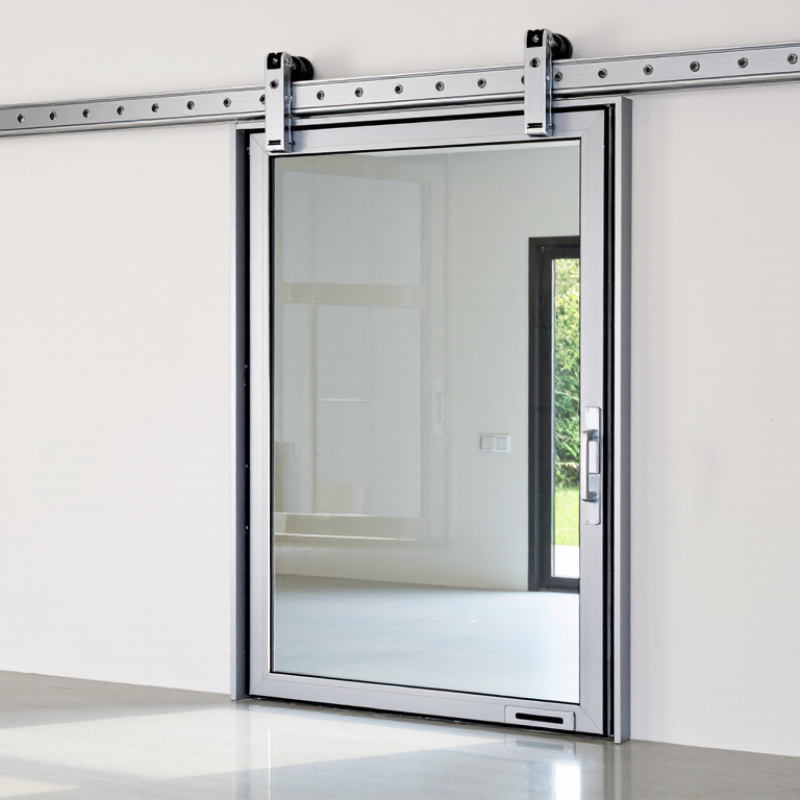
For global buyers, an aluminum hanging door should begin with material facts, not attractive renders. Aluminum has a density of approximately 2.70 g/cm³, according to standard engineering references. That is about one-third the density of steel. Lower mass can reduce handling effort and door-track stress. It may also simplify installation in warehouses, commercial interiors, and residential renovations.
The sustainability figure needs careful reading. The International Aluminium Institute reports that recycled aluminum uses about 5% of the energy required for primary aluminum production. That equals roughly 95% energy savings during remelting. This advantage depends on collection, sorting, and local electricity sources. It is not an automatic result for every door. The U.S. Department of Energy also highlights aluminum’s recyclability and lightweight potential in transport-related efficiency studies. A lighter panel can support smoother movement, but rollers, brackets, seals, and wall strength still determine performance. Small details matter.
In field selection, I would check alloy grade, panel thickness, track capacity, corrosion resistance, and recycled content documentation. Do not trust density alone. A thin panel may feel light but perform poorly under repeated use. A practical inspection should include sliding noise, alignment, impact resistance, and maintenance access. The “best” door is therefore a balanced specification, not merely the lightest option. Some project data may remain incomplete, and that limitation deserves honest review before purchasing.
For an exterior aluminum hanging door, thermal performance begins with aluminum’s high conductivity, about 205 W/m·K. That number is not a performance score. It explains why unbroken aluminum frames create fast heat paths. A polyamide thermal break interrupts that path. Insulated panels and low-emissivity glazing can reduce heat flow further. Yet rollers, joints, seals, and threshold details often weaken the design.
Buyers should request the complete doorset U-value, expressed in W/m²·K, rather than the panel value alone. For external pedestrian doorsets covered by EN 14351-1, the U-value assessment and declaration should match the tested or calculated configuration. The standard supports performance declarations, while local building rules determine acceptable limits.
Ask for test reports, calculation methods, dimensions, glazing type, and boundary conditions. A claimed value without these details is difficult to compare. Small changes matter.
For a coastal warehouse, I would inspect condensation risk near the lower frame and suspension hardware. For a heated office, I would compare solar gain, air leakage, and winter U-value. Do not select the lowest figure blindly. A very low center-panel value may hide a poor frame edge.
No model is perfect. Installation can change results. Check gaskets, fasteners, alignment, and drainage on a sample door before approving global production. That inspection may expose an awkward truth: the thermal target was too ambitious for the chosen hardware.
What Is the Best Aluminum Hanging Door for Global Buyers?
Clear opening should guide your choice, not appearance alone. Sliding doors usually provide a broad, uninterrupted opening with fewer moving panels. They suit patios, retail fronts, and rooms facing narrow terraces. However, each sliding panel often occupies part of the frame when open. Measure the usable width, not the overall frame size.
Folding systems can open almost the entire wall. Their panels stack neatly at one side or both sides. This works well for restaurants and wide living areas. Yet, the hinges, rollers, and panel weight need careful inspection. Lift-and-slide doors offer large panels with smooth operation and stronger weather sealing. They need adequate track depth and structural support. In field measurements, I have seen beautiful openings perform poorly because the head beam was too weak. A wider opening is not always better. That lesson is easy to miss.
Tips: Ask for the clear opening after installation, not only the catalog size. Check panel weight limits, drainage paths, handle height, and replacement hardware access. For windy or coastal locations, request tested air, water, and wind performance. Thermal breaks also matter in hot and cold climates. Leave room for adjustment. Site conditions are rarely perfect.
What Is the Best Aluminum Hanging Door for Global Buyers?
For global buyers, the best aluminum hanging door should be verified through performance testing. Wind resistance is not a marketing adjective. Under EN 12210, testing assigns a wind-load class to the complete door assembly. It evaluates deformation, operation, and resistance to damage at stated pressure levels. A higher class may suit exposed facades, but it cannot replace structural design. Door size, panel weight, fixing substrate, and local wind conditions still matter. Request a report for the exact tested configuration, not a generic certificate.
EN 12207 addresses air permeability through a closed door assembly. The result is given as a class based on measured leakage under pressure. Poor sealing can cause drafts, dust entry, and higher heating or cooling demand. Seals make the difference. Ask whether testing included the actual frame joints, seals, threshold, and hardware. A small profile change can affect the result. Hanging systems can be unforgiving, especially when installation tolerances are tight.
ASTM E330 evaluates structural performance under uniform static air pressure, commonly in positive and negative directions. It measures deflection and permanent deformation. This method is valuable for projects using North American specifications, but it is not automatically interchangeable with EN classifications. Confirm pressure values, specimen dimensions, supports, and acceptance criteria. In practice, comparisons often fail because test setups differ. That weakness deserves honest attention. Reliable suppliers should provide traceable laboratory records, installation drawings, and evidence that production matches the tested design.
| Evaluation Dimension | Relevant Standard | Verified Classification or Test Value | What the Result Means | Recommended Evidence for Global Buyers |
|---|---|---|---|---|
| Wind-load resistance | EN 12210 | Class 1: 400 Pa Class 2: 800 Pa Class 3: 1,200 Pa Class 4: 1,600 Pa Class 5: 2,000 Pa | Higher classes indicate resistance to higher test pressures. The appropriate class depends on building height, exposure, wind zone, door size, and local building codes. | An accredited test report identifying the complete door assembly, maximum tested dimensions, pressure sequence, deflection, and permanent deformation. |
| Air permeability | EN 12207 | Class 1: up to 50 m³/(h·m²) at 100 Pa Class 2: up to 27 m³/(h·m²) Class 3: up to 9 m³/(h·m²) Class 4: up to 3 m³/(h·m²) | Class 4 provides the lowest permitted air leakage among the EN 12207 classes. Leakage performance depends heavily on seals, joints, alignment, and installation quality. | A test report showing the air-permeability class, test pressure range, specimen dimensions, temperature, and installation method. |
| Structural performance under uniform pressure | ASTM E330/E330M | Project-specific positive and negative static air pressures; ASTM E330/E330M does not assign a universal product class. | The door assembly is checked for deflection, damage, permanent deformation, and loss of structural integrity at the specified pressure. | A laboratory report stating design pressure, test pressure, loading duration, specimen size, support conditions, measured deflection, and pass/fail criteria. |
| Aluminum frame and panel design | Product engineering and applicable local codes | Use a thermally suitable aluminum alloy and adequately reinforced rails, stiles, hanging members, and corner connections. No universal grade or thickness is prescribed by EN 12210 or EN 12207. | Material selection alone does not prove wind or air performance; the complete assembled door must be tested in its intended configuration. | Extrusion drawings, alloy and temper information, wall thickness, connection details, maximum panel size, and structural calculations where required. |
| Hanging hardware and load path | Manufacturer design documentation and project structural requirements | The overhead track, hangers, rollers, end stops, fasteners, and supporting structure must be designed for the door mass, operating forces, wind pressure, and safety factor required by the project. | A strong panel can still be unsafe if the track or building attachment cannot transfer the applied loads. | Load calculations, track span limits, hanger capacity, fixing details, corrosion protection, maintenance instructions, and installation tolerances. |
| Test specimen relevance | EN 12210, EN 12207, ASTM E330/E330M | The tested width, height, number of panels, glazing or infill type, track arrangement, seals, hardware, and fixing method should match the proposed door as closely as possible. | A certificate for a smaller or different configuration may not represent the performance of a larger hanging door. | Compare the report specimen against the purchase specification before accepting test results. |
| Weather-seal continuity | EN 12207 air-permeability testing | Continuous perimeter seals, inter-panel seals, corner joints, brush or compression seals, and correctly adjusted rollers are necessary to achieve the declared air class. | Gaps at meeting stiles, corners, or track interfaces can increase leakage even when the aluminum profile is well designed. | Seal material specification, replaceability information, adjustment procedure, and installation inspection checklist. |
| Recommended baseline for exposed locations | Project specification based on EN and ASTM test methods | Specify the wind-load class or design pressure calculated for the site, target EN 12207 Class 3 or Class 4 where low leakage is important, and an ASTM E330/E330M pressure test when required by the North American project specification. | There is no single “best” rating for every climate or building. The correct selection is the highest verified performance needed for the actual exposure and opening size. | Approved drawings, independent laboratory reports, project calculations, installation method statement, and final inspection records. |
What Is the Best Aluminum Hanging Door for Global Buyers?
For global buyers, the best aluminum hanging door is rarely the cheapest option. It is the supplier that can prove consistent quality through documents, samples, and production records. Ask for a current ISO 9001 certificate and confirm its scope, issuing body, and validity. A certificate alone can create false confidence. Request inspection photos, material specifications, coating details, and test reports for rollers, tracks, locks, and panels.
CE or UKCA marking should be checked where applicable to the product and destination market. Do not accept a printed logo without a Declaration of Conformity or supporting technical files. Details matter. A dependable supplier should explain which standards were applied and whether testing covered the complete door system. In my view, unclear compliance answers often signal future customs or installation problems.
Lead time needs more than one attractive number. Separate production time, quality inspection, packing, port handling, and ocean transit. For a commercial project, add a realistic buffer for revisions or material shortages. Promises need evidence. Ask for a production schedule and shipment milestones. The warranty should state coverage, exclusions, response time, and replacement procedures. A five-year promise sounds strong, but it means little if spare rollers are unavailable. Some suppliers also overlook local installation conditions, which can weaken performance. Confirm corrosion resistance, load limits, maintenance needs, and after-sales communication before approving the order.
A practical supplier-evaluation benchmark for international aluminum hanging door purchases. The weighting emphasizes compliance documentation, predictable delivery, and after-sales protection without using company or brand data.
Buyers should verify ISO 9001 certification, applicable CE or UKCA conformity evidence, a clearly defined production lead time, and a written warranty before placing an order. Higher scores indicate greater importance during supplier selection.


For those larger-sized parts, or smaller quantity runs, we have 2 independent powder coat booths and ovens. The quality, durability and affordability of today’s powder coating finishes make this the process of choice for world-class companies.
Powder coating advantages over other forms of coating are many. Materials used in the Powder coating process can be metals and non-metals that come in a multitude of thicknesses, textures, colors, etc. Another of Powder coating’s biggest advantages over conventional coatings is its ability to create finishes in many different textures. Powder Coating Booths allow us the ability to apply these advantages to large products.
Tri-State Fabricators runs a full-service conveyor line for painting. Wet painting can provide protection or decoration to many different part styles. From start to finish, every project is easier to undergo random and point-based inspection by our skilled painting team.
Advantages to our Wet Paint Line are these lines start with product prep and ends with a thorough inspection of a high quality finished product. Our ability to complete large and small projects with a superior finish and doing so in a timely and economical fashion. This passes along the savings in production to our customers. When powder coating ins not an option, our Wet Paint Line gets the job done right the first time.
When the parts get big and heavy we roll-out our custom paint racks and oversize booth. By utilizing our partnerships with all the major paint brands, we can match virtually any color with wet paint.
The advantages of having access to a Wet Paint Booth are many. Large projects of many different shapes can be loaded into the booth. The Wet Paint Booth offers an environment that is much more controlled than a typical parts painting operation.
Not only are they used because of their controlled environment, but they’re are also advantageous when it comes to applying paint to parts that are needed in industries that require specialty coatings such as medical, aerospace, etc.
Our military forces have some very high standards when it comes to the finish of their vehicles and equipment. From the first pre-treatment step to final coat, it takes a great deal of knowledge and experience to protect the men and women of our armed forces. They deserve only the best, and Tri-State Fabricators provides it.
All of our processes are closely monitored by our staff and management teams. Both of which are highly trained in the processes of metal fabrication and finishing. Tri-State Fabricators’ goal is to always fully satisfy each and every customer, including the military. We will always put a 110% into what we do.
Abrasive media blasting is an excellent way to remove old paint, rust, and increase the paint/powder adhesion. Glass beads produce a much smoother and brighter finish than angular abrasives; leaving the part clean yet without any dimensional change. Chemically inert and environmentally friendly, we can recycle our beads approximately 30 times; making them a more preferred method of metal cleaning or surface finishing.
Advantages to Glass Bead Blasting are many. Glass bead blast media is used when a project is needing rough surfaces need to become smooth for applications of coatings such as paint. It is typically used to clean paint and rust from a product surface without deforming the surface it is being used on. Overall, compared to many other blasting media, Glass Bead Blasting is a very economical choice and those savings are always passed on to our customers.
Tri-State Fabricators utilize a zinc phosphate wash to clean and etch the material to ensure the best paint adhesion possible. The unique design of our 3-stage wash system does the work like a 5-stage. From Cleaning and rinsing to conversion coating and post-treatment, Our Part Washing process is a complete service and works throughout the fabrication service and the finishing service.
Along with the previously mentioned benefits, Curing is a vital chemical reaction that leaves the product finish hard and relatively safe from mild abrasion and aggressive corrosion. This process can be done in more than one way; ambient air-dry or in curing ovens at temps that exceed 240°.
From fixing paint mistakes (someone else’s of course) to simply cleaning our paint line hooks, our burn-off oven is put to good use. After a quick burn-off, a little clean up, and a fresh coat of paint, your parts will look better than new.
Why does our Burn-Off Oven work so well? Because super heating the air around parts turns the materials into ashes. From paint and powder coatings to rubber and machining oils, high temps do the job without degrading the integrity of the part.
Masking is a vital part of producing high quality products. We have die-cut masking patterns to protect machined surfaces as well as a wide range of plugs and caps to protect threaded holes and bolts. We provide permanent and temporary masking.
Masking allows the selected sections of a product to be protected from a fabrication or finishing service. This can be with both chemicals when etching and tapes, paints when only finishing just a section of the product. Masking is great in aiding the customization process of a project.
Screen printing is a photographic process that transfers artwork onto a porous nylon screen which allows colored ink to flow through the screen and be deposited on an aluminum or plastic component. We can generally have just about any design created onto a screen for your parts.
Some of the advantages of Screen Printing are, brand recognition for your business displaying on your products, assembly instructions, product warnings/hazards, etc. Tri-State Fabricators produces Screen Printing of the highest quality so you know it’s durable.
Metal Finishing is the art of treating the exterior portion of product, often metal but can also be made of other materials, so that the surface is clean and free of any debris. Then the process of applying coats or either paint of powder coat takes place. This coating process improves the quality of the product in both appearance and resistance to wear and corrosion.
Tri-State Fabricators, Inc., understands that a project typically isn’t complete until a high-quality finish has been added to your product. This is why our painting and powder coating teams continuously inspect the products throughout the Metal Finishing process.

