


Which Multilayer PCB Board Is Best for 2026?

A Multilayer PCB Board for 2026 should be chosen by the job it must perform, not by layer count alone. A compact control board may need reliable routing and stable power. A high-speed communications design may demand carefully planned return paths, controlled impedance, and low-loss materials. These needs can point to different constructions.

As signal-integrity educator Dr. Eric Bogatin puts it, “Signal integrity is not about the signal; it’s about the interconnect.” That principle matters when copper layers, dielectric thickness, and via transitions shape a board’s electrical behavior. A dense stack-up can solve routing problems, but it can also raise fabrication cost and make design changes less forgiving. More layers are not automatically better.

For 2026, compare candidate boards against measurable requirements: operating frequency, current, thermal load, space, production volume, and assembly process. Ask fabricators for stack-up details and tolerances, then check that the proposed materials fit the application. Look closely at via structures, copper weights, and the path between critical components. Small details matter.

There is no universal winner. A sensible choice may be less impressive on paper, yet easier to manufacture consistently. That trade-off deserves honest review. Even experienced teams can overlook it when schedules tighten. This guide examines which Multilayer PCB Board options fit common design needs in 2026, and where the evidence still leaves room for judgment.
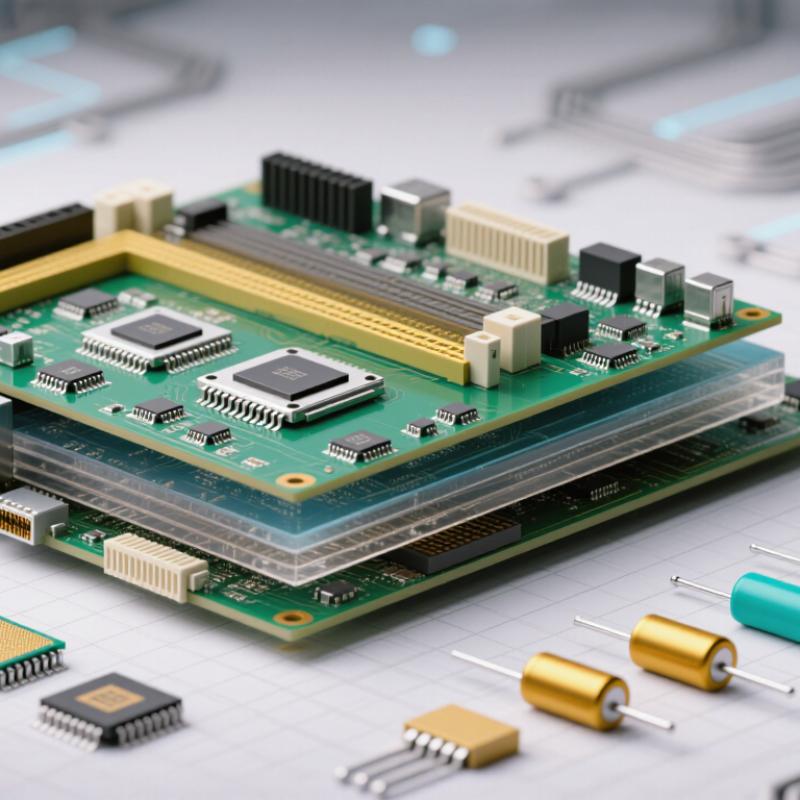
Which Multilayer PCB Board Is Best for 2026?

What Defines a Multilayer PCB and How Is It Built?

A multilayer PCB contains three or more conductive copper layers separated by insulating material. Unlike a simple two-sided board, its inner copper layers can carry power, ground, and signals beneath the outer surfaces. This arrangement supports dense circuits in devices where board area is limited. More layers do not automatically mean better performance. The stackup must match the circuit’s electrical, thermal, and mechanical needs.

Building one begins with a planned layer stack. Copper patterns are imaged and etched onto thin laminate sheets, then the layers are aligned and pressed together with bonding material under heat and pressure.

The bonded panel is drilled to create holes for component leads and connections between layers. Copper plating coats the hole walls, linking selected layers electrically.

Outer-layer patterns are then formed, followed by solder mask and surface finish. Finally, electrical tests check for opens and shorts. Small alignment errors can matter; that part is easy to underestimate.

A practical stackup often places signal layers beside reference planes, giving return currents a clear path and helping control interference. Designers also consider copper thickness, spacing, heat flow, and fabrication tolerances before settling on a layer count.

Sometimes a proposed stack looks elegant on screen but proves awkward to manufacture. Revisiting it early is worthwhile.

Testing a sample can reveal issues that a drawing alone cannot.

Which Materials and Layer Counts Shape PCB Performance?

Choosing a multilayer PCB for 2026 starts with the materials and electrical demands, not the largest possible layer count. FR-4 remains practical for many control boards, sensor systems, and moderate-speed designs. For higher signal speeds, low-loss laminates can reduce transmission loss, but they may cost more and require tighter fabrication controls. High-frequency performance also depends on copper roughness, dielectric thickness, and trace geometry. A premium material alone cannot fix a poorly planned stackup.

Layer count should follow routing density, power needs, and signal integrity targets. A four- or six-layer board may suit a compact controller, with dedicated planes helping reduce noise and simplify routing. Dense computing or communication hardware may need eight or more layers. More layers add routing options, but also increase cost, drilling complexity, and inspection demands. I have seen designs gain layers before anyone checked whether placement could be improved. That is an easy assumption to regret.

Thermal needs matter too: copper planes spread heat, but component placement and airflow still shape actual temperatures.

Tips: Ask the fabricator about laminate availability, minimum via dimensions, and stackup tolerances before finalizing the layout. Keep fast signals over continuous reference planes, and verify impedance with the real material data. Leave room for testing. Small layout changes can outperform one extra layer.

How Do You Compare Boards for Speed, Power, and Reliability?

Which Multilayer PCB Board Is Best for 2026?

Compare boards against the signals, heat, and operating conditions your design actually needs. A high-speed processor may benefit from controlled-impedance routing and carefully selected dielectric materials. Ask the fabricator for stack-up details, not just a layer count. More layers alone do not guarantee faster signals.

Check power performance under realistic load. Wider copper planes can reduce voltage drop, while thicker copper may help carry current. But thicker copper can also complicate fine-pitch routing. Measure temperature near power components during testing; a cool bench prototype may behave differently inside a sealed enclosure. Small details matter.

Reliability depends on materials, fabrication quality, and verification. Review thermal-cycle requirements, via construction, and the supplier’s inspection process. For dense designs, stacked or blind vias may save space, but they can add cost and process risk. Keep it testable. Compare sample boards under expected temperature and vibration conditions, then inspect for defects. No single stack-up wins every time. I would still question any recommendation based only on price or headline data rate; real operating conditions often expose the trade-offs.

Which Multilayer PCB Fits Each Application in 2026?

In 2026, the best multilayer PCB depends on the job it must do. A compact wearable or handheld device may need a six- or eight-layer HDI board, with fine-pitch connections and short signal paths. That density can reduce board size, but it raises fabrication demands. Check via structures and minimum spacing with the manufacturer before routing. Small does not always mean simpler.

For processors, networking equipment, and industrial controllers, an eight- to twelve-layer board can separate sensitive signals from power and ground planes. Controlled impedance matters for high-speed links; a careful stackup can limit interference and improve signal quality. RF applications need low-loss materials and deliberate separation between radio-frequency and digital sections. Power converters have different priorities: copper weight, thermal paths, and current capacity may matter more than maximum layer count. Heat is unforgiving.

For automotive or medical electronics, reliability targets, operating temperature, and expected service life should guide material and stackup choices. More layers may improve routing options, yet add cost and make repairs less practical. It is easy to overbuild a board because extra layers feel safer. They are not automatically better. Define the actual interface speeds, current loads, dimensions, and environment, then review the proposed stackup with a qualified PCB fabricator. That review can catch assumptions the schematic cannot.

How Should Cost and Manufacturing Needs Guide Your Choice?

Which Multilayer PCB Board Is Best for 2026?

Cost and manufacturing needs should shape your layer count more than a headline performance claim. Prismark’s 2024 industry forecast puts worldwide PCB production at about $73.8 billion in 2023, with the market projected to reach $90.4 billion by 2028. That growth reflects demand across many board types, not a reason to choose the most complex stackup. A six-layer board may route a compact controller cleanly, while a simpler four-layer design could suit a low-speed sensor. Every added layer brings material, lamination, drilling, and inspection costs.

Ask your fabricator to review the stackup before routing is finalized. Tight trace spacing, buried vias, thick copper, and unusual board thickness can reduce yields or limit supplier options. The cheapest quote may not stay cheap. IPC’s industry surveys track changing business conditions, but they cannot predict the yield of your specific design; request a design-for-manufacturing review and a quote based on the actual files. For a prototype, a readily available laminate and standard through-vias can shorten the path to a usable board. For higher volumes, compare the unit price against panel utilization, test needs, and expected scrap.

There is a trade-off. More ground planes can improve return paths and reduce noise, yet they occupy layers and can complicate routing. I would not assume that extra layers automatically improve reliability; that deserves a closer look. Share your impedance targets, copper weights, annual volume, and assembly process with the fabricator, then compare two stackups side by side. A small pilot run can reveal whether the theoretical savings survive real production.

Powder Coat Booths

For those larger-sized parts, or smaller quantity runs, we have 2 independent powder coat booths and ovens. The quality, durability and affordability of today’s powder coating finishes make this the process of choice for world-class companies.

Powder coating advantages over other forms of coating are many. Materials used in the Powder coating process can be metals and non-metals that come in a multitude of thicknesses, textures, colors, etc. Another of Powder coating’s biggest advantages over conventional coatings is its ability to create finishes in many different textures. Powder Coating Booths allow us the ability to apply these advantages to large products.

Wet Paint Line

Tri-State Fabricators runs a full-service conveyor line for painting. Wet painting can provide protection or decoration to many different part styles. From start to finish, every project is easier to undergo random and point-based inspection by our skilled painting team.

Advantages to our Wet Paint Line are these lines start with product prep and ends with a thorough inspection of a high quality finished product. Our ability to complete large and small projects with a superior finish and doing so in a timely and economical fashion. This passes along the savings in production to our customers. When powder coating ins not an option, our Wet Paint Line gets the job done right the first time.

Wet Paint Booths

When the parts get big and heavy we roll-out our custom paint racks and oversize booth. By utilizing our partnerships with all the major paint brands, we can match virtually any color with wet paint.

The advantages of having access to a Wet Paint Booth are many. Large projects of many different shapes can be loaded into the booth. The Wet Paint Booth offers an environment that is much more controlled than a typical parts painting operation.

Not only are they used because of their controlled environment, but they’re are also advantageous when it comes to applying paint to parts that are needed in industries that require specialty coatings such as medical, aerospace, etc.

Military CARC

Our military forces have some very high standards when it comes to the finish of their vehicles and equipment. From the first pre-treatment step to final coat, it takes a great deal of knowledge and experience to protect the men and women of our armed forces. They deserve only the best, and Tri-State Fabricators provides it.

All of our processes are closely monitored by our staff and management teams. Both of which are highly trained in the processes of metal fabrication and finishing. Tri-State Fabricators’ goal is to always fully satisfy each and every customer, including the military. We will always put a 110% into what we do.

Glass-Bead Blasting

Abrasive media blasting is an excellent way to remove old paint, rust, and increase the paint/powder adhesion. Glass beads produce a much smoother and brighter finish than angular abrasives; leaving the part clean yet without any dimensional change. Chemically inert and environmentally friendly, we can recycle our beads approximately 30 times; making them a more preferred method of metal cleaning or surface finishing.

Advantages to Glass Bead Blasting are many. Glass bead blast media is used when a project is needing rough surfaces need to become smooth for applications of coatings such as paint. It is typically used to clean paint and rust from a product surface without deforming the surface it is being used on. Overall, compared to many other blasting media, Glass Bead Blasting is a very economical choice and those savings are always passed on to our customers.

Part Washing

Tri-State Fabricators utilize a zinc phosphate wash to clean and etch the material to ensure the best paint adhesion possible. The unique design of our 3-stage wash system does the work like a 5-stage. From Cleaning and rinsing to conversion coating and post-treatment, Our Part Washing process is a complete service and works throughout the fabrication service and the finishing service.

Along with the previously mentioned benefits, Curing is a vital chemical reaction that leaves the product finish hard and relatively safe from mild abrasion and aggressive corrosion. This process can be done in more than one way; ambient air-dry or in curing ovens at temps that exceed 240°.

Burn-Off Oven

From fixing paint mistakes (someone else’s of course) to simply cleaning our paint line hooks, our burn-off oven is put to good use. After a quick burn-off, a little clean up, and a fresh coat of paint, your parts will look better than new.

Why does our Burn-Off Oven work so well? Because super heating the air around parts turns the materials into ashes. From paint and powder coatings to rubber and machining oils, high temps do the job without degrading the integrity of the part.

Masking

Masking is a vital part of producing high quality products. We have die-cut masking patterns to protect machined surfaces as well as a wide range of plugs and caps to protect threaded holes and bolts. We provide permanent and temporary masking.

Masking allows the selected sections of a product to be protected from a fabrication or finishing service. This can be with both chemicals when etching and tapes, paints when only finishing just a section of the product. Masking is great in aiding the customization process of a project.

Screen Printing

Screen printing is a photographic process that transfers artwork onto a porous nylon screen which allows colored ink to flow through the screen and be deposited on an aluminum or plastic component. We can generally have just about any design created onto a screen for your parts.

Some of the advantages of Screen Printing are, brand recognition for your business displaying on your products, assembly instructions, product warnings/hazards, etc. Tri-State Fabricators produces Screen Printing of the highest quality so you know it’s durable.

Metal Finishing

Metal Finishing is the art of treating the exterior portion of product, often metal but can also be made of other materials, so that the surface is clean and free of any debris. Then the process of applying coats or either paint of powder coat takes place. This coating process improves the quality of the product in both appearance and resistance to wear and corrosion.

Tri-State Fabricators, Inc., understands that a project typically isn’t complete until a high-quality finish has been added to your product. This is why our painting and powder coating teams continuously inspect the products throughout the Metal Finishing process.

