


10 Best Poultry Slaughter Line and Spare Parts Suppliers

Choosing a Poultry Slaugtering Line And Spare Parts supplier is a decision about reliability, not just purchase price. A line may look impressive in a showroom. Its real value shows during a busy shift, when shackles move steadily, water sprays evenly, and replacement bearings arrive on time. The OECD-FAO Agricultural Outlook 2023–2032 projects poultry will provide about 41% of all meat protein consumed globally by 2032. That growth makes dependable processing equipment and support increasingly important. Small details matter.

Supplier claims still need checking. Compare line capacity, materials, sanitation-friendly design, spare-part availability, service response, and operator training. Ask for technical documents and references from facilities with similar throughput. A low quote can hide long lead times or hard-to-source components. That deserves scrutiny. Animal handling also matters: Temple Grandin, an animal-behavior expert, has noted, “Animals are more sensitive to high-pitched noises than people are.” Her observation is a useful reminder to assess noise, movement, and handling points—not only machine speed. This guide reviews ten suppliers through practical criteria, including equipment range, parts support, and evidence of service capability. No ranking can replace a site inspection, and supplier information may change. Verify specifications before purchasing.
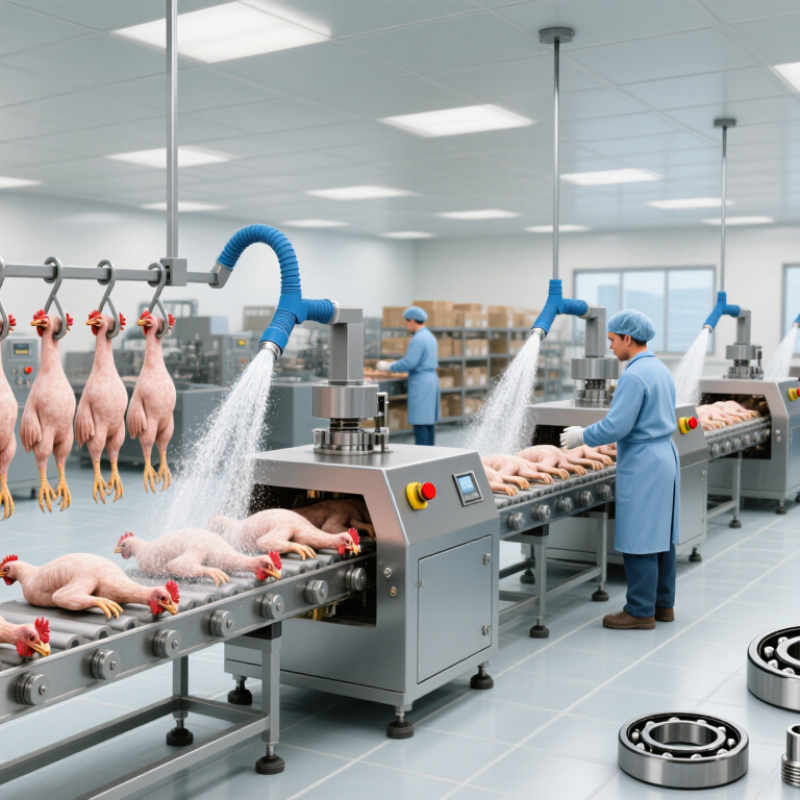
10 Best Poultry Slaughter Line and Spare Parts Suppliers

Understanding Poultry Slaughter Lines and Their Essential Components

A poultry slaughter line is a connected sequence of equipment, not a single machine. It may include shackles and overhead conveyors, scalding tanks, feather pluckers, evisceration stations, and chilling systems. Each stage affects the next. If conveyor speed exceeds the capacity of a downstream station, product can accumulate and workflow may suffer. Small details matter, too: accessible guards, suitable food-contact surfaces, and clear control panels support safer, steadier operation.

Tips: Match equipment capacity across the full line, not just at its fastest stage. Check that parts exposed to moisture are designed for washdown conditions. Keep spare bearings, belts, and seals available, but confirm dimensions and materials before ordering. A part that almost fits is still the wrong part.

Reliable performance depends on routine inspection and careful cleaning. Look for loose fasteners, worn belts, unusual vibration, and residue around joints. Maintenance records can help teams spot recurring problems, though records alone do not prevent them. A line may look efficient on paper and still feel awkward to clean or service. Review access, operator movement, and spare-part availability before selecting components, and reassess them as production needs change.


Criteria for Evaluating Poultry Slaughter Line and Spare Parts Suppliers

A poultry slaughter line supplier should be judged on verified performance, not brochure speed. Ask for throughput figures measured with comparable bird weights and operating conditions. Check whether shackles, conveyors, scalders, pluckers, and evisceration equipment integrate without awkward transfer points. Request documented acceptance-test results, hygienic design details, and a maintenance schedule. Small details matter.

Spare-parts support is equally important. Compare lead times for wear items such as blades, bearings, and conveyor components, and confirm parts are clearly identified in service manuals. Ask how the supplier handles urgent orders and technical support across your operating hours. The OECD-FAO Agricultural Outlook 2024–2033 projects poultry to account for 45% of additional meat consumption over the decade. That growth makes dependable capacity valuable, but forecasts cannot replace a site-specific production trial. A supplier’s quoted uptime may also hide cleaning or changeover delays.

Tips: Request a parts list with prices and delivery estimates before signing. Watch a full production cycle, including cleaning and restart. No checklist catches every weak weld; inspect the equipment closely, and record concerns before acceptance.

Profiles of 10 Leading Poultry Slaughter Line and Spare Parts Suppliers

Poultry equipment suppliers differ in line speed, plant scale, and parts support. These ten capability-based profiles help buyers compare options without treating any supplier as a universal fit. They cover turnkey line integrators, evisceration specialists, small-plant equipment makers, humane-handling system suppliers, scalding and plucking specialists, chilling-system providers, cut-up and deboning equipment firms, controls and automation teams, stainless-steel conveyor manufacturers, and spare-parts and maintenance specialists. Check the fit carefully.

FAOSTAT’s 2022 production dataset records more than 140 million tonnes of poultry meat worldwide. The OECD-FAO Agricultural Outlook 2024–2033 projects poultry meat to account for about 45% of additional global meat production over the decade. That scale makes dependable equipment and replacement parts important, but capacity claims alone can mislead. Ask for throughput figures under comparable bird weights, shift hours, and product mixes. Inspect wear parts, such as plucker fingers and conveyor bearings, and confirm their lead times. A supplier may offer a fast line yet lack local service. Another may provide durable parts but limited process support. Those trade-offs deserve scrutiny.

10 Best Poultry Slaughter Line and Spare Parts Suppliers - Profiles of 10 Leading Poultry Slaughter Line and Spare Parts Suppliers

An anonymized buyer’s guide to ten common supplier profiles. The entries describe supplier specializations and typical equipment or parts; they are not rankings or claims about specific companies. Actual line configurations and compatibility vary by facility and equipment model.

Supplier profile Typical scope Common equipment or spare parts Useful selection checks
1. Turnkey line integrator Coordinates a multi-stage processing line, equipment interfaces, installation, and commissioning. Overhead conveyors, transfer points, control panels, line sensors, and system-specific wear parts. Request a documented process flow, capacity assumptions, utility requirements, and an interface list for every machine.
2. Stunning and bleeding equipment specialist Supplies equipment for bird handling, stunning, and bleeding at the beginning of the process. Stunning equipment, shackles, guides, bleed-line components, and conveyor wear parts. Check local regulatory requirements, bird-size range, maintenance access, and compatibility with the existing conveyor.
3. Scalding equipment specialist Provides hot-water scalding systems and related temperature or water-circulation controls. Tank components, pumps, spray nozzles, temperature probes, seals, and heating-system parts. Compare tank capacity, temperature control, water use, cleaning access, and the intended scalding process.
4. Feather-plucking equipment specialist Focuses on mechanical defeathering equipment following scalding. Plucker fingers, finger holders, drive belts, bearings, and adjustable machine components. Verify bird-size range, finger material and dimensions, adjustment options, and replacement-part availability.
5. Evisceration equipment specialist Supplies machines and line components for internal-organ removal and associated processing steps. Evisceration tools, guides, shackles, adjustable supports, and machine-specific wear parts. Assess product-size range, line speed, cleaning procedures, operator access, and connection to inspection steps.
6. Chilling-system supplier Designs or supplies immersion or air-chilling equipment and associated product-handling systems. Chiller components, circulation pumps, agitators, conveyors, temperature sensors, and seals. Confirm the selected chilling method, product throughput, temperature monitoring, water-management needs, and sanitation access.
7. Overhead conveyor specialist Supplies or services suspended conveyor systems used to move birds or carcasses between processing stations. Chains, shackles, trolley wheels, sprockets, bearings, guides, and drive components. Match chain pitch and shackle design to the installed system; check load, speed, layout, and cleaning requirements.
8. Automation and controls integrator Integrates machine controls, monitoring, alarms, and production data across processing equipment. Sensors, motor drives, control-panel components, cables, switches, and compatible replacement modules. Ask for electrical drawings, control-system documentation, backup procedures, and confirmation of spare-part compatibility.
9. Spare-parts distributor Sources replacement parts for maintenance teams, often across several equipment categories. Bearings, belts, seals, nozzles, switches, conveyor parts, and selected machine-specific components. Provide equipment model and part numbers; confirm material, dimensions, lead time, and return terms before ordering.
10. Stainless fabrication and sanitation-equipment supplier Fabricates hygienic equipment or supplies components that support cleaning and plant maintenance. Stainless-steel tables, guards, platforms, washdown components, spray equipment, and replacement fittings. Specify dimensions, material grade, surface finish, drainage, cleaning chemicals, and applicable food-safety requirements.

Key Equipment and Spare Parts Offered by the Suppliers

A capable poultry slaughter line supplier offers more than a machine list. Core equipment may include overhead conveyors, shackles, scalders, pluckers, evisceration units, chillers, and weighing systems. The OECD-FAO Agricultural Outlook 2024–2033 projects poultry to account for 43% of additional global meat production by 2033, increasing pressure on processing capacity. That makes line speed only one purchasing measure. Buyers should also check whether equipment handles the required bird size range and allows practical access for cleaning and inspection. Small details matter.

Spare parts keep those systems working. Ask suppliers to specify compatible plucker fingers, conveyor bearings, seals, pump components, blades, sensors, and motor assemblies. Request material details, drawings, maintenance intervals, and realistic delivery estimates; a low-cost part is less useful if its dimensions or service life are unclear. In day-to-day operations, a worn seal can cause leakage, while a damaged finger may leave uneven feather removal. Some quotations look complete but omit routine wear items. That gap deserves a second look. Compare after-sales support and parts availability alongside purchase price, and confirm that replacement components fit the installed line before ordering.

How to Select a Supplier for Your Processing Facility

A poultry line should fit your daily bird count, product mix, and available floor space—not just a supplier’s headline capacity. USDA Economic Research Service estimates put U.S. chicken availability at 98.9 pounds per person in 2022. That scale makes dependable throughput important, but stated speeds can hide changeover delays and brief stoppages. Ask suppliers to demonstrate the proposed line using your bird weights, cut specifications, and shift pattern.

Inspect the details. Can the shackle spacing accommodate your flock? Are contact surfaces easy to reach, drain, and clean? Request drawings, utility requirements, wear-part lists, and service response times before comparing quotations. USDA FSIS sanitation guidance emphasizes preventing contamination through effective sanitation procedures; equipment design should support those routines, not obstruct them. Ask for references from facilities with similar output and product ranges. A polished demo is not a full production shift.

Spare parts matter. Confirm which bearings, blades, belts, and sensors are stocked locally, and ask how quickly uncommon parts can arrive. Review warranty exclusions and maintenance training, too. No spreadsheet predicts every jam. That is worth remembering. A modest line with accessible components may serve your crew better than a faster system that requires specialist service. During factory acceptance testing, record downtime, cleaning access, and actual output. Then compare the results with the supplier’s written guarantees.

How to Select a Poultry Processing Equipment Supplier

Illustrative evaluation weights for comparing suppliers of slaughter-line equipment and spare parts. Adjust the weights to match your facility’s capacity, compliance requirements, and maintenance priorities.

Powder Coat Booths

For those larger-sized parts, or smaller quantity runs, we have 2 independent powder coat booths and ovens. The quality, durability and affordability of today’s powder coating finishes make this the process of choice for world-class companies.

Powder coating advantages over other forms of coating are many. Materials used in the Powder coating process can be metals and non-metals that come in a multitude of thicknesses, textures, colors, etc. Another of Powder coating’s biggest advantages over conventional coatings is its ability to create finishes in many different textures. Powder Coating Booths allow us the ability to apply these advantages to large products.

Wet Paint Line

Tri-State Fabricators runs a full-service conveyor line for painting. Wet painting can provide protection or decoration to many different part styles. From start to finish, every project is easier to undergo random and point-based inspection by our skilled painting team.

Advantages to our Wet Paint Line are these lines start with product prep and ends with a thorough inspection of a high quality finished product. Our ability to complete large and small projects with a superior finish and doing so in a timely and economical fashion. This passes along the savings in production to our customers. When powder coating ins not an option, our Wet Paint Line gets the job done right the first time.

Wet Paint Booths

When the parts get big and heavy we roll-out our custom paint racks and oversize booth. By utilizing our partnerships with all the major paint brands, we can match virtually any color with wet paint.

The advantages of having access to a Wet Paint Booth are many. Large projects of many different shapes can be loaded into the booth. The Wet Paint Booth offers an environment that is much more controlled than a typical parts painting operation.

Not only are they used because of their controlled environment, but they’re are also advantageous when it comes to applying paint to parts that are needed in industries that require specialty coatings such as medical, aerospace, etc.

Military CARC

Our military forces have some very high standards when it comes to the finish of their vehicles and equipment. From the first pre-treatment step to final coat, it takes a great deal of knowledge and experience to protect the men and women of our armed forces. They deserve only the best, and Tri-State Fabricators provides it.

All of our processes are closely monitored by our staff and management teams. Both of which are highly trained in the processes of metal fabrication and finishing. Tri-State Fabricators’ goal is to always fully satisfy each and every customer, including the military. We will always put a 110% into what we do.

Glass-Bead Blasting

Abrasive media blasting is an excellent way to remove old paint, rust, and increase the paint/powder adhesion. Glass beads produce a much smoother and brighter finish than angular abrasives; leaving the part clean yet without any dimensional change. Chemically inert and environmentally friendly, we can recycle our beads approximately 30 times; making them a more preferred method of metal cleaning or surface finishing.

Advantages to Glass Bead Blasting are many. Glass bead blast media is used when a project is needing rough surfaces need to become smooth for applications of coatings such as paint. It is typically used to clean paint and rust from a product surface without deforming the surface it is being used on. Overall, compared to many other blasting media, Glass Bead Blasting is a very economical choice and those savings are always passed on to our customers.

Part Washing

Tri-State Fabricators utilize a zinc phosphate wash to clean and etch the material to ensure the best paint adhesion possible. The unique design of our 3-stage wash system does the work like a 5-stage. From Cleaning and rinsing to conversion coating and post-treatment, Our Part Washing process is a complete service and works throughout the fabrication service and the finishing service.

Along with the previously mentioned benefits, Curing is a vital chemical reaction that leaves the product finish hard and relatively safe from mild abrasion and aggressive corrosion. This process can be done in more than one way; ambient air-dry or in curing ovens at temps that exceed 240°.

Burn-Off Oven

From fixing paint mistakes (someone else’s of course) to simply cleaning our paint line hooks, our burn-off oven is put to good use. After a quick burn-off, a little clean up, and a fresh coat of paint, your parts will look better than new.

Why does our Burn-Off Oven work so well? Because super heating the air around parts turns the materials into ashes. From paint and powder coatings to rubber and machining oils, high temps do the job without degrading the integrity of the part.

Masking

Masking is a vital part of producing high quality products. We have die-cut masking patterns to protect machined surfaces as well as a wide range of plugs and caps to protect threaded holes and bolts. We provide permanent and temporary masking.

Masking allows the selected sections of a product to be protected from a fabrication or finishing service. This can be with both chemicals when etching and tapes, paints when only finishing just a section of the product. Masking is great in aiding the customization process of a project.

Screen Printing

Screen printing is a photographic process that transfers artwork onto a porous nylon screen which allows colored ink to flow through the screen and be deposited on an aluminum or plastic component. We can generally have just about any design created onto a screen for your parts.

Some of the advantages of Screen Printing are, brand recognition for your business displaying on your products, assembly instructions, product warnings/hazards, etc. Tri-State Fabricators produces Screen Printing of the highest quality so you know it’s durable.

Metal Finishing

Metal Finishing is the art of treating the exterior portion of product, often metal but can also be made of other materials, so that the surface is clean and free of any debris. Then the process of applying coats or either paint of powder coat takes place. This coating process improves the quality of the product in both appearance and resistance to wear and corrosion.

Tri-State Fabricators, Inc., understands that a project typically isn’t complete until a high-quality finish has been added to your product. This is why our painting and powder coating teams continuously inspect the products throughout the Metal Finishing process.
