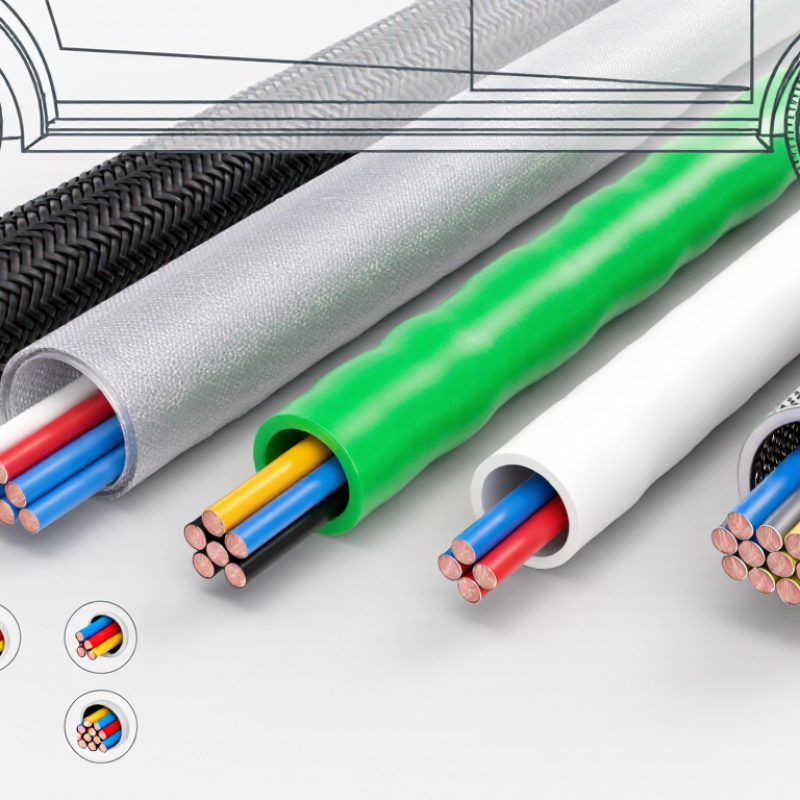
A Cable Protection Sleeve is a flexible covering designed to shield wires and cable bundles from daily damage. It can reduce abrasion, friction, heat exposure, moisture contact, and accidental impact. Common materials include braided PET, fiberglass, nylon, silicone, and woven metal. Each material behaves differently under pressure and temperature.
It wraps around cables like a protective jacket.
In practical installations, technicians use sleeves behind control panels, under vehicle floors, inside machinery, and near moving equipment. A properly fitted sleeve keeps cables organized and limits contact with sharp edges. It may also reduce noise caused by cable movement. However, protection depends on correct selection, not appearance alone. A thick sleeve is not automatically the safest choice.
The working principle is straightforward. The sleeve absorbs or redirects external forces before they reach the cable insulation. Some designs expand for easier installation, while split or hook-and-loop versions support repairs. Heat-resistant sleeves can slow thermal damage, but they cannot replace proper spacing or insulation. Waterproof products may resist splashes, yet they may fail when water remains trapped inside.
This detail matters.
Reliable practice begins with checking cable diameter, bend radius, temperature, chemical exposure, and movement. Product data should be reviewed carefully, preferably against recognized testing requirements and the equipment manufacturer’s guidance. Installers should also inspect ends, fasteners, and compressed sections after installation. Small mistakes can leave hidden weak points.
A Cable Protection Sleeve improves durability, but it is not a complete safety system. Real conditions can be unpredictable. Regular inspection remains necessary.
A cable protection sleeve is a flexible cover placed around one cable or a group of cables. It is not an electrical conductor, connector, or permanent cable repair. Its main purpose is to reduce damage from rubbing, bending, impact, heat, dust, and occasional fluid contact. The sleeve acts as a protective outer layer. It takes much of the daily abuse instead of the cable jacket.
Several designs are available. Woven sleeves allow air movement and expand around irregular cable bundles. Braided structures can offer strong abrasion resistance while remaining flexible. Split sleeves open along their length, making installation easier when connectors cannot be removed. Heat-shrink sleeves tighten around cables after controlled heating, but they require careful temperature management. Some sleeves resist flame or chemicals, while others focus only on mechanical protection. These properties are not interchangeable.
Installation quality matters. The sleeve should fit without crushing the cable or restricting its bend radius. At entry points, sharp edges need additional protection. A loose sleeve may slide, bunch, or expose the same weak section repeatedly. A tight sleeve can create pressure and make inspection difficult. Not every sleeve is waterproof. This detail is often overlooked. A sleeve can look secure while moisture still travels through its ends. Regular checks should examine fraying, heat discoloration, cuts, and movement. Choosing by appearance alone is tempting, but it can leave the cable vulnerable in real working conditions.
A cable protection sleeve is built as a flexible barrier around wires, not as a rigid shell. Its construction depends on the working environment. Common sleeves use braided polyester, nylon monofilaments, fiberglass, silicone rubber, or polyethylene. Each material handles different risks, including abrasion, heat, chemicals, and movement.
A braided sleeve is formed by interlacing yarns around a cable bundle. The open structure allows expansion and makes installation easier over connectors. Dense braids improve abrasion resistance, while looser patterns provide greater flexibility. Some designs add a flame-resistant coating or a silicone layer. These additions improve performance, but they can reduce flexibility. That trade-off is often underestimated.
Split sleeves use a longitudinal opening, allowing technicians to install them without disconnecting cables. Spiral designs wrap around irregular bundles and support quick maintenance. End sections may use heat-shrink tubing, clamps, or stitched closures to prevent fraying. Poor termination remains a common field problem.
Grand View Research reported that the global cable management market reached approximately USD 23.13 billion in 2022, with an expected 8.0% annual growth rate through 2030. This broader market includes protection sleeves and related systems. The data suggests rising demand, but market growth does not guarantee correct selection. Installers still need to check temperature, bend radius, bundle diameter, and exposure conditions before choosing sleeve construction.
What Is a Cable Protection Sleeve and How Does It Work?
A cable protection sleeve forms a flexible barrier around wires, cords, or cable bundles. It reduces damage from abrasion, sharp edges, dust, moisture, and repeated movement. During equipment inspections, worn cable jackets often show damage where bundles rub against metal frames. A suitable sleeve helps prevent this contact. Some sleeves also resist heat, chemicals, or limited flame exposure. However, no sleeve protects against every hazard.
The sleeve works by absorbing friction and spreading bending forces across its surface. Braided designs can expand around connectors and uneven bundles. Spiral sleeves allow quick installation and flexible routing. Heat-shrink sleeves create a tighter fit after controlled heating. The correct choice depends on temperature, movement, diameter, and exposure conditions. A sleeve that fits too tightly may restrict movement. One that fits loosely may slide and expose weak points. I have found that installation quality matters as much as material selection.
Tips: Measure the cable bundle before choosing a sleeve. Check the sleeve’s temperature and abrasion ratings. Leave enough flexibility near connectors and moving joints. Inspect both ends during maintenance. A small gap can become a serious failure point. Also, avoid covering damaged insulation without repairing it first. That shortcut can hide deterioration rather than solve it.
What Is a Cable Protection Sleeve and How Does It Work?
Cable protection sleeves shield wires from abrasion, heat, moisture, dust, and repeated movement. They form a physical barrier around cables, reducing damage from sharp edges, vibration, and friction. The sleeve does not repair damaged insulation. It prevents many problems before they begin.
Expandable braided sleeves suit cable bundles that need ventilation and flexibility. They are common in control cabinets, vehicles, and moving equipment. Split loom sleeves open along their length, making them practical for existing wiring. Spiral wrap works well when branches must leave the bundle at different points. Heat-shrink sleeves create a tighter seal around individual cables and terminals. Corrugated conduit offers stronger protection in workshops, machinery, and exposed areas. Each type has limits. A flexible sleeve may not resist heavy impact, while a sealed sleeve can trap moisture if installed poorly.
Tips: Match the sleeve to the real hazard, not just the cable size. Check temperature, bend radius, fluid exposure, and installation space. Leave enough room for movement. Over-tightening can stress connectors. I have seen neatly protected cables fail because water entered through an unsealed end. Secure the sleeve away from hot surfaces and sharp clamps. Recheck it during maintenance, because protection can wear quietly.
| Type of Cable Protection Sleeve | Typical Construction | How It Works | Main Protection Provided | Typical Temperature Range | Common Applications | Installation Characteristics | Important Considerations |
|---|---|---|---|---|---|---|---|
| Expandable Braided Sleeve | Woven polyethylene terephthalate (PET) monofilaments or multifilaments | The open braid expands to fit bundles and contracts around irregular shapes, creating a flexible protective layer. | Abrasion, scuffing, light UV exposure, and cable bundling | Approximately −50°C to 150°C | Automotive wiring, computer cables, control panels, robotics, and general cable management | Slides over cable bundles; ends should be secured with clips, heat-shrink tubing, tape, or cable ties to prevent fraying. | Lightweight and flexible, but the open weave does not provide a liquid-tight or fully dust-tight seal. |
| Expandable Flame-Retardant Sleeve | Flame-retardant polyester or other halogen-free braided fibers | The braided structure surrounds the cable while allowing movement, ventilation, and bundle expansion. | Abrasion, flame spread reduction, and limited heat exposure | Often approximately −40°C to 125°C | Industrial control cabinets, transportation equipment, electrical machinery, and low-voltage wiring | Installed by feeding the cable through the sleeve; the braid can normally be cut to length with a hot knife. | Verify the specific flame rating and smoke or halogen requirements before use in safety-critical installations. |
| Fiberglass Braided Sleeve | Braided fiberglass yarn, commonly with a silicone or acrylic coating | Heat-resistant fibers form a flexible barrier that isolates cables from radiant heat and occasional molten-metal splashes. | High-temperature exposure, abrasion, and thermal shielding | Commonly approximately −60°C to 260°C; higher ratings may apply to specialized constructions | Engine compartments, furnaces, welding equipment, glass processing, and high-temperature machinery | Slides over individual cables or bundles and is secured at the ends; the sleeve may become less flexible after prolonged heat exposure. | Temperature ratings depend strongly on the coating and exposure time. It is not automatically flameproof or liquid-tight. |
| Silicone-Coated Fiberglass Sleeve | Fiberglass braid coated with silicone rubber | The fiberglass carries the thermal load while the silicone coating adds flexibility, electrical insulation, and splash resistance. | Heat, abrasion, electrical contact, oils, and occasional fluid splashes | Typically approximately −60°C to 260°C | Motors, generators, welding leads, industrial heaters, and high-temperature electrical assemblies | Can be pushed over cables or installed around selected sections; end termination is required for reliable service. | Continuous exposure to harsh chemicals, sharp edges, or direct flame requires confirmation against the product specification. |
| Split Braided Sleeve | Braided textile sleeve with a longitudinal slit or overlapping closure | The split allows existing cables with connectors to be enclosed without disconnecting or re-routing them. | Abrasion, light impact, cable bundling, and maintenance protection | Often approximately −40°C to 125°C | Retrofitting vehicles, server rooms, machinery, and assembled electrical harnesses | Wraps around an installed cable bundle; installation is faster than threading a closed sleeve over a connector. | The opening can reduce mechanical protection and may require clips or hook-and-loop retention to remain closed. |
| Split Corrugated Conduit | Slit flexible corrugated plastic tubing, commonly made from polyethylene or polyamide | Corrugations provide bend flexibility while the surrounding tube separates cables from abrasion, impact, and contamination. | Mechanical abrasion, light impact, dirt, and organized routing | Commonly approximately −40°C to 120°C | Automotive harnesses, machinery, control cabinets, and equipment wiring | Cables can be inserted through the longitudinal slit without removing terminals; retaining clips may be used. | Provides stronger mechanical protection than an open braid, but the split design is generally not watertight. |
| Closed Corrugated Conduit | Continuous corrugated plastic tube made from polyethylene, polypropylene, or polyamide | The tube creates a structured enclosure that bends along its corrugations and keeps cables separated from surrounding hazards. | Abrasion, impact, dirt, routing movement, and moderate crush forces | Often approximately −40°C to 150°C, depending on material | Industrial automation, machine wiring, electrical cabinets, and vehicle installations | Usually installed before connectors are fitted or by pushing cables through the tube; conduit fittings can secure the ends. | It may need additional sealing fittings for water or dust protection. Bend radius must be respected. |
| Spiral Wrap | Helically cut polyethylene, polypropylene, or flexible elastomer strip | The spiral winds around cables and holds them together while allowing branch-outs and repeated access at any point. | Abrasion, bundling, light impact, and cable organization | Typically approximately −40°C to 90°C | Office equipment, control panels, laboratory equipment, and retrofit cable management | Wraps around installed cables without disconnecting them; branches can exit between spiral turns. | Easy to install and reuse, but it generally offers less complete coverage and strain protection than a closed conduit. |
| Heat-Shrink Tubing | Cross-linked polyolefin, fluoropolymer, elastomer, or other shrinkable polymer | When heated, the tubing contracts around the cable, forming a close-fitting layer that insulates and seals the covered area. | Electrical insulation, moisture sealing, strain relief, abrasion, and corrosion prevention | Commonly approximately −55°C to 135°C for polyolefin | Wire splices, terminal transitions, cable ends, harness branches, and connector backshell areas | Must be placed over the cable before the end connector is installed, unless a split or repairable version is used. | Requires a compatible heat source and correctly selected shrink ratio; overheating can damage the tubing or cable insulation. |
| Adhesive-Lined Heat-Shrink Tubing | Heat-shrinkable polymer with an internal hot-melt adhesive layer | Heating shrinks the outer layer while the adhesive melts and fills gaps, producing a more secure moisture-resistant seal. | Moisture, corrosion, electrical insulation, strain relief, and environmental sealing | Often approximately −55°C to 110°C | Outdoor wiring, marine connections, automotive harnesses, underground cable transitions, and repair joints | Requires controlled heating and sufficient overlap beyond the joint or cable transition. | Not a substitute for a certified waterproof connector or pressure-rated cable gland when immersion or pressure sealing is required. |
| Metal Braided Sleeve | Interwoven stainless-steel, tinned-copper, or other metal wires | The metal braid forms a strong flexible shield around the cable and can also provide electromagnetic shielding when properly terminated. | Severe abrasion, mechanical impact, heat, and electromagnetic interference shielding | Material-dependent; stainless steel commonly tolerates several hundred degrees Celsius | Industrial machinery, aerospace systems, high-temperature equipment, and EMI-sensitive cable assemblies | Installed over the cable or harness and terminated with suitable metal fittings or clamps. | Metal braid can be electrically conductive, heavier, less flexible, and more difficult to terminate than textile sleeves. |
| Hook-and-Loop Cable Sleeve | Woven fabric or polymer-coated textile with a hook-and-loop closure | The reclosable closure wraps around cables and permits frequent access, inspection, and cable additions. | Abrasion, bundling, light contamination, and maintenance protection | Commonly approximately −30°C to 105°C | Data centers, audio-video systems, test equipment, office installations, and temporary setups | Wraps around existing cables without disconnecting connectors; it can be opened and reused repeatedly. | Convenient for maintenance, but the closure may collect debris and usually provides less heat and liquid protection than sealed tubing. |
| Braided Sleeve with Foil or Drain Wire | Textile or conductive braid combined with a foil layer and, in some designs, a drain wire | The conductive layer surrounds signal cables and provides a controlled path for electromagnetic noise when connected to ground correctly. | Electromagnetic interference, radio-frequency interference, abrasion, and cable bundling | Often approximately −40°C to 125°C | Industrial sensors, instrumentation, communication wiring, audio systems, and control equipment | Requires correct overlap, termination, and grounding practices to maintain shielding continuity. | A sleeve alone does not guarantee shielding performance; connector design, grounding, and installation geometry are also important. |

What Is a Cable Protection Sleeve and How Does It Work?
A cable protection sleeve shields wires from abrasion, heat, dust, moisture, and repeated movement. Its structure spreads pressure across the cable bundle. A 2024 Grand View Research report valued the global cable-management market above USD 20 billion in 2023. This growth reflects rising demand for safer, more organized wiring systems. However, a sleeve alone cannot correct poor routing or excessive bending.
Select the sleeve by measuring the cable bundle’s outside diameter. Add limited clearance, not excessive space. A loose sleeve can slide, rub, and collect debris. A tight sleeve can restrict movement and trap heat. Check temperature, chemical exposure, flame performance, flexibility, and installation space. NFPA research found electrical distribution and lighting equipment appeared in 24% of reported home structure fires between 2015 and 2019. Proper protection is only one part of risk control. I have seen neat installations fail because the bend radius was ignored.
Tips: Cut the sleeve cleanly, then secure both ends with compatible clamps or heat-resistant ties. Keep connectors accessible. Avoid sharp edges and compression points. For moving cables, test the full travel repeatedly before final fastening. The best size is not always the smallest. Recheck it after installation.


For those larger-sized parts, or smaller quantity runs, we have 2 independent powder coat booths and ovens. The quality, durability and affordability of today’s powder coating finishes make this the process of choice for world-class companies.
Powder coating advantages over other forms of coating are many. Materials used in the Powder coating process can be metals and non-metals that come in a multitude of thicknesses, textures, colors, etc. Another of Powder coating’s biggest advantages over conventional coatings is its ability to create finishes in many different textures. Powder Coating Booths allow us the ability to apply these advantages to large products.
Tri-State Fabricators runs a full-service conveyor line for painting. Wet painting can provide protection or decoration to many different part styles. From start to finish, every project is easier to undergo random and point-based inspection by our skilled painting team.
Advantages to our Wet Paint Line are these lines start with product prep and ends with a thorough inspection of a high quality finished product. Our ability to complete large and small projects with a superior finish and doing so in a timely and economical fashion. This passes along the savings in production to our customers. When powder coating ins not an option, our Wet Paint Line gets the job done right the first time.
When the parts get big and heavy we roll-out our custom paint racks and oversize booth. By utilizing our partnerships with all the major paint brands, we can match virtually any color with wet paint.
The advantages of having access to a Wet Paint Booth are many. Large projects of many different shapes can be loaded into the booth. The Wet Paint Booth offers an environment that is much more controlled than a typical parts painting operation.
Not only are they used because of their controlled environment, but they’re are also advantageous when it comes to applying paint to parts that are needed in industries that require specialty coatings such as medical, aerospace, etc.
Our military forces have some very high standards when it comes to the finish of their vehicles and equipment. From the first pre-treatment step to final coat, it takes a great deal of knowledge and experience to protect the men and women of our armed forces. They deserve only the best, and Tri-State Fabricators provides it.
All of our processes are closely monitored by our staff and management teams. Both of which are highly trained in the processes of metal fabrication and finishing. Tri-State Fabricators’ goal is to always fully satisfy each and every customer, including the military. We will always put a 110% into what we do.
Abrasive media blasting is an excellent way to remove old paint, rust, and increase the paint/powder adhesion. Glass beads produce a much smoother and brighter finish than angular abrasives; leaving the part clean yet without any dimensional change. Chemically inert and environmentally friendly, we can recycle our beads approximately 30 times; making them a more preferred method of metal cleaning or surface finishing.
Advantages to Glass Bead Blasting are many. Glass bead blast media is used when a project is needing rough surfaces need to become smooth for applications of coatings such as paint. It is typically used to clean paint and rust from a product surface without deforming the surface it is being used on. Overall, compared to many other blasting media, Glass Bead Blasting is a very economical choice and those savings are always passed on to our customers.
Tri-State Fabricators utilize a zinc phosphate wash to clean and etch the material to ensure the best paint adhesion possible. The unique design of our 3-stage wash system does the work like a 5-stage. From Cleaning and rinsing to conversion coating and post-treatment, Our Part Washing process is a complete service and works throughout the fabrication service and the finishing service.
Along with the previously mentioned benefits, Curing is a vital chemical reaction that leaves the product finish hard and relatively safe from mild abrasion and aggressive corrosion. This process can be done in more than one way; ambient air-dry or in curing ovens at temps that exceed 240°.
From fixing paint mistakes (someone else’s of course) to simply cleaning our paint line hooks, our burn-off oven is put to good use. After a quick burn-off, a little clean up, and a fresh coat of paint, your parts will look better than new.
Why does our Burn-Off Oven work so well? Because super heating the air around parts turns the materials into ashes. From paint and powder coatings to rubber and machining oils, high temps do the job without degrading the integrity of the part.
Masking is a vital part of producing high quality products. We have die-cut masking patterns to protect machined surfaces as well as a wide range of plugs and caps to protect threaded holes and bolts. We provide permanent and temporary masking.
Masking allows the selected sections of a product to be protected from a fabrication or finishing service. This can be with both chemicals when etching and tapes, paints when only finishing just a section of the product. Masking is great in aiding the customization process of a project.
Screen printing is a photographic process that transfers artwork onto a porous nylon screen which allows colored ink to flow through the screen and be deposited on an aluminum or plastic component. We can generally have just about any design created onto a screen for your parts.
Some of the advantages of Screen Printing are, brand recognition for your business displaying on your products, assembly instructions, product warnings/hazards, etc. Tri-State Fabricators produces Screen Printing of the highest quality so you know it’s durable.
Metal Finishing is the art of treating the exterior portion of product, often metal but can also be made of other materials, so that the surface is clean and free of any debris. Then the process of applying coats or either paint of powder coat takes place. This coating process improves the quality of the product in both appearance and resistance to wear and corrosion.
Tri-State Fabricators, Inc., understands that a project typically isn’t complete until a high-quality finish has been added to your product. This is why our painting and powder coating teams continuously inspect the products throughout the Metal Finishing process.