


Global buyers rarely need the same flat washer for every joint. A thin plain washer can spread load beneath a small machine screw. A larger outside diameter may better protect a softer panel. Hardened washers suit demanding clamping conditions, while sealing designs address moisture around a fastener. Small details matter. A few millimeters can change fit, load distribution, and assembly speed.
This guide compares China Flat Washer types through practical sourcing questions: What material matches the mating parts? Which dimensions and tolerances does the drawing require? Does the finish suit the working environment? Buyers should verify specifications, samples, inspection records, and applicable standards before placing volume orders. ISO 7089 and ISO 7090 are useful references for certain metric flat washers, but they do not cover every design. Check the exact product scope. That step is easy to overlook.
A proposed expert line for a named specialist to review before publication is: “Choose the washer for the joint, not just the price per piece.” The attribution to Lin Wei should be verified before use. That caution is intentional. This article aims to help buyers compare common washer types, ask clearer questions, and spot mismatches before cartons reach the production floor. Not every catalog label tells the whole story.
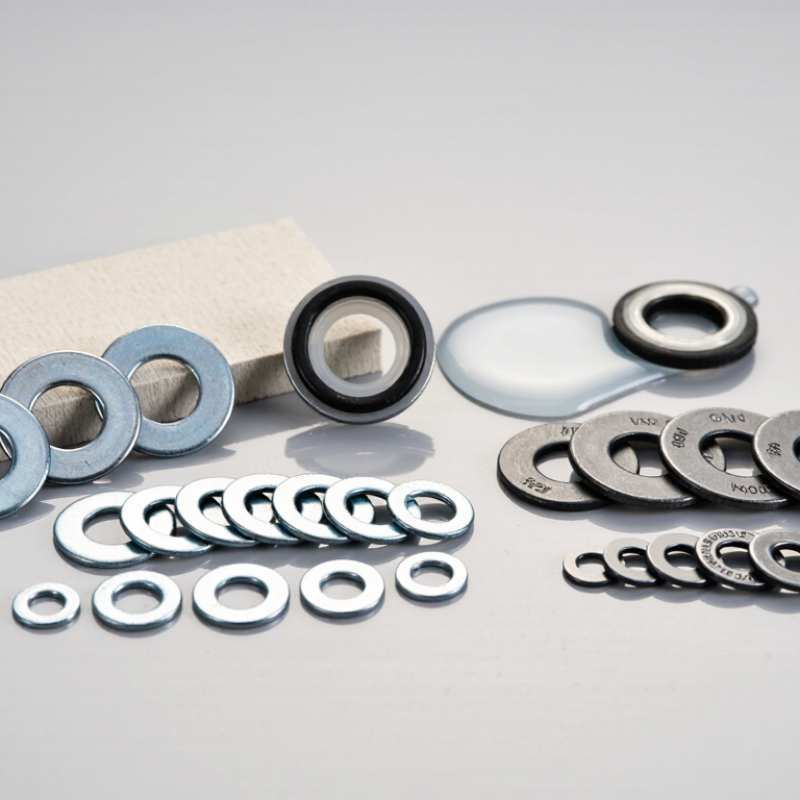
A flat washer is a thin, flat ring placed beneath a bolt head or nut. It creates a wider bearing surface against the joined material. As the fastener tightens, the washer helps spread clamping force across that surface. This can reduce indentation in softer materials, such as painted sheet metal or wood. A small part, but an important one. It can also help protect a component’s finish during assembly. However, a flat washer does not lock a fastener or correct damaged threads.
For global buyers comparing washer types, fit matters as much as appearance. The inner diameter should clear the bolt without excessive movement, while the outer diameter should support the contact area. Thickness and material also affect performance. A washer that is too thin may deform under load; one that is poorly matched to the assembly may corrode or mark the surface. Check the intended load, mating materials, and working environment before choosing. In practice, even a correctly sized washer cannot compensate for uneven surfaces or inconsistent tightening.
Tips: Inspect the washer for burrs, distortion, and coating damage before installation. Keep it flat against the surface, and avoid stacking washers unless the design calls for it. A quick visual check helps, though it is not a substitute for verifying the joint’s fit and tightening requirements.
For global buyers, material choice is a practical starting point when sourcing Chinese flat washers. Common options include carbon steel, stainless steel, brass, copper, aluminum, and nylon. Carbon steel suits many general fastening jobs and is often zinc-plated for added corrosion resistance. The coating can wear during handling or installation, though. Small details matter.
Stainless steel is a frequent choice where moisture is present. Grade 304 works for many everyday environments, while grade 316 offers better resistance to salt and some chemicals. Brass and copper provide useful conductivity and resist corrosion in suitable applications, but they may cost more than carbon steel. Aluminum is light, yet softer; under heavy clamping, it can deform. Nylon washers can electrically isolate parts and reduce surface damage, but heat and load limits need checking. Appearance can mislead.
Match the washer material to the bolt, clamping force, temperature, and exposure conditions. A stainless washer paired with a dissimilar metal may still face corrosion concerns in a damp assembly. Ask suppliers for material grades, dimensions, hardness where relevant, and coating details. Samples can reveal burrs, uneven plating, or a loose fit that a product description misses. Specifications are not always perfectly consistent across suppliers, so confirm critical measurements before ordering in volume.
Chinese manufacturers commonly offer standard flat washers, wide-pattern washers, square washers, and thick heavy-duty versions. Standard washers under ISO 7089 suit general bolted joints; ISO 7093-1 covers larger outside diameters that spread load across softer materials. Wide washers are useful on timber panels or thin sheet, where a small washer may pull through. Square types can provide a broad bearing face in framing and machinery.
Materials typically include carbon steel, stainless steel, and brass, with finishes such as zinc plating or plain passivation. The World Steel Association’s World Steel in Figures 2025 reports 2024 crude steel production of about 1,005 million tonnes in China, out of roughly 1,883 million tonnes worldwide. That signals a large steel-making base, not uniform washer quality. Ask suppliers for material certificates, dimensional inspection records, and coating-thickness results. Small details matter.
Match washer dimensions to the bolt and joint, not just the product name. Confirm inner diameter, outer diameter, thickness, hardness, and corrosion needs on the drawing. Some catalogs group spring washers with flat washers, but they serve different functions.
One caveat: a thicker washer is not automatically stronger; fit and material matter too. Sampling parts before a production order can expose burrs, uneven plating, or inconsistent thickness—issues that photographs may miss.
Matching a flat washer to an application starts with the joint, not the catalog photo. Measure the bolt diameter, clearance hole, and available space around the fastener. A standard flat washer spreads load beneath a nut or bolt head and helps protect softer surfaces from direct contact. Start with the joint. If the hole is oversized or the bearing area is narrow, a wider fender washer can provide more coverage, provided it fits the surrounding components.
Material matters too. Stainless steel can suit damp or outdoor settings, while carbon steel may be appropriate for dry, protected machinery. For higher clamp loads, choose a washer with strength suited to the fastener and joint; a soft washer can dish under pressure. Check the actual stack. Paint, coatings, and compressible materials can change how the joint settles after tightening. Corrosion resistance should also match the environment, not just the washer’s appearance.
For vibrating equipment, a flat washer alone may not prevent loosening; the assembly may need a suitable locking method. Confirm dimensions and material specifications against the drawing or application requirements before placing a bulk order. Small differences matter. A washer that fits the bolt but covers too little of the mounting surface can still be the wrong choice. I would not assume one type works across every production line; actual fit and service conditions deserve a final check.
How to match standard and large-series flat washers to fastening applications
Outside diameters shown are nominal dimensions in millimeters for ISO 7089 normal-series and ISO 7093-1 large-series washers. Choose the normal series for general-purpose fastening; the larger bearing surface of the large series can help distribute load on soft, thin, or oversized-hole materials. Confirm the applicable standard, material, and thickness for the design.
Global buyers should assess flat washers by the drawing, material, and intended joint—not by appearance alone. ISO 7089 covers normal-series washers, while ISO 7093 covers large-series washers; confirm the specified dimensions and tolerances before comparing quotations. On a sample, check the inner and outer diameters, thickness, burrs, and flatness. Small defects matter. A sharp edge or uneven face can affect assembly and load distribution.
Material claims need traceable evidence. The World Steel Association’s World Steel in Figures 2025 reports 1,882.6 million tonnes of crude steel production in 2024. The International Stainless Steel Forum’s Stainless Steel in Figures 2024 reports 58.4 million tonnes of stainless steel production in 2023. These figures describe a vast supply base, not the quality of any washer lot. Ask suppliers for material certificates, heat or batch traceability, coating specifications, and inspection records tied to the shipment.
Evaluate suppliers with a written specification and a small, representative trial order. Request sample measurements and test reports, then compare them with your drawing and application requirements. For coated washers, clarify coating thickness and the test method behind any corrosion-resistance claim. During receiving inspection, measure several pieces from different bags; one good sample proves little. I would also check how quickly the supplier explains a failed result. That detail is easy to overlook, and it is not a perfect measure.


For those larger-sized parts, or smaller quantity runs, we have 2 independent powder coat booths and ovens. The quality, durability and affordability of today’s powder coating finishes make this the process of choice for world-class companies.
Powder coating advantages over other forms of coating are many. Materials used in the Powder coating process can be metals and non-metals that come in a multitude of thicknesses, textures, colors, etc. Another of Powder coating’s biggest advantages over conventional coatings is its ability to create finishes in many different textures. Powder Coating Booths allow us the ability to apply these advantages to large products.
Tri-State Fabricators runs a full-service conveyor line for painting. Wet painting can provide protection or decoration to many different part styles. From start to finish, every project is easier to undergo random and point-based inspection by our skilled painting team.
Advantages to our Wet Paint Line are these lines start with product prep and ends with a thorough inspection of a high quality finished product. Our ability to complete large and small projects with a superior finish and doing so in a timely and economical fashion. This passes along the savings in production to our customers. When powder coating ins not an option, our Wet Paint Line gets the job done right the first time.
When the parts get big and heavy we roll-out our custom paint racks and oversize booth. By utilizing our partnerships with all the major paint brands, we can match virtually any color with wet paint.
The advantages of having access to a Wet Paint Booth are many. Large projects of many different shapes can be loaded into the booth. The Wet Paint Booth offers an environment that is much more controlled than a typical parts painting operation.
Not only are they used because of their controlled environment, but they’re are also advantageous when it comes to applying paint to parts that are needed in industries that require specialty coatings such as medical, aerospace, etc.
Our military forces have some very high standards when it comes to the finish of their vehicles and equipment. From the first pre-treatment step to final coat, it takes a great deal of knowledge and experience to protect the men and women of our armed forces. They deserve only the best, and Tri-State Fabricators provides it.
All of our processes are closely monitored by our staff and management teams. Both of which are highly trained in the processes of metal fabrication and finishing. Tri-State Fabricators’ goal is to always fully satisfy each and every customer, including the military. We will always put a 110% into what we do.
Abrasive media blasting is an excellent way to remove old paint, rust, and increase the paint/powder adhesion. Glass beads produce a much smoother and brighter finish than angular abrasives; leaving the part clean yet without any dimensional change. Chemically inert and environmentally friendly, we can recycle our beads approximately 30 times; making them a more preferred method of metal cleaning or surface finishing.
Advantages to Glass Bead Blasting are many. Glass bead blast media is used when a project is needing rough surfaces need to become smooth for applications of coatings such as paint. It is typically used to clean paint and rust from a product surface without deforming the surface it is being used on. Overall, compared to many other blasting media, Glass Bead Blasting is a very economical choice and those savings are always passed on to our customers.
Tri-State Fabricators utilize a zinc phosphate wash to clean and etch the material to ensure the best paint adhesion possible. The unique design of our 3-stage wash system does the work like a 5-stage. From Cleaning and rinsing to conversion coating and post-treatment, Our Part Washing process is a complete service and works throughout the fabrication service and the finishing service.
Along with the previously mentioned benefits, Curing is a vital chemical reaction that leaves the product finish hard and relatively safe from mild abrasion and aggressive corrosion. This process can be done in more than one way; ambient air-dry or in curing ovens at temps that exceed 240°.
From fixing paint mistakes (someone else’s of course) to simply cleaning our paint line hooks, our burn-off oven is put to good use. After a quick burn-off, a little clean up, and a fresh coat of paint, your parts will look better than new.
Why does our Burn-Off Oven work so well? Because super heating the air around parts turns the materials into ashes. From paint and powder coatings to rubber and machining oils, high temps do the job without degrading the integrity of the part.
Masking is a vital part of producing high quality products. We have die-cut masking patterns to protect machined surfaces as well as a wide range of plugs and caps to protect threaded holes and bolts. We provide permanent and temporary masking.
Masking allows the selected sections of a product to be protected from a fabrication or finishing service. This can be with both chemicals when etching and tapes, paints when only finishing just a section of the product. Masking is great in aiding the customization process of a project.
Screen printing is a photographic process that transfers artwork onto a porous nylon screen which allows colored ink to flow through the screen and be deposited on an aluminum or plastic component. We can generally have just about any design created onto a screen for your parts.
Some of the advantages of Screen Printing are, brand recognition for your business displaying on your products, assembly instructions, product warnings/hazards, etc. Tri-State Fabricators produces Screen Printing of the highest quality so you know it’s durable.
Metal Finishing is the art of treating the exterior portion of product, often metal but can also be made of other materials, so that the surface is clean and free of any debris. Then the process of applying coats or either paint of powder coat takes place. This coating process improves the quality of the product in both appearance and resistance to wear and corrosion.
Tri-State Fabricators, Inc., understands that a project typically isn’t complete until a high-quality finish has been added to your product. This is why our painting and powder coating teams continuously inspect the products throughout the Metal Finishing process.

