

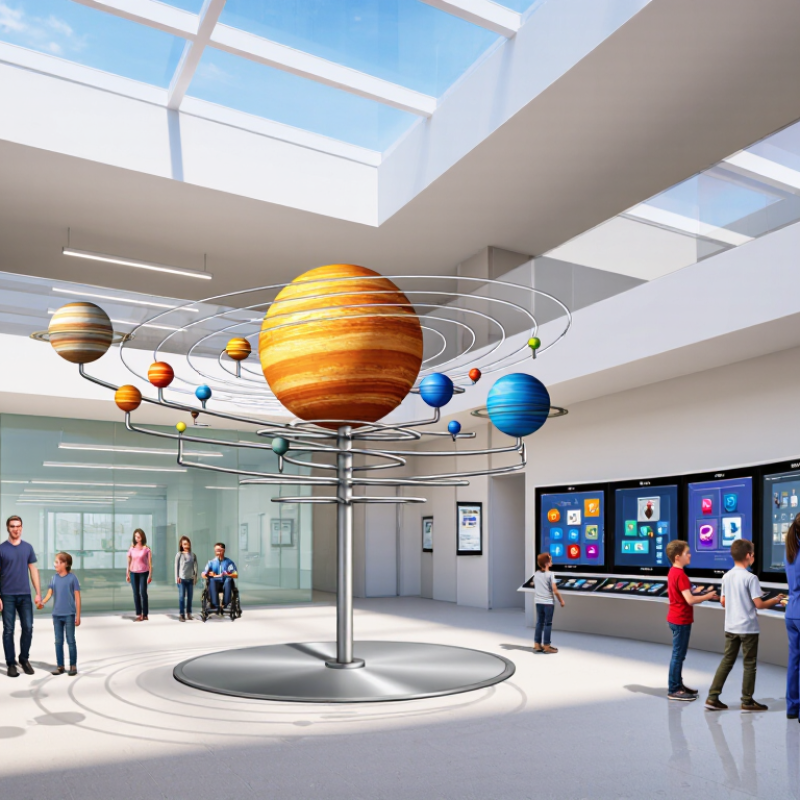
Choosing the right Science Museum Exhibits requires more than comparing prices, sizes, and attractive photographs. Global buyers must examine learning value, engineering quality, visitor safety, and long-term support. A rotating planet model may look impressive online, yet its motor, noise level, and replacement parts determine daily performance. A touchscreen wall needs reliable software, clear language options, and protection against constant public use.
Museum education scholar George E. Hein observed, “Museums are not schools, and visitors are not students.” This principle matters when selecting exhibits for international audiences. Effective displays should encourage discovery rather than deliver only fixed answers. They may combine visible mechanisms, short explanations, tactile controls, and measurable learning outcomes. Buyers should also request installation drawings, maintenance schedules, accessibility information, and evidence from completed projects. Supplier claims deserve verification.
Practical experience often reveals small details. Can children reach the controls? Can staff clean the surface quickly? Will replacement components arrive across borders? These questions are easy to overlook. They should not be.
The best China-made Science Museum Exhibits can offer strong customization, competitive manufacturing, and engaging interaction. However, quality varies between suppliers. A polished showroom sample may hide weak documentation or limited after-sales service. Buyers need factory audits, prototype testing, compliance records, and clear acceptance standards. No exhibit is perfect. Even a successful installation may need improved translations, stronger lighting, or simpler instructions after real visitors respond. This guide examines the most promising exhibit categories for global buyers, while recognizing that thoughtful evaluation remains essential.
China Best Science Museum Exhibits for Global Buyers
Science museum exhibits are public learning environments, not simply collections of machines. The 2022 ICOM museum definition emphasizes accessibility, education, research, and public participation. For global buyers, this means an exhibit should explain real science through touch, sound, movement, and visible results. A visitor should turn a wheel, change a variable, and observe an immediate response. That moment creates curiosity.
The scope is broad. Exhibits may cover physics, biology, space, climate, engineering, health, and local industrial history. Strong projects connect these subjects with daily life. The National Research Council’s 2009 report identifies six learning strands, including developing interest, understanding scientific knowledge, and participating in scientific reasoning. Interactive exhibits support these strands when instructions remain clear and the challenge feels achievable. Too many controls can confuse visitors.
The educational need is growing. UNESCO’s 2021 Science Report recorded global research and development spending at about 1.7% of GDP in 2018. Museums can translate this expanding knowledge into understandable experiences for families and school groups. Durable structures, multilingual labels, safe materials, and accessible controls improve long-term value. However, a bright screen is not automatically educational. Our own exhibit reviews sometimes praise visual impact too quickly. More careful testing with children, teachers, and older visitors reveals weaknesses that factory demonstrations may miss. Learning should be measurable, but not every valuable question fits a score sheet.
Science museum exhibits are interactive, evidence-based displays that help visitors understand scientific ideas through observation, experimentation, models, and real-world applications. This 100-point planning index reflects the main exhibit scope used in science learning: physical sciences, life sciences, Earth and space sciences, technology and engineering, environmental sustainability, and health sciences. The categories support hands-on learning, systems thinking, problem-solving, and public understanding of science. The values are a planning framework rather than market-share statistics.
Chinese science museum manufacturers commonly supply interactive physics, life science, space, earth science, and technology exhibits. Physics units often use hand wheels, magnetic tracks, air columns, and light sensors. Visitors can see force, sound, and energy change through direct action. Life science displays may include anatomical models, microscope stations, and touchscreens with layered biological images. These exhibits suit schools, public museums, and traveling education programs. In my experience, robust controls matter more than decorative complexity. Children repeat experiments quickly. Weak switches fail first.
Manufacturers also produce digital immersive rooms, projection tables, robotic demonstrations, and programmable STEM stations. A quality supplier should provide wiring diagrams, spare-part lists, user manuals, and factory test records. Buyers should request material specifications, electrical safety documents, accessibility details, and maintenance schedules before approval. Local climate matters. High humidity can damage poorly sealed sensors, while dust affects cooling fans. A pre-shipment inspection with video testing is useful, but it cannot replace on-site commissioning. That limitation deserves honest planning.
Custom exhibits can match a museum’s floor area, language needs, and visitor age range. Chinese production teams often adjust casing colors, interface languages, interaction height, and lesson content. Ask for a working prototype when the mechanism is complex. It reveals noise, delays, and confusing instructions early. Some proposals still overpromise visitor throughput. Measure actual cycle time. A quiet, simple exhibit may teach more than a spectacular one. The best purchasing decision remains partly technical and partly educational.
Global buyers should evaluate science museum exhibits beyond visual appeal. A glowing planetarium wall may attract visitors, yet weak content can limit learning. Check whether explanations are scientifically reviewed, factually current, and suitable for different age groups. Ask for sample scripts, learning objectives, and evidence from completed installations. Measure the footprint. Confirm viewing height, visitor flow, and wheelchair access before approving the layout.
Durability matters in busy public spaces. Inspect materials, touch panels, lighting systems, and protective surfaces. Request test records for daily operation, temperature changes, dust, and repeated use. Visitors notice delays. The control system should restart safely after power interruptions and protect stored visitor data. Buyers should also review electrical standards, fire requirements, language options, and local certification needs. A technically impressive exhibit may still fail if replacement parts take months to arrive.
Installation planning often reveals the real quality of a supplier. Require clear drawings, packing lists, training plans, maintenance schedules, and response times. Speak with previous museum operators, not only sales contacts. Watch a live demonstration when possible. Some displays look excellent in a quiet showroom but become confusing in a crowded gallery. No evaluation is perfect. Leave room for pilot testing, visitor feedback, and honest adjustments before full production.
China Best Science Museum Exhibits for Global Buyers
Custom science exhibits should begin with visitor needs, not decoration. We adapt height, interaction force, language, lighting, and learning goals for each museum. A child-friendly control panel may need large buttons, rounded edges, and clear visual feedback. A busy floor exhibit also requires stable bases, protected wiring, and surfaces that tolerate repeated cleaning.
Safety testing must be planned during design. We check pinch points, sharp edges, tipping risks, heat, noise, and electrical access. Materials should be traceable, durable, and suitable for public environments. For electrical systems, buyers may request testing aligned with IEC requirements. Toy-like interactive parts may require review against standards such as EN 71 or ASTM F963, depending on the market and product classification. RoHS and REACH considerations can also affect material selection. Compliance is not one universal certificate.
Reliable export projects include risk assessments, inspection records, wiring diagrams, user instructions, and maintenance schedules. Independent laboratory testing can strengthen confidence, but documents must match the final production model. We have learned that a visually impressive prototype may still fail a load test or confuse younger visitors. Some designs need revision after trial use. That is not wasted work. It reveals practical issues early, such as a button placed too low or an instruction panel overlooked in crowded galleries. Careful customization makes the exhibit safer, clearer, and more dependable across international museum settings.
For global buyers, China’s strongest science museum exhibits combine robust engineering with clear educational purpose. The UNESCO Science Report 2021 recorded China’s 2018 research spending at 22% of the global total. This capacity supports interactive physics walls, robotics displays, laboratory simulators, and large-scale kinetic installations. Buyers should request a working prototype, not only attractive renderings. A quiet motor, rounded edge, and replaceable sensor matter more than decoration.
Quality control needs measurable checkpoints. The ISO Survey 2022 recorded more than one million ISO 9001 certificates in China, but certification alone cannot guarantee exhibit reliability. Require material lists, wiring diagrams, software versions, load tests, and factory acceptance testing. Check repeated use, especially on buttons, touchscreens, hinges, and handrails. One missed cable label can delay installation. I have seen beautiful exhibits fail because maintenance access was designed too late.
Export planning should begin before production. The WTO World Trade Statistical Review 2023 reported China’s merchandise exports represented about 14% of global exports in 2022, reflecting extensive logistics capacity. Still, buyers must confirm crate dimensions, shock protection, humidity controls, spare parts, installation tools, and customs documents. Electrical compatibility needs careful review, including voltage, plugs, electromagnetic performance, and applicable safety standards. Regional compliance is not identical. Some specifications may need revision after local testing. That is inconvenient, but cheaper than rebuilding an exhibit overseas.
| Exhibit Category | Typical Visitor Interaction | Common Construction Materials | Key Sourcing Specifications | Recommended Quality-Control Checks | Relevant Safety Considerations | Export and Installation Notes |
|---|---|---|---|---|---|---|
| Physics and Mechanics | Visitors operate levers, pulleys, gears, balance systems, or motion demonstrations. | Powder-coated steel, aluminum, polycarbonate, engineering plastics, rubber grips. | Load capacity, cycle life, pinch-point protection, surface finish, replacement-part availability. | Functional testing, repeated-use testing, fastener inspection, edge-radius inspection, stability testing. | Guard moving parts, eliminate sharp edges, use captive fasteners, and provide clear operating instructions. | Request exploded drawings, assembly instructions, spare-part lists, and floor-loading data before shipment. |
| Optics and Light | Visitors explore mirrors, lenses, color mixing, shadows, polarization, or optical illusions. | Optical glass or acrylic, aluminum frames, LED modules, laminated panels. | Optical clarity, light output, color consistency, glare control, viewing distance, power requirements. | Lens and mirror inspection, illumination measurement, electrical safety testing, image-quality checks. | Use shatter-resistant materials where possible, control glare, protect electrical components, and assess photobiological risks for intense light sources. | Confirm voltage, plug configuration, power frequency, replacement LED availability, and installation tolerances. |
| Electricity and Magnetism | Visitors create circuits, observe magnetic fields, or activate conductive touch points. | Insulated copper wiring, low-voltage power supplies, acrylic covers, steel or ferrite components. | Operating voltage, current limit, duty cycle, enclosure rating, cable routing, reset behavior. | Continuity testing, insulation checks, overload testing, grounding verification, connector-cycle testing. | Prefer low-voltage designs, shield exposed conductors, prevent unauthorized access to power supplies, and include over-current protection. | Electrical compliance requirements depend on the destination market; obtain test reports and wiring diagrams before export. |
| Earth Science and Geology | Visitors examine rock specimens, seismic models, erosion simulations, or geological layers. | Reinforced display cases, laminated glass, resin models, stone samples, steel support frames. | Specimen weight, case ventilation, humidity control, UV resistance, mounting security, labeling accuracy. | Case-seal inspection, load testing, specimen-retention testing, label proofreading, moisture and condensation checks. | Secure heavy specimens against tipping, use laminated or tempered glazing where suitable, and assess dust or mineral exposure. | Natural materials may require customs declarations or phytosanitary review; verify import rules for rocks, soil, fossils, and organic samples. |
| Biology and Human Body | Visitors use anatomical models, microscopes, interactive displays, or simulated biological processes. | Medical-grade or educational resins, acrylic, silicone, stainless steel, touch displays. | Model accuracy, cleanability, color stability, touch durability, accessibility, language localization. | Visual comparison with approved drawings, touch-cycle testing, cleaning-agent compatibility, software and content review. | Use non-toxic, easy-to-clean surfaces; avoid biological materials unless legally permitted and professionally managed. | Confirm data-privacy settings for connected devices, provide multilingual labels, and specify cleaning and maintenance procedures. |
| Chemistry Demonstration | Visitors observe safe reactions, pH changes, molecular models, or fluid behavior. | Chemical-resistant plastics, stainless steel, borosilicate glass, spill trays, sealed fluid systems. | Chemical compatibility, spill containment, ventilation needs, fluid volume, refill frequency. | Leak testing, material-compatibility review, dispensing accuracy, emergency-shutdown testing, cleaning validation. | Use non-hazardous demonstration substances where possible; provide safety data sheets and secure all chemicals from public access. | Check transport restrictions for liquids and chemicals, classify dangerous goods when applicable, and protect glassware with shock-absorbing packaging. |
| Astronomy and Space | Visitors use star maps, planetary models, scale displays, or digital astronomy interfaces. | Aluminum, fiberglass, acrylic, composite panels, electronic displays, precision bearings. | Dimensional scale, rotational accuracy, display brightness, software update method, ceiling or floor clearance. | Dimensional verification, balance testing, bearing-life testing, screen burn-in testing, content accuracy review. | Secure overhead components, control rotational speed, protect cables, and provide stable anti-tip bases. | Large models may require a site survey, special crating, lift access, and professional installation after arrival. |
| Environmental Science | Visitors explore water cycles, renewable energy, climate systems, recycling, or pollution control. | Water-resistant panels, pumps, tubing, sensors, aluminum frames, recycled or recyclable plastics. | Water capacity, pump duty cycle, sensor range, drainage, noise level, energy consumption. | Continuous operation test, water-leak test, sensor calibration, noise measurement, drainage verification. | Prevent standing-water hazards, use residual-current protection where required, control biofouling, and provide safe access to maintenance areas. | Drain all water systems before packing; document pipe connections, filters, pumps, consumables, and commissioning requirements. |
| Digital and Immersive Technology | Visitors interact with touchscreens, projection systems, sensors, augmented reality, or virtual reality. | Commercial displays, aluminum enclosures, optical sensors, computing hardware, fabric or acoustic panels. | Screen size, brightness, response time, network requirements, operating temperature, content format. | Burn-in test, touch-accuracy test, sensor calibration, software stress test, network and recovery testing. | Manage cable hazards, hygiene, motion-sickness risks, ventilation, accessibility, and safe recovery after power interruption. | Clarify software ownership, offline operation, cybersecurity responsibilities, remote support, and destination-country power requirements. |
| Area | Recommended Requirement | Buyer Evidence to Request |
|---|---|---|
| Pre-production approval | Approve drawings, materials, colors, dimensions, interface layouts, and visitor-flow assumptions before mass production. | Signed technical drawings, approved sample, bill of materials, and revision-controlled specifications. |
| Factory quality control | Use incoming-material inspection, in-process checks, final inspection, and documented functional testing. | Inspection checklist, test records, calibration records, defect report, and corrective-action documentation. |
| Electrical compliance | Match the exhibit to the destination market’s electrical, electromagnetic-compatibility, and safety requirements. | Electrical schematics, risk assessment, test reports, declarations, and user-maintenance instructions. |
| Packaging and protection | Protect against shock, vibration, moisture, abrasion, and incorrect lifting during multimodal transport. | Packing drawings, crate dimensions, gross weight, center-of-gravity data, lifting points, and moisture protection details. |
| Customs documentation | Use accurate product descriptions, tariff classification, country-of-origin information, and shipment values. | Commercial invoice, packing list, transport document, certificate of origin when required, and applicable permits. |
| Installation and after-sales support | Define commissioning, training, warranty scope, response times, spare parts, and software support in writing. | Installation method statement, service manual, spare-parts list, warranty terms, training plan, and acceptance criteria. |


For those larger-sized parts, or smaller quantity runs, we have 2 independent powder coat booths and ovens. The quality, durability and affordability of today’s powder coating finishes make this the process of choice for world-class companies.
Powder coating advantages over other forms of coating are many. Materials used in the Powder coating process can be metals and non-metals that come in a multitude of thicknesses, textures, colors, etc. Another of Powder coating’s biggest advantages over conventional coatings is its ability to create finishes in many different textures. Powder Coating Booths allow us the ability to apply these advantages to large products.
Tri-State Fabricators runs a full-service conveyor line for painting. Wet painting can provide protection or decoration to many different part styles. From start to finish, every project is easier to undergo random and point-based inspection by our skilled painting team.
Advantages to our Wet Paint Line are these lines start with product prep and ends with a thorough inspection of a high quality finished product. Our ability to complete large and small projects with a superior finish and doing so in a timely and economical fashion. This passes along the savings in production to our customers. When powder coating ins not an option, our Wet Paint Line gets the job done right the first time.
When the parts get big and heavy we roll-out our custom paint racks and oversize booth. By utilizing our partnerships with all the major paint brands, we can match virtually any color with wet paint.
The advantages of having access to a Wet Paint Booth are many. Large projects of many different shapes can be loaded into the booth. The Wet Paint Booth offers an environment that is much more controlled than a typical parts painting operation.
Not only are they used because of their controlled environment, but they’re are also advantageous when it comes to applying paint to parts that are needed in industries that require specialty coatings such as medical, aerospace, etc.
Our military forces have some very high standards when it comes to the finish of their vehicles and equipment. From the first pre-treatment step to final coat, it takes a great deal of knowledge and experience to protect the men and women of our armed forces. They deserve only the best, and Tri-State Fabricators provides it.
All of our processes are closely monitored by our staff and management teams. Both of which are highly trained in the processes of metal fabrication and finishing. Tri-State Fabricators’ goal is to always fully satisfy each and every customer, including the military. We will always put a 110% into what we do.
Abrasive media blasting is an excellent way to remove old paint, rust, and increase the paint/powder adhesion. Glass beads produce a much smoother and brighter finish than angular abrasives; leaving the part clean yet without any dimensional change. Chemically inert and environmentally friendly, we can recycle our beads approximately 30 times; making them a more preferred method of metal cleaning or surface finishing.
Advantages to Glass Bead Blasting are many. Glass bead blast media is used when a project is needing rough surfaces need to become smooth for applications of coatings such as paint. It is typically used to clean paint and rust from a product surface without deforming the surface it is being used on. Overall, compared to many other blasting media, Glass Bead Blasting is a very economical choice and those savings are always passed on to our customers.
Tri-State Fabricators utilize a zinc phosphate wash to clean and etch the material to ensure the best paint adhesion possible. The unique design of our 3-stage wash system does the work like a 5-stage. From Cleaning and rinsing to conversion coating and post-treatment, Our Part Washing process is a complete service and works throughout the fabrication service and the finishing service.
Along with the previously mentioned benefits, Curing is a vital chemical reaction that leaves the product finish hard and relatively safe from mild abrasion and aggressive corrosion. This process can be done in more than one way; ambient air-dry or in curing ovens at temps that exceed 240°.
From fixing paint mistakes (someone else’s of course) to simply cleaning our paint line hooks, our burn-off oven is put to good use. After a quick burn-off, a little clean up, and a fresh coat of paint, your parts will look better than new.
Why does our Burn-Off Oven work so well? Because super heating the air around parts turns the materials into ashes. From paint and powder coatings to rubber and machining oils, high temps do the job without degrading the integrity of the part.
Masking is a vital part of producing high quality products. We have die-cut masking patterns to protect machined surfaces as well as a wide range of plugs and caps to protect threaded holes and bolts. We provide permanent and temporary masking.
Masking allows the selected sections of a product to be protected from a fabrication or finishing service. This can be with both chemicals when etching and tapes, paints when only finishing just a section of the product. Masking is great in aiding the customization process of a project.
Screen printing is a photographic process that transfers artwork onto a porous nylon screen which allows colored ink to flow through the screen and be deposited on an aluminum or plastic component. We can generally have just about any design created onto a screen for your parts.
Some of the advantages of Screen Printing are, brand recognition for your business displaying on your products, assembly instructions, product warnings/hazards, etc. Tri-State Fabricators produces Screen Printing of the highest quality so you know it’s durable.
Metal Finishing is the art of treating the exterior portion of product, often metal but can also be made of other materials, so that the surface is clean and free of any debris. Then the process of applying coats or either paint of powder coat takes place. This coating process improves the quality of the product in both appearance and resistance to wear and corrosion.
Tri-State Fabricators, Inc., understands that a project typically isn’t complete until a high-quality finish has been added to your product. This is why our painting and powder coating teams continuously inspect the products throughout the Metal Finishing process.