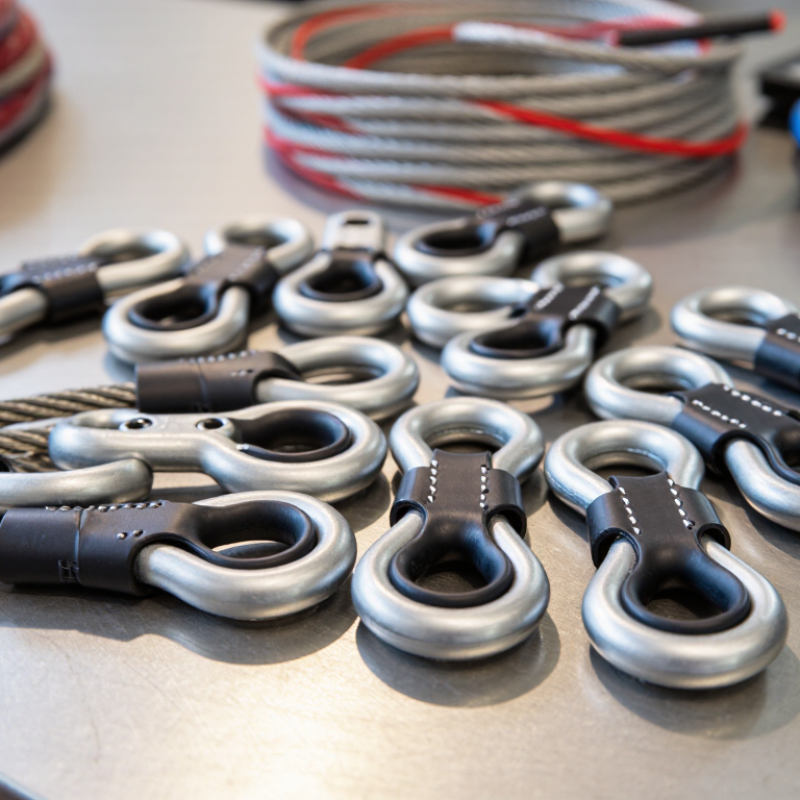
China’s lifting equipment sector includes many manufacturers and exporters serving construction, logistics, marine, and industrial applications. This guide introduces China Top 10 Wire Rope Thread Lifting Loop Suppliers through practical purchasing criteria. The focus is not on impressive claims alone. It considers manufacturing experience, material control, stitching quality, testing practices, and customer support.
A dependable Wire Rope Thread Lifting Loop should show careful workmanship at every visible point. Look closely at the wire rope, protective sleeve, eye formation, and connection area. Galvanized strands may resist corrosion, while reinforced stitching can improve durability under repeated handling. Supplier evaluations should also review working load limits, safety factors, inspection records, traceability, and packaging conditions. Clear labels matter. So do readable test documents.
Real purchasing experience often reveals small differences. A sample may feel flexible, yet its stitching can appear uneven under close inspection. A polished catalog cannot replace batch testing. Ask whether the supplier checks rope diameter, breaking strength, sleeve position, and finished-loop dimensions. Verify whether quoted capacities match actual product configurations. Communication speed is useful, but technical accuracy matters more.
No ranking stays perfect forever. Supplier capabilities, equipment, and service teams can change. Some companies may excel at custom orders but struggle with consistent volume production. Others may offer competitive prices while providing limited documentation. This overview should therefore support further verification, not replace it. Buyers should compare samples, certificates, inspection methods, lead times, and after-sales responses before making a final decision. Reliable cooperation begins with evidence.
A wire rope thread lifting loop combines a flexible steel rope eye with a threaded end fitting. The loop passes around a pin, hook, or lifting point. The threaded section then seats inside a compatible anchor. Under tension, the rope carries the load, while the fitting transfers force into the supporting structure. The connection must remain fully engaged. A few exposed threads can indicate poor assembly, not extra capacity.
These loops work best when the rope, thread, anchor, and load direction match. Side loading can bend the fitting and concentrate stress near the termination. Small parts matter. A clean loop can still fail if corrosion, crushed strands, or incorrect thread dimensions are ignored. ISO 4309 recommends inspection for broken wires, deformation, corrosion, and other discard conditions. ASME B30.9 also emphasizes compatible slings, rated fittings, and controlled working loads.
Grand View Research’s 2024 wire-rope market assessment places the global market near US$10 billion in 2023, with projected annual growth of roughly 4–5% through 2030. That expansion reflects continued use in construction, mining, ports, and industrial handling. However, market growth does not make every lifting loop equivalent. Suppliers should provide traceable material records, working-load-limit tables, thread specifications, and inspection guidance. In field use, measurements are sometimes rushed. That is a weakness worth admitting. A qualified person should verify the complete load path before lifting, especially when angles, shock loading, or repeated cycles are involved.
China Top 10 Wire Rope Thread Lifting Loop Suppliers
China’s top ten suppliers should be selected through measurable evidence, not search ranking. A practical review checks factory history, production capacity, inspection records, and export experience. MarketsandMarkets’ 2024 Wire Rope Market report estimates steady global growth through 2029, increasing pressure on suppliers to prove consistency. That matters for threaded lifting loops, where a small machining defect can affect load transfer.
Comparison begins with technical conformity. ISO 2408 covers steel wire rope requirements, while ISO 4309 describes inspection and discard practices. We compare breaking-load test results, thread accuracy, material certificates, heat-treatment records, and batch traceability. Suppliers with in-house tensile testing usually respond faster when irregular results appear. However, laboratory ownership alone proves little. Calibration dates and independent verification deserve equal attention. Our scoring can still be imperfect, because published factory data may not reflect every production shift.
Tips: Request three recent batch reports, not one sample. Confirm the working load limit, safety factor, and thread dimensions against your lifting design. Check surface finish under bright light. Look for burrs, uneven zinc coverage, and damaged threads. The ILO’s occupational safety guidance emphasizes competent inspection and safe lifting procedures, so supplier comparison must include manuals and operator training. Price should be recorded, but it should never outweigh traceability, test evidence, or rejection control.
China Top 10 Wire Rope Thread Lifting Loop Suppliers
Profiles of China’s Top 10 wire rope lifting loop Suppliers
China’s leading wire rope lifting loop suppliers differ by manufacturing focus, not just production size. One profile emphasizes compact lifting loops for workshops and maintenance teams. Another serves heavy industrial projects with larger diameters and documented breaking loads. Several suppliers focus on hand-spliced construction, while others use mechanical swaging for consistent dimensions.
The strongest profiles show practical control at each stage. They inspect rope diameter, core condition, splice quality, and sleeve placement. They also provide working load limits, safety factors, material records, and batch identification. Some suppliers support custom lengths and protective coverings. Others maintain testing equipment for tensile checks and visual inspections. Clear drawings help buyers avoid fitting errors.
A reliable supplier should explain limitations, not only advantages. Site conditions, edge contact, bending radius, and lifting angles can change performance. Factory certificates are useful, but independent verification may still be necessary. A polished catalog is not enough. In my assessment, suppliers with traceable records and responsive technical teams deserve stronger consideration. Yet even experienced manufacturers can leave gaps in documentation. Buyers should request recent test reports, inspection procedures, and replacement guidance before placing large orders. 马会
China Top 10 Wire Rope Thread Lifting Loop Suppliers
Reliable suppliers should explain which standard governs each lifting loop. Common references include ISO 2408 for wire rope, EN 13414 for wire rope slings, and ASME B30.9 for sling safety. Chinese projects may also require applicable GB/T standards. The correct standard depends on the product design, working load limit, and destination market. A catalog statement alone is not enough.
Material selection affects service life. Galvanized carbon-steel rope suits many outdoor applications and resists ordinary moisture. Stainless steel can support cleaner environments, but it may not provide the same strength at equal size. The loop should include a suitable thimble, secure termination, and clearly marked working load limit. Ferrules, sockets, and stitching need inspection records. Ask for material certificates, dimensional drawings, and proof-test results.
Safety control begins before shipment. Suppliers should provide traceable batch numbers and inspection procedures. Check rope diameter, broken wires, corrosion, deformation, and termination condition before use. Never confuse breaking force with working load limit. The design must account for sling angle, edge contact, bending radius, and shock loading. Small details matter. I have seen specifications omit the lifting angle, which can create dangerous assumptions. That omission deserves a written correction, not a guess. Periodic inspection and competent-user training remain necessary, even when factory documentation appears complete.
| Rank | Supplier Capability Profile | Typical Lifting-Loop Construction | Common Rope Diameter | Wire Rope Grade | Core and Surface | Termination Method | Applicable Product Standards | WLL and Design Basis | Essential Safety Requirements |
|---|---|---|---|---|---|---|---|---|---|
| 1 | Integrated wire-rope and sling manufacturer Suitable for standard industrial lifting loops and repeat OEM orders. | Single-leg or endless-loop sling made from compacted or ordinary-lay steel wire rope. | 6–32 mm | 1770 or 1960 N/mm² nominal tensile grade | Independent wire rope core (IWRC) for higher strength and crush resistance; galvanized finish available. | Swaged ferrule, hand-spliced eye, or mechanically pressed eye termination. | EN 13414-1; ASME B30.9; applicable Chinese GB/T requirements. | WLL depends on rope diameter, construction, termination efficiency, sling angle, and mode factor; it must be marked and certified by the manufacturer. | Use only with a legible identification tag; protect the rope from sharp edges and never exceed the rated WLL. |
| 2 | Galvanized wire-rope lifting-sling specialist Focused on corrosion-resistant lifting applications. | Galvanized steel wire-rope loop for outdoor, marine-adjacent, and general construction use. | 8–38 mm | 1770 N/mm² or 1960 N/mm² | Galvanized carbon-steel wires; IWRC commonly selected for heavy-duty lifting. | Aluminum or steel ferrule termination, subject to the applicable termination standard and proof requirements. | EN 13414-1; ISO 2408 for wire-rope characteristics; GB/T 16762 where applicable. | Capacity is calculated from minimum breaking force and the required design factor; corrosion, bending, and termination efficiency reduce usable capacity. | Inspect for broken wires, corrosion, kinks, birdcaging, heat damage, and ferrule deformation before every use. |
| 3 | Heavy-lift wire-rope assembly supplier Designed for cranes, steel handling, machinery installation, and fabrication yards. | Large-diameter single-leg, two-leg, or endless grommet-style lifting assembly. | 20–60 mm | 1770 or 1960 N/mm² | IWRC or compacted IWRC rope; bright or galvanized surface depending on the environment. | Hand-spliced Flemish eye, pressed socket, or socketed termination for high-load configurations. | ASME B30.9; EN 13414-1; ISO 4309 for crane-rope inspection principles. | Actual WLL must account for the number of legs, sling angle, D/d ratio, hitch type, and any reductions caused by bends or fittings. | Use compatible shackles and hooks; keep the included angle between sling legs within the certified limit and prevent shock loading. |
| 4 | OEM lifting-loop assembler Provides custom lengths, eyes, protective sleeves, and lifting accessories. | Custom endless loop or eye-and-eye wire-rope sling with specified length tolerance. | 6–26 mm | 1770 N/mm² is common; 1960 N/mm² available for higher strength-to-weight requirements. | IWRC for lifting; fiber-core rope may be used only where permitted by the design and application. | Hand-spliced eye with serving, swaged sleeve, or thimble-eye assembly. | EN 13414-1; ASME B30.9; GB/T 16762; GB/T 5972 for discard and inspection guidance. | Supplier documentation should state rope construction, nominal diameter, minimum breaking force, WLL, length, and termination type. | Do not drag the sling, expose it to welding heat, or use a damaged thimble, sleeve, hook, or identification tag. |
| 5 | Construction and infrastructure lifting supplier Commonly serves precast concrete, bridge, tower, and site-installation work. | Short lifting loops, bridles, and single-leg slings for controlled vertical or choker lifting. | 8–24 mm | 1770 N/mm² galvanized or bright rope | IWRC preferred for repeated bending and crane use; galvanized wires improve resistance to atmospheric corrosion. | Pressed ferrule or spliced eye fitted with a thimble where required. | GB/T 16762; EN 13414-1; local lifting-equipment regulations and site procedures. | Choker, basket, and vertical hitch capacities are different; the marked rating must correspond to the intended hitch configuration. | Ensure the load is balanced, avoid side loading, use edge protection, and keep personnel outside the fall zone. |
| 6 | Port and marine cargo lifting supplier Provides assemblies for frequent handling and demanding working environments. | Galvanized wire-rope lifting loop, heavy-duty eye sling, or multi-leg cargo sling. | 12–40 mm | 1770 or 1960 N/mm² | Galvanized IWRC rope; corrosion-resistant ferrules and thimbles may be specified. | Hand-spliced or swaged eye with heavy-duty thimble; socket terminations may be used for high loads. | EN 13414-1; ISO 2408; ASME B30.9 where specified by the purchaser. | WLL is affected by corrosion allowance, hitch type, angle, bending radius, and the condition of end fittings. | Rinse salt deposits when appropriate, dry before storage, lubricate according to the rope manufacturer’s instructions, and quarantine corroded assemblies. |
| 7 | Mining and quarry lifting supplier Targets abrasive, high-cycle handling of machinery, rock, and process equipment. | High-strength wire-rope sling with abrasion-resistant protection at contact points. | 16–50 mm | 1770 or 1960 N/mm² compacted or ordinary-lay rope | IWRC; galvanized or bright finish selected according to the mine environment and operating procedure. | Pressed ferrule, socket, or mechanically spliced termination with protective serving. | ASME B30.9; EN 13414-1; GB/T 5972 inspection and discard principles. | Capacity must be verified against the actual rope construction and the manufacturer’s minimum breaking force; generic diameter tables are not sufficient. | Remove from service for excessive broken wires, localized wear, diameter reduction, heat damage, core failure, or permanent distortion. |
| 8 | General industrial rigging supplier Offers commonly stocked lifting loops for workshops, warehouses, and maintenance teams. | Eye-and-eye or endless-loop sling for vertical, basket, and choker arrangements. | 6–20 mm | 1770 N/mm² | Bright or galvanized IWRC rope; fiber-core options require application-specific approval. | Swaged ferrule with thimble, or hand-spliced eye with protective serving. | EN 13414-1; ASME B30.9; GB/T 16762. | WLL must be permanently identified and must reflect the hitch type, sling angle, rope construction, and termination efficiency. | Never knot a wire-rope sling, shorten it with bolts or improvised devices, or allow the load to rotate without suitable controls. |
| 9 | Custom engineering and low-volume supplier Suitable for non-standard lengths, narrow clearances, and engineered lifting points. | Application-specific loop with selected rope lay, end fitting, protective sleeve, and length. | 6–45 mm | 1770 or 1960 N/mm² after engineering review | IWRC normally selected; special coatings or sleeves may be added for abrasion, heat, or chemical exposure. | Swaged sleeve, hand splice, socket, or thimble eye, depending on the design calculation. | EN 13414-1; ASME B30.9; ISO 4309; relevant GB/T standards. | Each non-standard design should have a calculation or technical data sheet covering breaking force, design factor, WLL, and inspection criteria. | Confirm minimum sheave or pin diameter, avoid bends over sharp hardware, and verify compatibility with the lifting point before use. |
| 10 | Export-oriented lifting-equipment supplier Typically prepares multilingual certificates, marking, packaging, and inspection records. | Certified wire-rope lifting loop supplied with traceability documents and user instructions. | 8–32 mm | 1770 or 1960 N/mm² | Galvanized or bright IWRC rope; surface treatment is selected according to the destination market and service conditions. | Swaged ferrule, hand-spliced eye, or socket termination, provided within the approved design. | EN 13414-1; ASME B30.9; ISO 2408; GB/T 16762; GB/T 5972. | Documentation should identify the WLL, rope diameter, rope construction, effective length, termination, serial or batch reference, and inspection status. | Follow the supplied instructions, conduct pre-use inspection, arrange periodic competent-person inspections, and store slings clean, dry, and off the floor. |

Choosing among China’s top wire rope thread lifting loop suppliers requires more than comparing prices. A 2024 industrial lifting equipment market report estimates steady global demand growth of over 5% annually through 2030. That growth also attracts inconsistent quality. Ask each supplier for a current material certificate, production drawings, working load limit, minimum breaking force, and batch traceability. Confirm whether testing follows ISO 4309, EN 13414, or an equivalent standard. The documents should match the actual product, not only a generic catalogue.
Inspect the loop’s eye length, rope diameter, stitching, thimble fit, and protective sleeve. These small details affect load stability. Request a sample and an independent proof-load report. OSHA 1910.184 requires wire-rope slings to receive inspection before use, while common rejection criteria include broken wires, severe kinking, crushing, or heat damage. A reliable supplier should explain these limits clearly. Ask about factory audits, inspection frequency, packaging, and replacement support.
Do not select the lowest quotation too quickly. It may exclude testing or proper traceability. That is the uncomfortable part. I would compare at least three suppliers using the same technical specification. Check whether their stated capacity considers sling angle, bending ratio, and end termination. A supplier may show impressive test figures, yet communicate poorly after payment. That warning deserves attention. Verify production lead time with a small trial order, because real delivery performance can differ from promised schedules.
Use this practical procurement scorecard to compare suppliers of wire rope thread lifting loops. The recommended weighting reflects key purchasing priorities for lifting equipment: compliance, traceability, tested capacity, material quality, production control, and delivery reliability. The percentages are evaluation weights, not company performance data.
Before placing an order, request proof of conformity to the applicable lifting-equipment standard, rated capacity documentation, material certificates, inspection records, batch traceability, and product samples. Confirm that the supplier can provide clear marking, consistent dimensions, suitable end fittings, and reliable after-sales support.


For those larger-sized parts, or smaller quantity runs, we have 2 independent powder coat booths and ovens. The quality, durability and affordability of today’s powder coating finishes make this the process of choice for world-class companies.
Powder coating advantages over other forms of coating are many. Materials used in the Powder coating process can be metals and non-metals that come in a multitude of thicknesses, textures, colors, etc. Another of Powder coating’s biggest advantages over conventional coatings is its ability to create finishes in many different textures. Powder Coating Booths allow us the ability to apply these advantages to large products.
Tri-State Fabricators runs a full-service conveyor line for painting. Wet painting can provide protection or decoration to many different part styles. From start to finish, every project is easier to undergo random and point-based inspection by our skilled painting team.
Advantages to our Wet Paint Line are these lines start with product prep and ends with a thorough inspection of a high quality finished product. Our ability to complete large and small projects with a superior finish and doing so in a timely and economical fashion. This passes along the savings in production to our customers. When powder coating ins not an option, our Wet Paint Line gets the job done right the first time.
When the parts get big and heavy we roll-out our custom paint racks and oversize booth. By utilizing our partnerships with all the major paint brands, we can match virtually any color with wet paint.
The advantages of having access to a Wet Paint Booth are many. Large projects of many different shapes can be loaded into the booth. The Wet Paint Booth offers an environment that is much more controlled than a typical parts painting operation.
Not only are they used because of their controlled environment, but they’re are also advantageous when it comes to applying paint to parts that are needed in industries that require specialty coatings such as medical, aerospace, etc.
Our military forces have some very high standards when it comes to the finish of their vehicles and equipment. From the first pre-treatment step to final coat, it takes a great deal of knowledge and experience to protect the men and women of our armed forces. They deserve only the best, and Tri-State Fabricators provides it.
All of our processes are closely monitored by our staff and management teams. Both of which are highly trained in the processes of metal fabrication and finishing. Tri-State Fabricators’ goal is to always fully satisfy each and every customer, including the military. We will always put a 110% into what we do.
Abrasive media blasting is an excellent way to remove old paint, rust, and increase the paint/powder adhesion. Glass beads produce a much smoother and brighter finish than angular abrasives; leaving the part clean yet without any dimensional change. Chemically inert and environmentally friendly, we can recycle our beads approximately 30 times; making them a more preferred method of metal cleaning or surface finishing.
Advantages to Glass Bead Blasting are many. Glass bead blast media is used when a project is needing rough surfaces need to become smooth for applications of coatings such as paint. It is typically used to clean paint and rust from a product surface without deforming the surface it is being used on. Overall, compared to many other blasting media, Glass Bead Blasting is a very economical choice and those savings are always passed on to our customers.
Tri-State Fabricators utilize a zinc phosphate wash to clean and etch the material to ensure the best paint adhesion possible. The unique design of our 3-stage wash system does the work like a 5-stage. From Cleaning and rinsing to conversion coating and post-treatment, Our Part Washing process is a complete service and works throughout the fabrication service and the finishing service.
Along with the previously mentioned benefits, Curing is a vital chemical reaction that leaves the product finish hard and relatively safe from mild abrasion and aggressive corrosion. This process can be done in more than one way; ambient air-dry or in curing ovens at temps that exceed 240°.
From fixing paint mistakes (someone else’s of course) to simply cleaning our paint line hooks, our burn-off oven is put to good use. After a quick burn-off, a little clean up, and a fresh coat of paint, your parts will look better than new.
Why does our Burn-Off Oven work so well? Because super heating the air around parts turns the materials into ashes. From paint and powder coatings to rubber and machining oils, high temps do the job without degrading the integrity of the part.
Masking is a vital part of producing high quality products. We have die-cut masking patterns to protect machined surfaces as well as a wide range of plugs and caps to protect threaded holes and bolts. We provide permanent and temporary masking.
Masking allows the selected sections of a product to be protected from a fabrication or finishing service. This can be with both chemicals when etching and tapes, paints when only finishing just a section of the product. Masking is great in aiding the customization process of a project.
Screen printing is a photographic process that transfers artwork onto a porous nylon screen which allows colored ink to flow through the screen and be deposited on an aluminum or plastic component. We can generally have just about any design created onto a screen for your parts.
Some of the advantages of Screen Printing are, brand recognition for your business displaying on your products, assembly instructions, product warnings/hazards, etc. Tri-State Fabricators produces Screen Printing of the highest quality so you know it’s durable.
Metal Finishing is the art of treating the exterior portion of product, often metal but can also be made of other materials, so that the surface is clean and free of any debris. Then the process of applying coats or either paint of powder coat takes place. This coating process improves the quality of the product in both appearance and resistance to wear and corrosion.
Tri-State Fabricators, Inc., understands that a project typically isn’t complete until a high-quality finish has been added to your product. This is why our painting and powder coating teams continuously inspect the products throughout the Metal Finishing process.