

Choosing a Gas Cylinder Transportation Frame in 2026 requires more than comparing prices or counting cylinder slots. The right frame should match cylinder size, valve protection, loading method, vehicle design, and workplace conditions. A crowded warehouse aisle, a wet loading dock, or a steep ramp can expose weaknesses quickly. Stability matters. So does restraint.
Trevor Kletz, a respected process-safety expert, said, “If you think safety is expensive, try ignorance.” His warning applies directly to frame selection. A low-cost frame may look practical, yet poor welds, weak castors, or missing securing chains can create avoidable risks. Check load capacity, frame dimensions, wheel locks, corrosion resistance, and contact points before approval. Ask whether workers can move it without twisting, dragging, or reaching awkwardly. Small design details matter.
This guide examines the main choices for 2026, including fixed and mobile designs, material options, safety features, maintenance needs, and supplier evidence. It also considers changing workplace expectations, such as better ergonomics and clearer inspection records. Do not treat one specification as universally correct. A frame that works beside a filling station may fail inside a narrow service vehicle. That is an easy assumption to miss. Product descriptions can also hide limitations. Review drawings, test certificates, warranty terms, and real operating feedback. When possible, inspect a working sample. Practical experience often reveals what a catalogue does not.
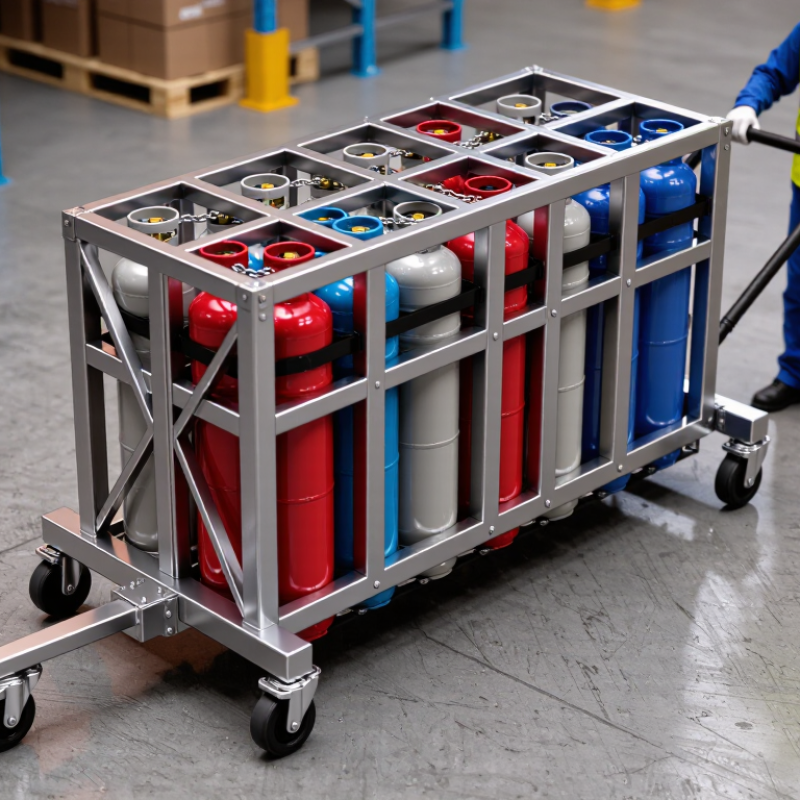
Gas cylinder transportation frames must match the cylinder type, load, and working environment. A two-cylinder frame suits maintenance teams and short indoor transfers. Larger multi-cylinder frames support laboratories, hospitals, workshops, and industrial gas stations. According to the International Energy Agency’s Global Hydrogen Review 2024, announced projects could raise low-emissions hydrogen production capacity to 49 million tonnes annually by 2030. This growth may increase demand for safer, more organized cylinder handling.
Frame design matters. Steel frames with fixed retaining chains work well for standard cylinders and uneven service yards. Lightweight aluminum frames suit field technicians who move smaller loads frequently. Forklift-compatible frames support warehouses, but their pockets must match equipment dimensions precisely. For compressed hydrogen, the U.S. Department of Energy identifies 350-bar and 700-bar storage as common pressure levels. Frames need suitable clearance, restraints, and visible pressure identification.
Check the details.
A practical inspection should confirm wheel load ratings, brake performance, cylinder separation, and tie-down access.
Frames used near corrosive chemicals may need coated or stainless components.
In my experience, operators often choose capacity first and ergonomics later. That is a mistake. A frame holding twelve cylinders can still be unsuitable if one person cannot steer it safely. Specifications also deserve review; published capacity may assume smooth floors, not ramps or damaged concrete. Risk assessment should reflect the actual route, weather, and handling frequency.
How to Choose a Gas Cylinder Transportation Frame in 2026?
A safe gas cylinder transportation frame begins with the correct load rating. Check the combined weight of the cylinders, frame, and accessories. The design should keep cylinders upright, separated, and firmly restrained. Two independent securing points are better than one. Chains, straps, and locking bars must resist movement during braking, turning, and uneven-floor travel.
Look closely at the frame’s construction. Welds should appear continuous, clean, and free from visible cracks. Tubes should not show deep corrosion or crushed sections. Choose wheels that match the working surface, with reliable brakes on at least two wheels. Handles should provide control without forcing operators to twist their wrists. A low center of gravity helps prevent tipping. Small details matter.
The frame should support the requirements of applicable local regulations and recognized guidance, such as OSHA rules, EN load-securing principles, or ISO cylinder-handling guidance. Requirements vary by location and cylinder type. Verify them before purchase. Check warning labels, inspection records, and the manufacturer’s stated capacity. Do not assume a heavy frame is automatically safer. An overloaded design may still move badly. In practice, teams sometimes ignore doorway width, ramp angles, or glove access. That oversight deserves honest review. Test the loaded frame on the actual route, not only on a level workshop floor.
A gas cylinder transportation frame should match the cylinder, not merely fit inside a warehouse plan. Measure diameter, height, valve protection, and filled weight before selecting the frame. A narrow cylinder needs close support points, while a tall cylinder needs a lower center of gravity. Check the frame’s safe working load against the total filled weight, not the empty cylinder weight. Include accessories, regulators, and handling impacts. The U.S. Bureau of Labor Statistics recorded over 1,000 fatal injuries in transportation and material-moving occupations in 2023. Stability deserves serious attention.
For multiple cylinders, calculate the combined load and its distribution. Uneven spacing can twist the base during turning or braking. Use restrained pockets, rounded contact surfaces, and corrosion-resistant materials suitable for the operating environment. Guidance from ISO 11120 and the Compressed Gas Association stresses secure handling, correct restraints, and protection from valve damage. These standards do not replace a site-specific engineering review. A common mistake is trusting catalogue dimensions. Real cylinders often have protective caps, worn feet, or slight dimensional variation.
Tips: Leave practical clearance around each cylinder. Test one loaded frame before ordering many. Record the heaviest configuration. Inspect welds, wheels, restraints, and locking points regularly. I would also review the design after the first month; operators often reveal problems that drawings miss.
How to Match Frame Design with Cylinder Size and Load Requirements
Data basis: representative nominal dimensions and filled masses commonly used for transport planning. Actual tare weight, gas fill weight, valve configuration, and cylinder dimensions vary by specification and local standard.
Choosing a gas cylinder transportation frame in 2026 requires more than checking its load rating. In daily handling, stability starts with a low center of gravity and a wide, rigid base. Select a frame that matches cylinder diameter, height, and filled weight. Adjustable retaining chains or padded straps should hold cylinders firmly without damaging surfaces. Test the frame on uneven flooring. A small wobble becomes serious near ramps, door thresholds, or loading vehicles. It should not.
Protection also depends on details people often overlook. Rounded edges reduce snags, while corrosion-resistant finishes help in damp storage areas. Separate cylinders with durable dividers when contact could damage valves or labels. A guard around the valve area adds useful protection during turning and parking. For easy handling, choose balanced handles, smooth-rolling wheels, and a reliable brake. Larger wheels cross cracked concrete better, but they may make the frame heavier. I have found that an empty frame can feel easy, then become awkward when fully loaded. Measure turning space before purchase.
Tips: Inspect welds, wheels, straps, and brakes before every use. Keep the frame upright and move it slowly, especially on slopes. Ask operators to trial the loaded frame with gloves and normal work footwear. Their feedback may reveal problems that a specification sheet misses. Document inspection findings and replace worn restraints promptly. Some designs look strong but lack practical balance.
How to Choose a Gas Cylinder Transportation Frame in 2026?
Inspection, Maintenance, and Safe Use of Transportation Frames
Choosing a transportation frame should begin with inspection access, not appearance. In field checks, I examine welds, rails, feet, corner supports, and cylinder restraints. Hairline cracks matter. Rust around joints may indicate trapped moisture or weakened metal. Check that locking pins move smoothly and remain fully engaged. The frame should keep cylinders upright, separated, and protected from impact. Its dimensions must match the cylinder size and approved load rating.
Before each use, remove dirt, oil, and loose corrosion from contact points. Inspect straps for cuts, stretched stitching, damaged buckles, or missing labels. Replace defective parts; do not repair critical restraints with wire or improvised fasteners. A competent inspector should verify lifting points and load-bearing components at planned intervals. Keep records with dates, findings, corrective actions, and the inspector’s name. Records expose repeated failures. I have learned that rushed checks miss small problems.
During loading, place cylinders evenly and secure them before moving the frame. Keep valves protected and prevent contact with sharp edges. Use only rated lifting equipment and designated lifting points. Do not exceed the frame’s capacity, even for a short distance. On uneven ground, move slowly and watch for shifting. Stop immediately if a strap loosens, a wheel binds, or the frame tilts. Follow applicable workplace rules and the frame’s operating instructions. One missed restraint can change the load’s balance. Be careful.
| Data Dimension | Selection or Safety Requirement | Inspection Method | Recommended Frequency | Acceptance Criteria | Corrective Action | Priority |
|---|---|---|---|---|---|---|
| Cylinder Compatibility | Select a frame designed for the cylinder type, diameter, height, valve arrangement, and filled mass. Do not combine cylinders that cannot be securely restrained in the same frame. | Compare the frame specification with the cylinder identification plate and current cylinder dimensions. | Before purchase and whenever the cylinder type changes. | Every cylinder is fully supported, fits without excessive clearance, and can be removed without forcing or striking adjacent cylinders. | Stop use until a compatible frame or approved insert is provided. | Critical |
| Rated Capacity | The combined cylinder mass, valve protection, regulators, hoses, and accessories must remain below the frame's marked working load and any vehicle or lifting limit. | Calculate the total filled mass and compare it with the manufacturer's rated capacity and the transport equipment rating. | Before each new load configuration. | Total load does not exceed the lowest applicable rated capacity; the rating is legible and traceable to technical documentation. | Reduce the load or use a higher-capacity frame. Never rely on an estimated empty-cylinder mass. | Critical |
| Frame Stability | Choose a low-center-of-gravity design with a base wide enough to remain stable during normal movement, turning, braking, and loading. | Place the empty frame on a level surface and check for rocking, uneven feet, distortion, or a visibly unstable load position. | Before every use and after impact. | No rocking, tipping tendency, bent base members, or unstable wheel arrangement. | Quarantine the frame and repair or replace damaged structural parts. | Critical |
| Cylinder Restraint | Provide positive restraint using chains, straps, bars, or purpose-built retainers. Cylinders should remain upright unless the cylinder and transport procedure specifically allow another orientation. | Check restraint position, tension, attachment points, and contact with the cylinder body. | Before movement and at each planned stop during extended transport. | Cylinders cannot slide, roll, rotate, or fall from the frame; restraints do not press on valves or damage cylinder surfaces. | Re-secure the cylinders before moving. Replace worn, stretched, cut, or corroded restraints. | Critical |
| Valve Protection | Protective caps or guards must be installed whenever the cylinder is not connected for use, unless the cylinder design provides equivalent permanent protection. | Visually inspect caps, guards, threads, retaining devices, and clearance from the frame. | Before loading, unloading, and storage. | Valve protection is fitted, undamaged, secure, and not obstructed by the frame or restraints. | Do not transport an unprotected cylinder unless an approved equivalent protection system is in place. | Critical |
| Frame Material | Use materials suitable for the operating environment, cylinder contents, moisture exposure, and expected mechanical loads. Avoid incompatible materials that may promote corrosion or contamination. | Inspect welds, tubes, plates, fasteners, hooks, and contact surfaces for corrosion, cracks, deformation, or chemical attack. | Monthly and after exposure to chemicals, salt, impact, or abnormal loading. | No cracks, separated welds, sharp edges, significant section loss, or loose structural fasteners. | Remove from service when structural integrity is uncertain; repair only through a competent process. | Critical |
| Wheels and Casters | Wheels or casters should be rated for the complete loaded frame and suited to the floor surface. At least one effective parking or locking device is needed when the frame is stationary. | Check wheel condition, bearings, swivel action, fasteners, brakes, and contact with the floor. | Before each use; lubricate or service according to the equipment schedule. | Wheels rotate freely, remain attached, do not have damaged treads, and locking devices hold the loaded frame. | Do not push the frame until defective wheels or brakes are replaced. | Critical |
| Lifting Points | If the frame is designed for crane or forklift handling, use only marked lifting points and the stated lifting method. Do not lift from restraints, valve guards, or unapproved members. | Inspect lifting lugs, pockets, shackles, welds, labels, and the balance of the loaded frame. | Before every lift and after any shock load. | Lifting points are clearly identified, undamaged, compatible with the lifting accessories, and within the rated lifting capacity. | Tag out the frame if markings are missing or any lifting point is bent, cracked, or excessively worn. | Critical |
| Forklift Interface | Fork pockets, when provided, must accept the intended fork size and prevent the frame from sliding off during handling. | Confirm fork spacing, pocket condition, load center, and forklift capacity before lifting. | Before every forklift operation. | Forks are fully inserted, load is balanced, and the forklift capacity exceeds the actual load at the applicable load center. | Use a suitable handling attachment or forklift; never improvise with straps around valves or cylinder necks. | Critical |
| Vehicle Restraint | Secure the loaded frame to the vehicle using rated anchor points and suitable tie-downs. The frame must not depend only on its wheel brakes. | Check tie-down routing, tension, anchor points, contact protection, and clearance from valves and hoses. | Before departure and after significant route disturbance or loading changes. | The frame cannot slide, tip, or shift under expected vehicle movement; tie-downs remain tight and undamaged. | Stop the vehicle in a safe location and re-secure the load before continuing. | Critical |
| Cylinder Identification | Labels, hazard markings, service identification, and cylinder test or inspection markings must remain visible and legible. | Check cylinder labels and markings before loading and verify that the frame does not conceal required information. | Before every shipment or transfer. | Contents and hazards can be identified without removing the cylinders from the frame. | Do not ship unidentified or illegibly marked cylinders; contact the responsible gas-safety authority or supplier. | Critical |
| Leak Check | Inspect valves, connections, regulators, and hoses for leakage using an approved leak-detection method. Never use a flame to locate a leak. | Perform a visual check and use a compatible leak-detection solution or approved instrument where appropriate. | Before transport, after connection, and whenever a leak is suspected. | No audible leak, frost formation, pressure loss attributable to leakage, or positive leak-test indication. | Move people away, isolate the area, and follow the applicable emergency procedure. Do not transport a leaking cylinder. | Critical |
| Gas Separation | Segregate incompatible gases according to the applicable dangerous-goods rules and site procedures. Oxidizing gases should be kept away from combustible materials, oil, and grease. | Review the gas list, frame compartments, labels, and loading arrangement. | Before each mixed-gas load. | Incompatible gases are separated or transported under an approved arrangement; no oil or grease contaminates oxygen-service components. | Unload and rearrange the shipment according to the approved segregation plan. | Critical |
| Ventilation | Transport and storage areas should prevent gas accumulation. Enclosed vehicles or rooms require ventilation appropriate to the gas hazard and local regulations. | Check ventilation openings, vehicle requirements, gas detection where required, and signs of gas accumulation. | Before use and during periodic workplace inspections. | Ventilation is unobstructed and the transport method complies with the applicable gas and dangerous-goods requirements. | Do not use an unsuitable enclosed area; consult the site safety procedure before transport. | Critical |
| Temperature and Sun Exposure | Keep cylinders away from excessive heat, flames, hot surfaces, and direct prolonged sunlight. Do not exceed the cylinder service temperature specified by its approval. | Inspect the route and parking location for heat sources, hot surfaces, and direct sun exposure. | Before loading and during planned stops. | Cylinders remain within the permitted temperature range and are not exposed to uncontrolled heat. | Move the frame to a suitable shaded, ventilated, and approved location. | Critical |
| Manual Handling | Push the frame from a designated handle at a controlled walking speed. Do not drag, drop, roll, or use cylinder valves as handles. | Observe the route, floor condition, operator position, and handling technique. | Every movement. | Operator maintains control, route is clear, and no person is positioned in a crush zone or downhill path. | Stop movement and correct the route, staffing, or handling equipment before proceeding. | Routine |
| Parking and Storage | Park the frame on a level, stable surface with wheels locked where applicable. Keep it away from emergency exits, ignition sources, vehicle traffic, and unauthorized access. | Inspect the parking location, clearance, wheel locks, signage, and access control. | At every parking location. | Frame is stable, secured, protected from impact, and does not obstruct escape routes or safety equipment. | Relocate the frame or improve the controls before leaving it unattended. | Critical |
| Hose and Regulator Protection | Remove or protect regulators and hoses during transport. Prevent bending, crushing, contamination, and contact with sharp frame edges. | Check hose routing, caps, connectors, protective covers, and storage clips. | Before every movement and after connection changes. | Hoses and regulators are secured, protected, and free from cuts, kinks, damaged threads, or contamination. | Replace damaged components and keep them isolated until inspected by a competent person. | Critical |
| Cleaning | Keep the frame free from oil, grease, metal chips, chemicals, and debris that could damage cylinders, contaminate fittings, or interfere with restraints. | Visually inspect the base, contact points, restraints, and handling surfaces. | Weekly in routine service and immediately after contamination. | Surfaces are clean, dry where appropriate, and free from residues that could create a safety or compatibility hazard. | Clean using a method compatible with the cylinder service and coating; investigate the source of contamination. | Routine |
| Fasteners and Restraint Hardware | Bolts, pins, hooks, shackles, buckles, and retaining bars must be correctly fitted and suitable for the intended load. | Check for missing parts, loose nuts, damaged threads, distortion, corrosion, and unauthorized modifications. | Monthly and before heavy-duty use. | All hardware is present, secure, undamaged, and matches the approved design. | Replace with correctly rated parts; do not substitute ordinary wire, rope, or unapproved hardware. | Critical |
| Inspection Records | Maintain a frame identification number, inspection date, findings, corrective actions, person conducting the inspection, and next due date. | Review the inspection log and compare it with the frame in service. | After every formal inspection, repair, incident, or modification. | Records are complete, current, legible, and retained according to the site document-control procedure. | Update missing records and remove untraceable equipment from service until its condition is verified. | Routine |
| Damage and Incident Control | Any frame involved in a collision, drop, overturn, overload, fire, or suspected chemical exposure requires a competent inspection before reuse. | Quarantine the frame and inspect the structure, restraint system, lifting points, wheels, and labels. | Immediately after an incident. | Competent personnel confirm that the frame remains fit for service and document the decision. | Tag out, repair, test, or scrap the frame according to the approved engineering procedure. | Critical |
| Training and Authorization | Only trained and authorized personnel should load, move, secure, connect, or unload gas cylinders and transportation frames. | Verify training records, practical competency, and authorization for the gas type and handling equipment. | Before assignment and at the retraining interval defined by the employer or regulation. | Personnel understand cylinder hazards, frame limits, emergency actions, manual handling, and vehicle restraint requirements. | Restrict the task to authorized personnel and provide documented refresher training. | Critical |
| Standards and Local Rules | Apply the current national, regional, workplace, and dangerous-goods requirements in addition to the frame manufacturer's instructions. Requirements may differ by gas, quantity, route, and transport mode. | Confirm the compliance review, transport documents, placards, emergency information, and applicable cylinder approvals. | At least annually and whenever regulations, gases, vehicles, or routes change. | The selected frame and operating procedure meet all applicable requirements for the intended service. | Pause procurement or transport until the compliance review is completed. | Critical |

For those larger-sized parts, or smaller quantity runs, we have 2 independent powder coat booths and ovens. The quality, durability and affordability of today’s powder coating finishes make this the process of choice for world-class companies.
Powder coating advantages over other forms of coating are many. Materials used in the Powder coating process can be metals and non-metals that come in a multitude of thicknesses, textures, colors, etc. Another of Powder coating’s biggest advantages over conventional coatings is its ability to create finishes in many different textures. Powder Coating Booths allow us the ability to apply these advantages to large products.
Tri-State Fabricators runs a full-service conveyor line for painting. Wet painting can provide protection or decoration to many different part styles. From start to finish, every project is easier to undergo random and point-based inspection by our skilled painting team.
Advantages to our Wet Paint Line are these lines start with product prep and ends with a thorough inspection of a high quality finished product. Our ability to complete large and small projects with a superior finish and doing so in a timely and economical fashion. This passes along the savings in production to our customers. When powder coating ins not an option, our Wet Paint Line gets the job done right the first time.
When the parts get big and heavy we roll-out our custom paint racks and oversize booth. By utilizing our partnerships with all the major paint brands, we can match virtually any color with wet paint.
The advantages of having access to a Wet Paint Booth are many. Large projects of many different shapes can be loaded into the booth. The Wet Paint Booth offers an environment that is much more controlled than a typical parts painting operation.
Not only are they used because of their controlled environment, but they’re are also advantageous when it comes to applying paint to parts that are needed in industries that require specialty coatings such as medical, aerospace, etc.
Our military forces have some very high standards when it comes to the finish of their vehicles and equipment. From the first pre-treatment step to final coat, it takes a great deal of knowledge and experience to protect the men and women of our armed forces. They deserve only the best, and Tri-State Fabricators provides it.
All of our processes are closely monitored by our staff and management teams. Both of which are highly trained in the processes of metal fabrication and finishing. Tri-State Fabricators’ goal is to always fully satisfy each and every customer, including the military. We will always put a 110% into what we do.
Abrasive media blasting is an excellent way to remove old paint, rust, and increase the paint/powder adhesion. Glass beads produce a much smoother and brighter finish than angular abrasives; leaving the part clean yet without any dimensional change. Chemically inert and environmentally friendly, we can recycle our beads approximately 30 times; making them a more preferred method of metal cleaning or surface finishing.
Advantages to Glass Bead Blasting are many. Glass bead blast media is used when a project is needing rough surfaces need to become smooth for applications of coatings such as paint. It is typically used to clean paint and rust from a product surface without deforming the surface it is being used on. Overall, compared to many other blasting media, Glass Bead Blasting is a very economical choice and those savings are always passed on to our customers.
Tri-State Fabricators utilize a zinc phosphate wash to clean and etch the material to ensure the best paint adhesion possible. The unique design of our 3-stage wash system does the work like a 5-stage. From Cleaning and rinsing to conversion coating and post-treatment, Our Part Washing process is a complete service and works throughout the fabrication service and the finishing service.
Along with the previously mentioned benefits, Curing is a vital chemical reaction that leaves the product finish hard and relatively safe from mild abrasion and aggressive corrosion. This process can be done in more than one way; ambient air-dry or in curing ovens at temps that exceed 240°.
From fixing paint mistakes (someone else’s of course) to simply cleaning our paint line hooks, our burn-off oven is put to good use. After a quick burn-off, a little clean up, and a fresh coat of paint, your parts will look better than new.
Why does our Burn-Off Oven work so well? Because super heating the air around parts turns the materials into ashes. From paint and powder coatings to rubber and machining oils, high temps do the job without degrading the integrity of the part.
Masking is a vital part of producing high quality products. We have die-cut masking patterns to protect machined surfaces as well as a wide range of plugs and caps to protect threaded holes and bolts. We provide permanent and temporary masking.
Masking allows the selected sections of a product to be protected from a fabrication or finishing service. This can be with both chemicals when etching and tapes, paints when only finishing just a section of the product. Masking is great in aiding the customization process of a project.
Screen printing is a photographic process that transfers artwork onto a porous nylon screen which allows colored ink to flow through the screen and be deposited on an aluminum or plastic component. We can generally have just about any design created onto a screen for your parts.
Some of the advantages of Screen Printing are, brand recognition for your business displaying on your products, assembly instructions, product warnings/hazards, etc. Tri-State Fabricators produces Screen Printing of the highest quality so you know it’s durable.
Metal Finishing is the art of treating the exterior portion of product, often metal but can also be made of other materials, so that the surface is clean and free of any debris. Then the process of applying coats or either paint of powder coat takes place. This coating process improves the quality of the product in both appearance and resistance to wear and corrosion.
Tri-State Fabricators, Inc., understands that a project typically isn’t complete until a high-quality finish has been added to your product. This is why our painting and powder coating teams continuously inspect the products throughout the Metal Finishing process.