

How to Choose Stone Plastic Flooring in 2026?

Choosing a Stone Plastic Floor in 2026 requires more than comparing colors and prices. A convincing surface can still hide a weak core, poor locking system, or unsuitable backing. The right decision depends on room conditions, installation quality, product testing, and long-term maintenance.

A practical evaluation begins with the subfloor. It should be clean, dry, level, and stable before installation. In a bright living room, sunlight may reveal uneven planks by late afternoon. In a kitchen, moisture resistance matters more than a dramatic wood pattern. Check the wear layer, dimensional stability, slip performance, formaldehyde emissions, and available test documentation. Certifications and manufacturer data deserve closer attention than vague phrases such as “premium quality.” They are not perfect, but they provide useful evidence.

A careful buyer should also inspect samples under real lighting. Touch the surface. Examine the edge profile. Test how the click joints align. A thick plank is not automatically better, and a low price can become expensive after repairs. Installation instructions, warranty exclusions, and cleaning requirements should be read before payment. Some products perform well in homes but are unsuitable for commercial traffic. No checklist is perfect. Even experienced installers can miss a damp subfloor or underestimate seasonal movement. This guide explores how to choose Stone Plastic Floor products with practical judgment, credible information, and realistic expectations for 2026. The best floor is not merely attractive. It should remain stable, safe, and manageable after daily footsteps, furniture movement, spills, and changing indoor temperatures.
How to Choose Stone Plastic Flooring in 2026?

What Is Stone Plastic Flooring and How Does It Work?

Stone Plastic Flooring, often called SPC flooring, is a rigid floor made from limestone powder, PVC resin, and stabilizers. These materials form a dense core that resists dents and everyday moisture. It is not natural stone. Its strength comes from engineered compression, not from a solid rock slab.

A typical plank has several working layers. The bottom layer helps reduce movement. The SPC core provides rigidity and water resistance. A printed film creates wood or stone patterns, while the wear layer protects the surface from scratches. Some products also include a factory-attached underlayment. The planks usually connect through click-lock edges, creating a floating floor above a prepared subfloor.

Installation quality still matters. The subfloor should be clean, dry, and reasonably level. Small bumps can create hollow sounds or stress the joints. Leave an expansion gap near walls, cabinets, and heating pipes. In a kitchen, wipe standing water quickly, even though the planks resist moisture. Water-resistant does not mean every joint is permanently sealed.

It feels stable.

During evaluation, check the core thickness, wear-layer rating, locking profile, and installation instructions. A thicker plank may feel more solid, but it cannot correct a poor subfloor. Some sales descriptions also overstate scratch resistance. Sand, grit, and sharp furniture legs can still mark the surface. Choosing well means matching construction details to room conditions, not trusting appearance alone.

How to Choose Stone Plastic Flooring in 2026? - What Is Stone Plastic Flooring and How Does It Work?

Typical specifications and selection guidance for stone plastic composite (SPC) flooring. Actual values vary by product and installation conditions.
Selection Dimension Typical Data or Range What It Means Practical Buying Guidance
Flooring Type Stone plastic composite (SPC), a rigid-core resilient floor The core commonly combines mineral filler, usually calcium carbonate, with polymer resin and stabilizers. Confirm that the product is clearly identified as SPC or stone plastic composite rather than flexible vinyl flooring.
Construction Layers Protective finish, wear layer, printed décor film, rigid SPC core, and attached or separate underlayment Each layer contributes to appearance, abrasion resistance, dimensional stability, sound control, or installation performance. Request a cross-section specification sheet and verify whether underlayment is already attached.
Overall Thickness Commonly about 4–8 mm, including the wear layer and core; some products are thinner or thicker Thickness affects transition height, perceived solidity, acoustic performance, and tolerance for minor subfloor irregularities. Measure door clearances and adjoining floor levels before choosing a thickness.
Wear Layer Common residential choices include 0.20–0.30 mm; higher-use products may use 0.50 mm or more The wear layer helps protect the décor from surface abrasion and everyday traffic. Choose the wear layer according to traffic, pets, wheeled furniture, and cleaning frequency; do not judge durability by thickness alone.
Water Resistance The rigid core is generally water-resistant and does not readily absorb liquid Water resistance applies to the flooring material; seams, edges, subfloor, and room construction can still be vulnerable. Use approved sealing details where required, wipe spills promptly, and avoid assuming that every installation is waterproof.
Dimensional Stability Generally more dimensionally stable than flexible vinyl, but expansion and contraction still occur Temperature, sunlight, room size, and installation conditions can affect plank movement. Follow the specified perimeter expansion gap and acclimation requirements, especially in large or sunlit rooms.
Installation Method Floating click installation is common; glue-down installation is available for selected products A floating floor locks planks together without full-surface adhesive, while glue-down flooring bonds directly to the prepared subfloor. Select the method based on room size, moisture conditions, acoustic needs, maintenance plans, and manufacturer instructions.
Subfloor Flatness Many rigid-floor systems require approximately no more than 3/16 inch variation over 10 feet, but the product specification controls A rigid core can reflect high spots or voids, causing movement, joint stress, or noise. Inspect and level the subfloor before installation; do not use the flooring to hide major unevenness.
Underfloor Heating Compatibility varies; many products permit hydronic or electric systems under controlled temperature limits Excessive heat can affect joints, adhesives, and dimensional stability. Check the flooring temperature limit, heating-system instructions, and required moisture or commissioning procedure.
Acoustic Performance Depends on core density, plank thickness, underlayment, subfloor, and installation quality SPC can sound harder or more hollow underfoot than softer resilient flooring when installed without suitable acoustic treatment. Review tested impact-sound or sound-transmission ratings where apartment or multi-level performance matters.
Slip Resistance Performance is product-specific and should be supported by a recognized slip-resistance test Surface texture, finish, contamination, and footwear influence slip behavior. For bathrooms, entrances, or commercial areas, request documented wet and dry slip-resistance results.
Maintenance Regular sweeping or vacuuming and damp mopping with a neutral cleaner are commonly recommended Removing grit helps reduce scratching and premature wear. Use soft cleaning tools, avoid abrasive powders and excessive water, and follow the product care instructions.
Indoor Air Quality Look for tested low-emission performance and compliance with applicable flooring safety standards Emissions can come from the flooring, backing, adhesive, or underlayment—not only the rigid core. Request current laboratory documentation covering the complete flooring system where indoor air quality is important.
Fire Performance Classification depends on the complete product and applicable local testing system Fire behavior can change with backing, adhesive, underlayment, and installation assembly. For public or commercial projects, verify the required fire classification from official test reports.
Best-Fit Applications Living areas, bedrooms, hallways, offices, retail spaces, and many moisture-prone rooms when approved SPC is valued for rigid feel, decorative variety, relatively simple installation, and resistance to everyday moisture. Avoid locations exposed to standing water, uncontrolled outdoor conditions, or temperatures outside the product’s approved range.
Key Documents to Check Technical data sheet, installation guide, care guide, warranty terms, test reports, and safety documentation These documents reveal installation limits and performance claims that may not appear in product images. Compare documented test results, installation requirements, and warranty exclusions before making a final decision.

Which Stone Plastic Flooring Types Fit Different Spaces?

Stone plastic flooring, commonly called SPC, is not a single product type. Its rigid mineral core suits areas needing dimensional stability and moisture resistance.

For kitchens and entryways, choose click-lock SPC with a 0.3–0.5 mm wear layer. It handles grit, spills, and frequent cleaning better than thinner options.

The waterproof core helps, but open joints can still allow moisture underneath.

Small details matter.

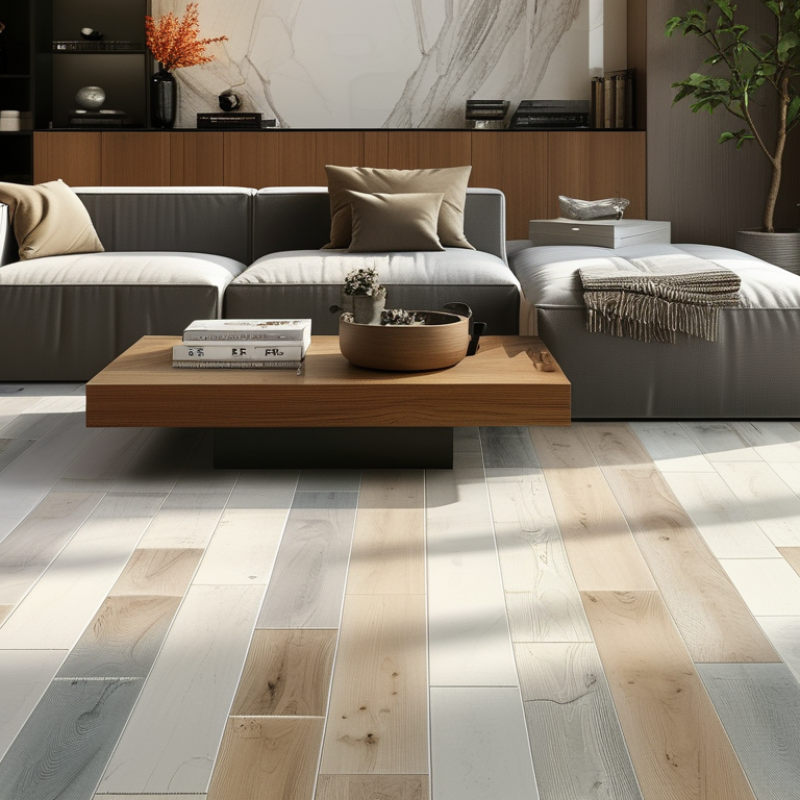
Living rooms benefit from embossed SPC planks with a realistic wood or stone texture. The surface feels less artificial and offers better traction near sofas or dining tables. Bedrooms may need SPC with an attached acoustic pad. It reduces footfall noise and feels slightly softer. However, thicker underlay is not always better. It can affect joint performance if the flooring system does not approve it.

Bathrooms require careful installation, not just a waterproof product.

Use tightly fitted click systems, sealed perimeter gaps, and a level subfloor. Commercial corridors and small shops usually need a stronger wear layer and a textured surface for heavy traffic. Glue-down SPC can work around complex layouts, but removal becomes harder.

I have seen attractive planks fail because installers ignored floor moisture and uneven concrete. I once focused too much on color during a rushed renovation. The sample looked excellent, yet the room sounded hollow underfoot. Testing a full-size sample in the actual space is wiser than trusting a showroom light.

How to Evaluate Durability, Safety, and Waterproof Performance?

Choosing stone plastic composite flooring in 2026 requires more than comparing wear-layer thickness. Durability should be verified through test results, not showroom appearance. Ask for residual indentation data under ASTM F970 and dimensional-stability results under ISO 23999. EN 16511 testing can also indicate how locking panels perform under repeated movement. A thicker wear layer helps, but it does not guarantee a stronger core.

Safety begins with indoor air quality and slip resistance. The U.S. Environmental Protection Agency reports that indoor pollutant levels can be two to five times higher than outdoor levels. Request independent emissions testing against CDPH Standard Method v1.2. For wet areas, review dynamic coefficient of friction data under ANSI A326.3. A value around 0.42 or higher is commonly used for level interior surfaces. Still, flooring is not automatically safe when water, dust, or cleaning residue remains on top.

Waterproof claims need careful reading. SPC cores resist water, but joints, cut edges, and perimeter gaps can still allow moisture beneath the floor. Look for documented water-exposure testing, edge-stability results, and installation limits. Check the subfloor moisture level before installation. I have seen attractive floors fail because the expansion gap was ignored. That detail matters. A reliable evaluation compares laboratory data with room conditions, cleaning habits, furniture loads, and local humidity, rather than trusting one impressive specification.

What Installation Methods and Maintenance Requirements Should You Know?

Installing stone plastic flooring starts with the subfloor, not the planks. It must be clean, dry, firm, and reasonably level. Small bumps can create movement and hollow sounds later. I once underestimated a minor dip near a doorway, and the finished floor felt uneven. That mistake was avoidable. Measure room moisture before installation, especially over concrete. Let the flooring rest indoors according to the supplier’s instructions. Temperature changes can affect fitting.

Click-lock systems usually need careful alignment and a clean tapping block. Do not force the joints. For adhesive installation, spread the approved adhesive evenly and respect its open time. Leave the required expansion gap around walls, pipes, and fixed cabinets. Cover the gap with suitable trim. Doorways deserve extra attention because movement often appears there first. A simple floor plan can prevent awkward cuts.

Maintenance is practical but not careless. Sweep grit regularly, since sand can scratch the protective surface. Use a damp microfiber mop, not a soaking-wet one. Clean spills quickly. Choose a neutral cleaner approved for resilient flooring. Avoid abrasive powders, steel wool, wax, and harsh solvents. Place protective pads beneath heavy furniture, but do not drag furniture across the floor. Inspect seams every few months. If a plank lifts or separates, investigate moisture or subfloor movement instead of hiding the defect. Some cleaning advice sounds harmless, yet excessive water remains a common failure point.

How to Compare Costs, Sustainability, and Long-Term Value?

Choosing stone plastic flooring in 2026 requires more than comparing showroom prices. A realistic cost includes the floor, underlayment, delivery, installation, subfloor preparation, and future repairs. Regional labor can change the final bill sharply. Request three itemized quotations, not three headline prices. The 2025 RSMeans Construction Cost Data supports this approach because installation conditions strongly affect construction pricing. A thicker wear layer may cost more initially, yet it can reduce replacement risk in hallways, kitchens, and rental units.

Sustainability needs careful reading. Stone plastic flooring usually contains PVC, stabilizers, and mineral filler. Its stone appearance does not prove low environmental impact. VinylPlus reported 810,775 tonnes of PVC recycled in Europe during 2023, showing progress but also limited recovery capacity. The U.S. Environmental Protection Agency estimated 600 million tons of construction and demolition debris in 2018. Flooring waste is only one part of that stream. Ask for a product-specific Environmental Product Declaration under ISO 14025 and EN 15804. Check whether transport, manufacturing, use, and end-of-life stages are included.

Long-term value depends on measurable performance. Compare wear-layer thickness, dimensional stability, moisture tolerance, slip resistance, repair options, and warranty exclusions. A rigid core can hide minor subfloor imperfections, but it cannot correct serious unevenness. That matters. Replacing one damaged plank is valuable, although matching future batches may be difficult. I would also inspect installation guidance and recycling access before purchase. The comparison remains imperfect, because laboratory durability rarely mirrors sandy entrances, heavy furniture, or careless maintenance. A lower-priced floor may win today, then lose financially after one avoidable replacement cycle.

Powder Coat Booths

For those larger-sized parts, or smaller quantity runs, we have 2 independent powder coat booths and ovens. The quality, durability and affordability of today’s powder coating finishes make this the process of choice for world-class companies.

Powder coating advantages over other forms of coating are many. Materials used in the Powder coating process can be metals and non-metals that come in a multitude of thicknesses, textures, colors, etc. Another of Powder coating’s biggest advantages over conventional coatings is its ability to create finishes in many different textures. Powder Coating Booths allow us the ability to apply these advantages to large products.

Wet Paint Line

Tri-State Fabricators runs a full-service conveyor line for painting. Wet painting can provide protection or decoration to many different part styles. From start to finish, every project is easier to undergo random and point-based inspection by our skilled painting team.

Advantages to our Wet Paint Line are these lines start with product prep and ends with a thorough inspection of a high quality finished product. Our ability to complete large and small projects with a superior finish and doing so in a timely and economical fashion. This passes along the savings in production to our customers. When powder coating ins not an option, our Wet Paint Line gets the job done right the first time.

Wet Paint Booths

When the parts get big and heavy we roll-out our custom paint racks and oversize booth. By utilizing our partnerships with all the major paint brands, we can match virtually any color with wet paint.

The advantages of having access to a Wet Paint Booth are many. Large projects of many different shapes can be loaded into the booth. The Wet Paint Booth offers an environment that is much more controlled than a typical parts painting operation.

Not only are they used because of their controlled environment, but they’re are also advantageous when it comes to applying paint to parts that are needed in industries that require specialty coatings such as medical, aerospace, etc.

Military CARC

Our military forces have some very high standards when it comes to the finish of their vehicles and equipment. From the first pre-treatment step to final coat, it takes a great deal of knowledge and experience to protect the men and women of our armed forces. They deserve only the best, and Tri-State Fabricators provides it.

All of our processes are closely monitored by our staff and management teams. Both of which are highly trained in the processes of metal fabrication and finishing. Tri-State Fabricators’ goal is to always fully satisfy each and every customer, including the military. We will always put a 110% into what we do.

Glass-Bead Blasting

Abrasive media blasting is an excellent way to remove old paint, rust, and increase the paint/powder adhesion. Glass beads produce a much smoother and brighter finish than angular abrasives; leaving the part clean yet without any dimensional change. Chemically inert and environmentally friendly, we can recycle our beads approximately 30 times; making them a more preferred method of metal cleaning or surface finishing.

Advantages to Glass Bead Blasting are many. Glass bead blast media is used when a project is needing rough surfaces need to become smooth for applications of coatings such as paint. It is typically used to clean paint and rust from a product surface without deforming the surface it is being used on. Overall, compared to many other blasting media, Glass Bead Blasting is a very economical choice and those savings are always passed on to our customers.

Part Washing

Tri-State Fabricators utilize a zinc phosphate wash to clean and etch the material to ensure the best paint adhesion possible. The unique design of our 3-stage wash system does the work like a 5-stage. From Cleaning and rinsing to conversion coating and post-treatment, Our Part Washing process is a complete service and works throughout the fabrication service and the finishing service.

Along with the previously mentioned benefits, Curing is a vital chemical reaction that leaves the product finish hard and relatively safe from mild abrasion and aggressive corrosion. This process can be done in more than one way; ambient air-dry or in curing ovens at temps that exceed 240°.

Burn-Off Oven

From fixing paint mistakes (someone else’s of course) to simply cleaning our paint line hooks, our burn-off oven is put to good use. After a quick burn-off, a little clean up, and a fresh coat of paint, your parts will look better than new.

Why does our Burn-Off Oven work so well? Because super heating the air around parts turns the materials into ashes. From paint and powder coatings to rubber and machining oils, high temps do the job without degrading the integrity of the part.

Masking

Masking is a vital part of producing high quality products. We have die-cut masking patterns to protect machined surfaces as well as a wide range of plugs and caps to protect threaded holes and bolts. We provide permanent and temporary masking.

Masking allows the selected sections of a product to be protected from a fabrication or finishing service. This can be with both chemicals when etching and tapes, paints when only finishing just a section of the product. Masking is great in aiding the customization process of a project.

Screen Printing

Screen printing is a photographic process that transfers artwork onto a porous nylon screen which allows colored ink to flow through the screen and be deposited on an aluminum or plastic component. We can generally have just about any design created onto a screen for your parts.

Some of the advantages of Screen Printing are, brand recognition for your business displaying on your products, assembly instructions, product warnings/hazards, etc. Tri-State Fabricators produces Screen Printing of the highest quality so you know it’s durable.

Metal Finishing

Metal Finishing is the art of treating the exterior portion of product, often metal but can also be made of other materials, so that the surface is clean and free of any debris. Then the process of applying coats or either paint of powder coat takes place. This coating process improves the quality of the product in both appearance and resistance to wear and corrosion.

Tri-State Fabricators, Inc., understands that a project typically isn’t complete until a high-quality finish has been added to your product. This is why our painting and powder coating teams continuously inspect the products throughout the Metal Finishing process.