7 Tips for Choosing the Best RO Filtration System

Choosing a reverse osmosis system is not just a matter of comparing prices or counting filter stages. The right fit depends on your source water, daily use, available space, and willingness to replace filters on schedule. A tap-water report can reveal whether sediment, hardness, or specific dissolved contaminants deserve attention. Details matter.

The WHO/UNICEF Joint Monitoring Programme reported that 2.2 billion people lacked safely managed drinking water in 2022. That global figure does not tell you which home system to buy, but it highlights why treatment claims deserve careful checking. For household decisions, look for independently tested contaminant-reduction claims, clear replacement schedules, and realistic output rates. A small under-sink unit may suit a couple; a busy kitchen may need a larger storage tank. Not just price.

Membrane expert Menachem Elimelech’s published research examines reverse osmosis alongside energy use and membrane fouling. A fair paraphrase of its practical lesson is simple: judge performance together with operating demands. That is important when comparing any Ro Filtration System. A high rejection rate sounds impressive, yet it cannot answer every question about taste, maintenance, wastewater, or performance as filters age. I should admit, product labels can make those trade-offs easy to miss.

The following seven tips offer a grounded way to compare options: verify your water needs, check certification, assess capacity, review maintenance, understand wastewater, compare total cost, and confirm support. Your circumstances may differ. That is precisely why a careful checklist helps.
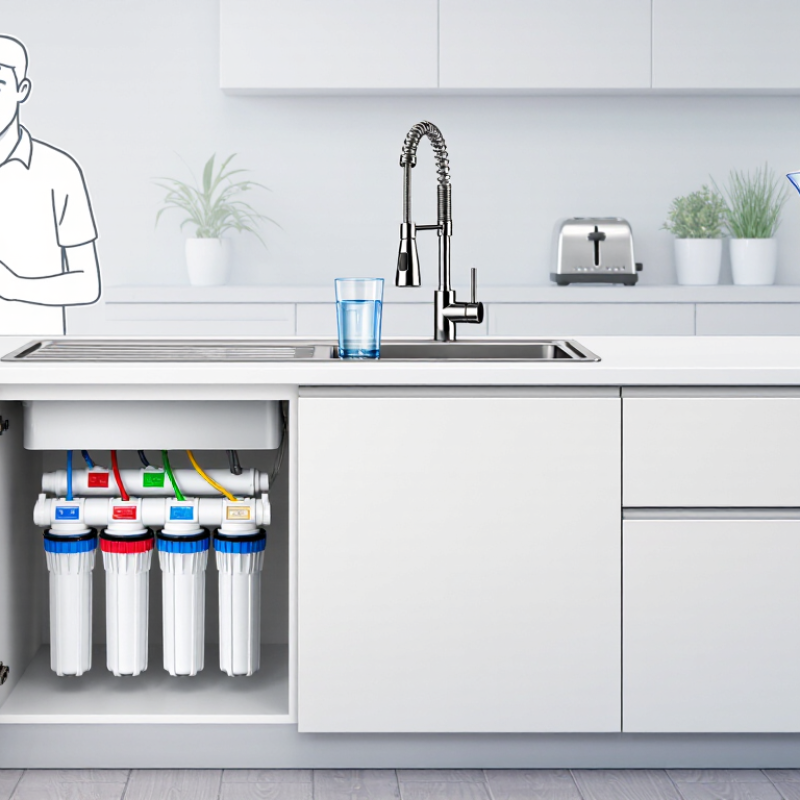
7 Tips for Choosing the Best RO Filtration System

Understand How Reverse Osmosis Filtration Works

Reverse osmosis (RO) uses water pressure to push water through a semipermeable membrane. The membrane allows water molecules through while reducing many dissolved salts and other substances. A separate reject stream carries concentrated material toward the drain. In many under-sink systems, sediment and carbon prefilters catch particles and reduce chlorine before water reaches the membrane. This helps protect the membrane. Performance varies with feed-water quality, pressure, temperature, and maintenance. That is the basic path.

Tip: Check which stages your system uses and what each one is designed to reduce. RO does not remove every possible contaminant, and a low total dissolved solids reading does not prove water is free of all unwanted substances. For specific concerns, compare the system’s independent test data with your water report. Not magic.

Tip: Follow the replacement schedule, but also watch for changes in flow or taste. A clogged prefilter can slow production; an aging membrane may reduce performance. Many units store treated water in a small tank, so output is not always immediate. Check the manual for flushing instructions after replacing filters. I used to assume slower flow meant a failing membrane, but clogged prefilters can cause it too. That detail is easy to miss.

Assess Your Water Quality and Household Needs

Before choosing an RO system, find out what is actually in your water. A recent utility water-quality report can identify common minerals, disinfectants, and listed contaminants. If you use a private well, arrange testing through a qualified laboratory, since conditions can change. Testing matters. Pay attention to hardness, nitrate, lead, and total dissolved solids, but do not assume one number explains everything. A result is useful only when you know the test method and sampling date. It is easy to overread a single test. If results are unclear, ask a local water professional which contaminants need follow-up testing.

Then consider how your household uses water. A couple who mainly drinks tap water may need less daily output than a family that also cooks with it. Check the unit’s rated production, storage-tank capacity, and your available sink or cabinet space. Low incoming pressure can affect performance, so check the installation requirements before buying. RO systems also send some water to drain; the amount varies by design and operating conditions. Not every system reduces every contaminant. Compare independent certifications and specific reduction claims with your test results. Filters and membranes need timely replacement, too. I would not assume maintenance will take care of itself; a note on the cabinet door can help.

Assess Water Quality and Household Needs

Estimated daily purified-water demand by household size

Planning estimate: 3 liters per person per day for drinking and cooking. Actual use varies; check your household’s consumption and your water test results before choosing a system’s rated daily output.

Compare System Types, Capacity, and Certifications

An under-sink RO system treats drinking water at one tap and usually suits smaller households. A tank model stores filtered water, while a tankless model saves cabinet space but depends on adequate plumbing pressure. Whole-house RO can serve more outlets, yet it needs more space, careful sizing, and often higher operating costs. Match the design to your actual use, not the most impressive product description. That distinction matters.

Check capacity in gallons per day, then compare it with your household’s drinking and cooking needs. A rating is not a promise of constant output; cold water and low inlet pressure can slow production. If several people fill bottles before work, storage capacity and recovery time deserve attention. Look at wastewater, too. Some systems send several gallons to drain for each gallon produced, and that ratio varies with pressure and setup. I would not choose on capacity alone.

Certifications can help verify specific performance claims. For RO systems, look for NSF/ANSI 58 certification, and confirm the exact model in the certifier’s directory. A standard may cover particular claims, not every contaminant or every component. Read the certified reduction list and check replacement-filter availability. Small print can be easy to miss. Compare installation requirements and filter-change intervals before buying; maintenance is the part people often underestimate.

Evaluate Installation, Maintenance, and Operating Costs

An RO system’s purchase price is only part of its cost. Ask an installer to itemize labor, tubing, a storage tank, and any new faucet or drain connection. A cramped cabinet can add labor. So can a sink without a spare faucet opening. Get a written quote before choosing a model, and check whether the installation includes leak testing. Small details matter.

Operating costs depend on water use, local water and sewer rates, and replacement filters. The US EPA’s WaterSense specification sets a minimum 30% efficiency rating for labeled point-of-use RO systems. At that threshold, roughly 2.3 gallons go to drain for every gallon of treated water. Compare that figure with a system’s rated efficiency, then estimate its water cost using your utility bill. For maintenance, price each prefilter and membrane, and follow the replacement schedule for your water conditions. NSF/ANSI 58 covers RO system performance and material safety; certification does not remove the need for regular upkeep. Keep receipts. I would still budget for an occasional service visit, even when the manual makes maintenance sound simple.

Choose a System That Fits Your Home and Budget

Choosing an RO system starts with your water source and daily drinking needs, not the biggest advertised capacity. The U.S. Geological Survey’s 2015 water-use report estimated domestic use at 82 gallons per person per day. That figure includes showers, laundry, and other uses, so it is not a sensible target for a kitchen RO unit. Track your household’s drinking and cooking water for a week. Then compare that demand with the system’s rated daily output and storage-tank capacity. Small details matter. A tank can run low during busy mornings, while excess capacity may add cost without helping your household.

The Centers for Disease Control and Prevention estimates that about 43 million people in the United States use private wells. If that describes your home, test the water before paying for extra filtration stages. Check that any performance claims match the contaminants found in your test results; NSF/ANSI 58 certification covers specific RO system claims, not every possible contaminant. Test first. Compare the full cost, too: installation, replacement filters, membrane changes, and wastewater all affect the long-term budget. It is tempting to choose the most advanced unit, but more features are not automatically better value. I would leave room in the budget for maintenance. That part is easy to overlook.


Powder Coat Booths

For those larger-sized parts, or smaller quantity runs, we have 2 independent powder coat booths and ovens. The quality, durability and affordability of today’s powder coating finishes make this the process of choice for world-class companies.

Powder coating advantages over other forms of coating are many. Materials used in the Powder coating process can be metals and non-metals that come in a multitude of thicknesses, textures, colors, etc. Another of Powder coating’s biggest advantages over conventional coatings is its ability to create finishes in many different textures. Powder Coating Booths allow us the ability to apply these advantages to large products.

Wet Paint Line

Tri-State Fabricators runs a full-service conveyor line for painting. Wet painting can provide protection or decoration to many different part styles. From start to finish, every project is easier to undergo random and point-based inspection by our skilled painting team.

Advantages to our Wet Paint Line are these lines start with product prep and ends with a thorough inspection of a high quality finished product. Our ability to complete large and small projects with a superior finish and doing so in a timely and economical fashion. This passes along the savings in production to our customers. When powder coating ins not an option, our Wet Paint Line gets the job done right the first time.

Wet Paint Booths

When the parts get big and heavy we roll-out our custom paint racks and oversize booth. By utilizing our partnerships with all the major paint brands, we can match virtually any color with wet paint.

The advantages of having access to a Wet Paint Booth are many. Large projects of many different shapes can be loaded into the booth. The Wet Paint Booth offers an environment that is much more controlled than a typical parts painting operation.

Not only are they used because of their controlled environment, but they’re are also advantageous when it comes to applying paint to parts that are needed in industries that require specialty coatings such as medical, aerospace, etc.

Military CARC

Our military forces have some very high standards when it comes to the finish of their vehicles and equipment. From the first pre-treatment step to final coat, it takes a great deal of knowledge and experience to protect the men and women of our armed forces. They deserve only the best, and Tri-State Fabricators provides it.

All of our processes are closely monitored by our staff and management teams. Both of which are highly trained in the processes of metal fabrication and finishing. Tri-State Fabricators’ goal is to always fully satisfy each and every customer, including the military. We will always put a 110% into what we do.

Glass-Bead Blasting

Abrasive media blasting is an excellent way to remove old paint, rust, and increase the paint/powder adhesion. Glass beads produce a much smoother and brighter finish than angular abrasives; leaving the part clean yet without any dimensional change. Chemically inert and environmentally friendly, we can recycle our beads approximately 30 times; making them a more preferred method of metal cleaning or surface finishing.

Advantages to Glass Bead Blasting are many. Glass bead blast media is used when a project is needing rough surfaces need to become smooth for applications of coatings such as paint. It is typically used to clean paint and rust from a product surface without deforming the surface it is being used on. Overall, compared to many other blasting media, Glass Bead Blasting is a very economical choice and those savings are always passed on to our customers.

Part Washing

Tri-State Fabricators utilize a zinc phosphate wash to clean and etch the material to ensure the best paint adhesion possible. The unique design of our 3-stage wash system does the work like a 5-stage. From Cleaning and rinsing to conversion coating and post-treatment, Our Part Washing process is a complete service and works throughout the fabrication service and the finishing service.

Along with the previously mentioned benefits, Curing is a vital chemical reaction that leaves the product finish hard and relatively safe from mild abrasion and aggressive corrosion. This process can be done in more than one way; ambient air-dry or in curing ovens at temps that exceed 240°.

Burn-Off Oven

From fixing paint mistakes (someone else’s of course) to simply cleaning our paint line hooks, our burn-off oven is put to good use. After a quick burn-off, a little clean up, and a fresh coat of paint, your parts will look better than new.

Why does our Burn-Off Oven work so well? Because super heating the air around parts turns the materials into ashes. From paint and powder coatings to rubber and machining oils, high temps do the job without degrading the integrity of the part.

Masking

Masking is a vital part of producing high quality products. We have die-cut masking patterns to protect machined surfaces as well as a wide range of plugs and caps to protect threaded holes and bolts. We provide permanent and temporary masking.

Masking allows the selected sections of a product to be protected from a fabrication or finishing service. This can be with both chemicals when etching and tapes, paints when only finishing just a section of the product. Masking is great in aiding the customization process of a project.

Screen Printing

Screen printing is a photographic process that transfers artwork onto a porous nylon screen which allows colored ink to flow through the screen and be deposited on an aluminum or plastic component. We can generally have just about any design created onto a screen for your parts.

Some of the advantages of Screen Printing are, brand recognition for your business displaying on your products, assembly instructions, product warnings/hazards, etc. Tri-State Fabricators produces Screen Printing of the highest quality so you know it’s durable.

Metal Finishing

Metal Finishing is the art of treating the exterior portion of product, often metal but can also be made of other materials, so that the surface is clean and free of any debris. Then the process of applying coats or either paint of powder coat takes place. This coating process improves the quality of the product in both appearance and resistance to wear and corrosion.

Tri-State Fabricators, Inc., understands that a project typically isn’t complete until a high-quality finish has been added to your product. This is why our painting and powder coating teams continuously inspect the products throughout the Metal Finishing process.


