


Choosing the right Seamless Steel Tube in 2026 requires more than comparing price lists. Engineers must connect material performance with pressure, temperature, corrosion, and installation conditions. A tube used in a refinery line faces different risks from one installed in a hydraulic cylinder.
Real project experience shows that small details matter. Wall thickness, outside diameter, steel grade, heat treatment, and end finish can affect service life. A mill certificate should support every important claim. It should identify chemical composition, mechanical properties, heat number, and inspection results. Traceability builds confidence when questions appear years later.
Standards still matter. Buyers may consult specifications such as ASTM, ASME, EN, or API, depending on the application and region. However, selecting a familiar standard does not guarantee a suitable product. Not always. The operating medium, design pressure, joining method, and expected fatigue cycles deserve equal attention.
A reliable supplier should explain manufacturing limits clearly. Ask about ultrasonic testing, dimensional tolerances, surface defects, packaging, and storage protection. Request sample documents before placing a large order. Measure twice.
Cost can mislead. A cheaper tube may require extra machining, faster replacement, or complicated inspection. A higher initial price may reduce long-term risk, but this is not automatic. The best decision combines verified data, practical experience, and independent technical judgment.
This guide examines the choices that matter in 2026. It also recognizes an uncomfortable truth: specifications can be correct while the final selection remains wrong. Careful questioning prevents that mistake.
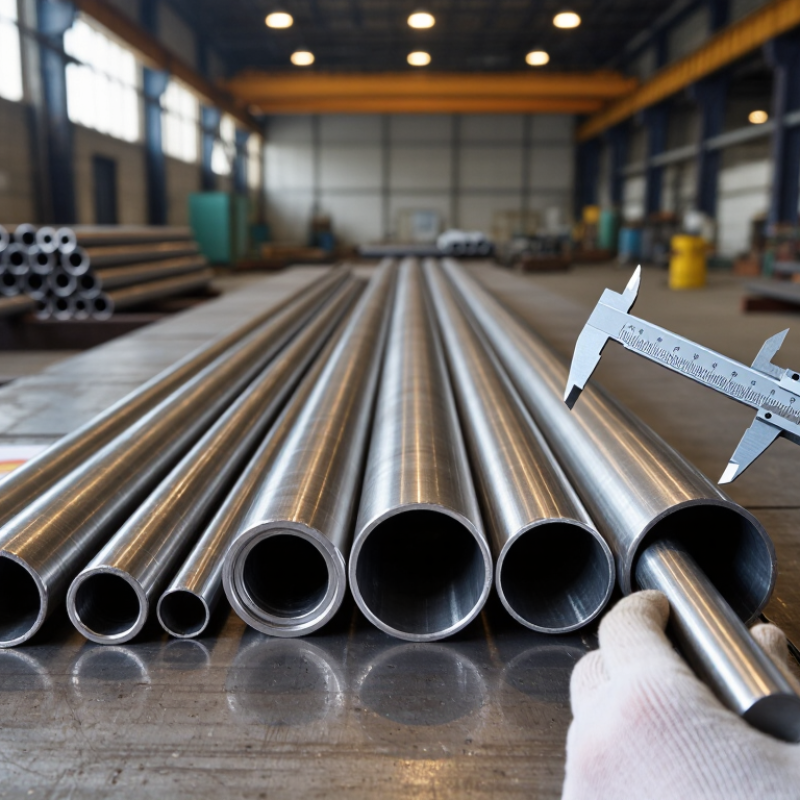
Start with the actual service conditions, not only the required tube diameter. Record operating pressure, surge pressure, temperature range, and pressure cycles. Wall thickness must consider stress, corrosion allowance, manufacturing tolerance, and the project’s safety factor. High temperatures can reduce strength and toughness. Low temperatures may increase brittleness. A tube suitable for water service may fail in a hot, pressurized process line.
Identify the medium carefully. Water, steam, oil, chlorides, hydrogen, and sour environments create different risks. Check corrosion rates, chemical concentration, flow velocity, and possible contamination. Then define the design life, such as 20 or 30 years, including startup cycles and shutdowns. Ask a qualified engineer to verify the material grade and applicable design code. Review heat treatment, impact testing, dimensional inspection, and traceable mill certificates. I have seen specifications fail because they described normal conditions but ignored short pressure spikes. Real projects are rarely perfect.
How to Choose the Right Seamless Steel Tube in 2026?
ASTM A106 Grade B is a practical choice for high-temperature service. Its minimum tensile strength is 415 MPa, while minimum yield strength is commonly specified at 240 MPa under ASTM A106/A106M. These values describe mechanical capacity, not complete service performance. Design temperature, pressure, corrosion allowance, and wall thickness still control the decision. A 415 MPa figure can look reassuring. It is only one line on the mill certificate.
In field inspections, I would match the grade with traceable heat numbers, chemical composition, and test results. ASME B31.3 design rules should guide process piping checks. The World Steel Association reported about 1.89 billion tonnes of crude steel production in 2023. That scale does not guarantee consistent tube quality. Manufacturing route and inspection discipline still matter. The International Energy Agency also identifies steelmaking as responsible for roughly 8% of global energy-related emissions, so avoiding oversized tubes can reduce material waste. I may be too cautious here, but cheaper material is not always lower-cost engineering.
Tips: Confirm the certificate states 415 MPa minimum tensile strength. Check yield strength, elongation, dimensions, and hydrostatic test records. Compare the specified wall with measured thickness at several points. Request ultrasonic inspection for critical lines. Do not select Grade B from tensile strength alone. Temperature changes everything.
How to Choose the Right Seamless Steel Tube in 2026?
Selecting diameter and wall thickness should begin with ASME B36.10M, not a supplier’s stock list. The standard separates nominal pipe size from actual outside diameter. For example, NPS 2 has a 2.375-inch outside diameter. Schedule 40 uses a 0.154-inch wall, while Schedule 80 uses 0.218 inches. That difference changes internal flow area, weight, pressure capacity, and corrosion allowance.
Pressure calculations still control the decision. Consider design pressure, temperature, fluid density, corrosion rate, and external loading. A larger diameter can reduce friction loss, but it may increase support loads and installation costs. A thicker wall improves resistance, yet it reduces flow area. The table looks definitive. It is not.
The World Steel Association’s World Steel in Figures 2024 reports 1,888.2 million tonnes of crude steel production in 2023. Such scale makes traceability essential. Request heat numbers, mechanical test results, dimensional inspection records, and the applicable material specification. For process lines, compare the selected dimensions with ASME B31.3 design calculations. For structural or low-pressure service, the same schedule may be excessive. In field reviews, dimensional misunderstandings appear often. A “two-inch tube” can still require precise OD and wall verification. Even experienced teams miss this step.
Choosing a seamless steel tube in 2026 requires more than checking grade and price. The World Steel Association reported about 1.89 billion tonnes of crude steel production in 2023. Such scale can hide uneven process control. OECD Steel Market Developments estimated global excess capacity could reach roughly 630 million tonnes by 2026. Traceability matters.
Ask for ISO 10893 non-destructive testing records, not only a certificate. Ultrasonic testing can reveal longitudinal flaws, laminations, and wall-thickness variation. Eddy-current testing can detect near-surface discontinuities. Automated equipment should show calibration blocks, sensitivity settings, scan coverage, and operator qualification. Inspect the report beside the tube bundle. Heat numbers should match.
Hydrostatic testing adds a different safeguard. It challenges pressure containment across the full tube length. Check the test pressure, holding time, medium, temperature, and permanent deformation record. The acceptance criteria must match the purchase specification and service design. A passing result does not replace NDT; it confirms a separate risk.
No test is perfect. I would also request mill certificates, dimensional readings, and random witness inspection. A clean report can still be incomplete. ISO 10893 supports consistent examination, but it does not choose the correct tube for your application. That decision still depends on pressure, temperature, corrosion allowance, and installation loads.
How to Choose the Right Seamless Steel Tube in 2026?
A tube is not cheap when it fails inside a running plant. In field inspections, corrosion often begins beneath insulation, near welds, or inside stagnant elbows. The NACE IMPACT study estimated global corrosion costs at 2.5 trillion dollars annually, equal to about 3.4% of global GDP. That figure is dated, but still useful. It shows why corrosion allowance deserves engineering attention.
Do not add thickness blindly. Match the allowance to the fluid, temperature, pressure, and expected service life. A two-millimeter allowance may protect carbon steel in mild service. It may disappear quickly in wet, acidic conditions. Design data, corrosion coupons, and previous inspection records provide stronger evidence than habit. Sometimes, the old specification is simply wrong.
Traceability also affects total cost. EN 10204 3.1 certification links chemical analysis, mechanical tests, heat numbers, and dimensions to the supplied tube. Verify that certificate details match markings on each bundle. The manufacturer’s authorized inspection representative must validate the results independently from production. Missing records can delay commissioning or trigger replacement costs. The World Bank’s Commodity Markets Outlook has repeatedly shown that steel prices remain volatile, so purchase price alone is unreliable. Compare material cost, inspection effort, coating, installation, downtime, and future replacement. A cheaper tube can become an expensive decision. Evidence matters more than confident assumptions.


For those larger-sized parts, or smaller quantity runs, we have 2 independent powder coat booths and ovens. The quality, durability and affordability of today’s powder coating finishes make this the process of choice for world-class companies.
Powder coating advantages over other forms of coating are many. Materials used in the Powder coating process can be metals and non-metals that come in a multitude of thicknesses, textures, colors, etc. Another of Powder coating’s biggest advantages over conventional coatings is its ability to create finishes in many different textures. Powder Coating Booths allow us the ability to apply these advantages to large products.
Tri-State Fabricators runs a full-service conveyor line for painting. Wet painting can provide protection or decoration to many different part styles. From start to finish, every project is easier to undergo random and point-based inspection by our skilled painting team.
Advantages to our Wet Paint Line are these lines start with product prep and ends with a thorough inspection of a high quality finished product. Our ability to complete large and small projects with a superior finish and doing so in a timely and economical fashion. This passes along the savings in production to our customers. When powder coating ins not an option, our Wet Paint Line gets the job done right the first time.
When the parts get big and heavy we roll-out our custom paint racks and oversize booth. By utilizing our partnerships with all the major paint brands, we can match virtually any color with wet paint.
The advantages of having access to a Wet Paint Booth are many. Large projects of many different shapes can be loaded into the booth. The Wet Paint Booth offers an environment that is much more controlled than a typical parts painting operation.
Not only are they used because of their controlled environment, but they’re are also advantageous when it comes to applying paint to parts that are needed in industries that require specialty coatings such as medical, aerospace, etc.
Our military forces have some very high standards when it comes to the finish of their vehicles and equipment. From the first pre-treatment step to final coat, it takes a great deal of knowledge and experience to protect the men and women of our armed forces. They deserve only the best, and Tri-State Fabricators provides it.
All of our processes are closely monitored by our staff and management teams. Both of which are highly trained in the processes of metal fabrication and finishing. Tri-State Fabricators’ goal is to always fully satisfy each and every customer, including the military. We will always put a 110% into what we do.
Abrasive media blasting is an excellent way to remove old paint, rust, and increase the paint/powder adhesion. Glass beads produce a much smoother and brighter finish than angular abrasives; leaving the part clean yet without any dimensional change. Chemically inert and environmentally friendly, we can recycle our beads approximately 30 times; making them a more preferred method of metal cleaning or surface finishing.
Advantages to Glass Bead Blasting are many. Glass bead blast media is used when a project is needing rough surfaces need to become smooth for applications of coatings such as paint. It is typically used to clean paint and rust from a product surface without deforming the surface it is being used on. Overall, compared to many other blasting media, Glass Bead Blasting is a very economical choice and those savings are always passed on to our customers.
Tri-State Fabricators utilize a zinc phosphate wash to clean and etch the material to ensure the best paint adhesion possible. The unique design of our 3-stage wash system does the work like a 5-stage. From Cleaning and rinsing to conversion coating and post-treatment, Our Part Washing process is a complete service and works throughout the fabrication service and the finishing service.
Along with the previously mentioned benefits, Curing is a vital chemical reaction that leaves the product finish hard and relatively safe from mild abrasion and aggressive corrosion. This process can be done in more than one way; ambient air-dry or in curing ovens at temps that exceed 240°.
From fixing paint mistakes (someone else’s of course) to simply cleaning our paint line hooks, our burn-off oven is put to good use. After a quick burn-off, a little clean up, and a fresh coat of paint, your parts will look better than new.
Why does our Burn-Off Oven work so well? Because super heating the air around parts turns the materials into ashes. From paint and powder coatings to rubber and machining oils, high temps do the job without degrading the integrity of the part.
Masking is a vital part of producing high quality products. We have die-cut masking patterns to protect machined surfaces as well as a wide range of plugs and caps to protect threaded holes and bolts. We provide permanent and temporary masking.
Masking allows the selected sections of a product to be protected from a fabrication or finishing service. This can be with both chemicals when etching and tapes, paints when only finishing just a section of the product. Masking is great in aiding the customization process of a project.
Screen printing is a photographic process that transfers artwork onto a porous nylon screen which allows colored ink to flow through the screen and be deposited on an aluminum or plastic component. We can generally have just about any design created onto a screen for your parts.
Some of the advantages of Screen Printing are, brand recognition for your business displaying on your products, assembly instructions, product warnings/hazards, etc. Tri-State Fabricators produces Screen Printing of the highest quality so you know it’s durable.
Metal Finishing is the art of treating the exterior portion of product, often metal but can also be made of other materials, so that the surface is clean and free of any debris. Then the process of applying coats or either paint of powder coat takes place. This coating process improves the quality of the product in both appearance and resistance to wear and corrosion.
Tri-State Fabricators, Inc., understands that a project typically isn’t complete until a high-quality finish has been added to your product. This is why our painting and powder coating teams continuously inspect the products throughout the Metal Finishing process.

