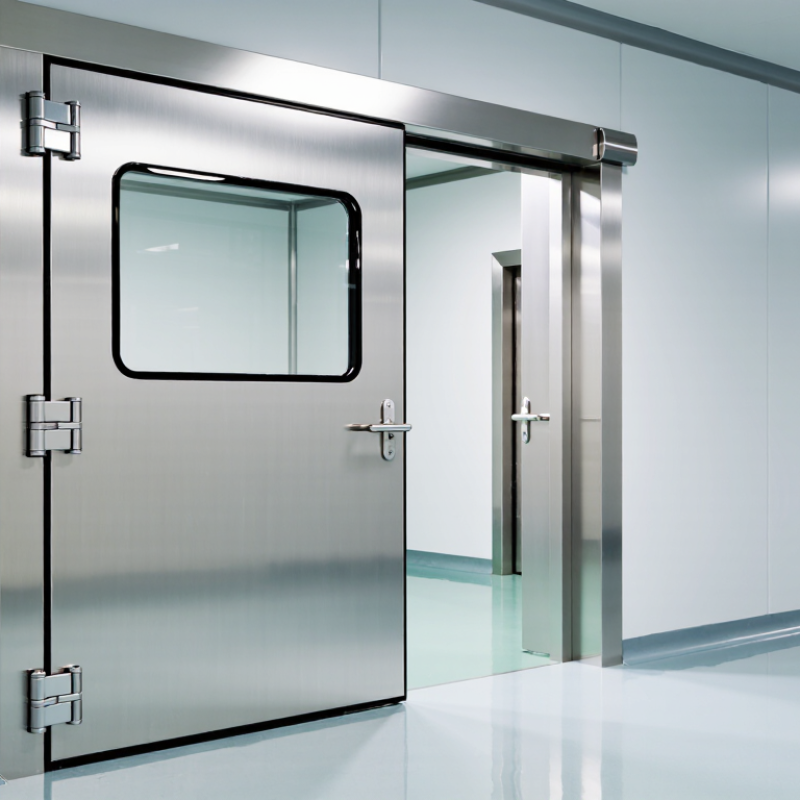
Cleanroom Swing Doors are designed to protect controlled environments from dust, microbes, pressure loss, and unnecessary air movement. They commonly use stainless steel, smooth laminates, or other cleanable surfaces. Their rounded edges reduce dirt traps. Sealed frames help limit leakage around the opening.
The operating principle is simple, but the details matter. When someone pushes the door open, hinges guide its movement and usually return it to a closed position. A gasket can compress against the frame, creating a tighter barrier. Some systems include vision panels, interlocks, or automatic closers. These features help staff observe nearby areas and reduce accidental door conflicts.
Cleanroom performance depends on more than the door itself. Pressure differentials, airflow patterns, installation quality, and maintenance all influence results. A well-sealed door cannot correct poor room design. That point is easy to overlook. Facility engineers often inspect hinges, seals, handles, and closing speed during routine qualification work. They may also check whether the door opens against the intended pressure direction.
There is no universal swing-door specification. A pharmaceutical suite may require different materials and controls than an electronics assembly room. The correct choice should match the room classification, cleaning chemicals, traffic volume, and safety requirements. Designers should review applicable standards and manufacturer data before installation. Even then, real-world use can reveal problems, such as slow closing or damaged seals. Continuous observation remains essential.
Cleanroom swing doors are hinged doors designed to control movement between spaces with different cleanliness levels. They commonly use smooth, non-shedding surfaces that tolerate repeated cleaning. Their frames fit tightly against wall panels, while gaskets reduce uncontrolled air leakage around the edges. Some models include flush vision panels, allowing staff to check the next room before opening.
The operation is simple but carefully controlled. A user pushes or pulls the door through its swing path, and hinges guide it back toward the closed position. A closer may complete this movement slowly, preventing sudden pressure changes and accidental impacts.
In higher-control areas, an interlock prevents two connected doors from opening together. This helps protect room pressure and reduces unnecessary air exchange.
Cleanroom swing doors are not magic barriers. Their performance depends on correct installation, seal condition, cleaning methods, and user behavior. Even a small gap under the door can weaken the room’s pressure balance. In practice, operators should inspect hinges, latches, gaskets, and viewing panels regularly. Door traffic also matters. Frequent opening can carry particles into a controlled area, even when the door itself is well designed. The details are easy to overlook. That is where many problems begin.
Cleanroom swing doors are built to control movement, air leakage, and contamination between controlled areas. Their construction usually starts with a rigid metal skin surrounding an insulated, low-shedding core. Stainless steel or coated steel provides a smooth surface that tolerates frequent cleaning. Welded or sealed joints reduce dirt traps around the frame. The details matter. Flush faces are easier to wipe than decorative profiles. A small, poorly sealed gap can still disturb room pressure.
Key components include hinges, a door closer, a latch, perimeter gaskets, and a vision panel. Hinges must support repeated cycles without creating excessive movement. The closer returns the leaf to its sealed position, while the latch keeps compression consistent. Flexible gaskets fill the contact line between door and frame. Many designs include a narrow, impact-resistant window for safer visibility. Some doors also use kick plates, automatic operators, or access controls, depending on the room’s workflow.
In operation, a user pushes or pulls the door through its swing path. The closer then guides it back against the frame, compressing the gasket. This action helps maintain pressure differences and limits uncontrolled airflow. However, a cleanroom door is not a complete contamination solution. Poor installation, damaged seals, or careless traffic can weaken performance. In practice, door selection should reflect trolley size, cleaning chemicals, opening frequency, and maintenance skill. A technically strong door may still fail when the surrounding frame is uneven. That is worth checking.
Cleanroom swing doors control movement between areas with different cleanliness levels. They usually have a rigid, smooth panel, sealed edges, and corrosion-resistant hardware. The door opens when a person pushes the handle or activates an approved access control device. Hinges then guide the panel through a controlled arc. A closer returns it to the frame without requiring another touch.
The sealing action matters more than the swing itself. As the panel closes, its edges meet compression gaskets around the frame. These gaskets limit uncontrolled air leakage and reduce the entry of particles. Many cleanrooms also use interlocks. One door must close before another can open. This simple sequence protects pressure differences and discourages rushed traffic. Airflow still depends on room design, filtration, and pressure control.
Operators should move slowly and check the door after every passage. A partly open door can disrupt airflow within seconds. In daily inspections, technicians look for damaged seals, loose hinges, and delayed closing. Small gaps are easy to overlook. That is where practice can fail. A door may appear clean but still leak around its lower edge. Regular cleaning, functional testing, and documented maintenance provide stronger evidence than appearance alone.
Cleanroom swing doors support airflow control by limiting uncontrolled air exchange between adjacent spaces. They usually include a rigid door leaf, perimeter seals, hinges, and a self-closing mechanism. Some systems also use interlocking controls, preventing two connected doors from opening together. This creates a practical airlock effect. Small gaps matter.
In practice, the door works with the room’s pressure cascade, not alone. EU GMP Annex 1 identifies 10 Pa as a guidance value between adjacent rooms of different grades. When the door opens, pressure temporarily equalizes and air turbulence can carry particles across the threshold. Operators should therefore minimize opening time and avoid blocking the closing path. A poor seal can quietly defeat an otherwise well-designed ventilation system.
ISO 14644-1:2015 sets a maximum concentration of 3,520 particles per cubic meter at 0.5 micrometers for an ISO Class 5 environment. The limit rises to 352,000 particles for ISO Class 7. These figures show why door movement and cleaning routines require control. Door surfaces, handles, hinges, and floor-level edges need documented inspection. A self-closing door is helpful, but it is not contamination-proof. That assumption deserves review. Performance testing should include leakage checks, pressure monitoring, and airflow visualization under realistic traffic conditions.
| Data Dimension | Typical Specification or Characteristic | How It Works | Contamination-Control Relevance |
|---|---|---|---|
| Door Definition | A hinged personnel or material door designed for controlled environments. | The door leaf rotates around vertical hinges and closes against a frame fitted with seals or gaskets. | A controlled closing interface limits uncontrolled air exchange and helps maintain the room’s cleanliness conditions. |
| Common Door Configuration | Single-leaf or double-leaf swing construction; single-leaf doors are common for personnel access. | Double-leaf doors can provide a wider clear opening for carts, equipment, or larger loads. | The configuration should match traffic volume, equipment size, and the required cleanroom zoning strategy. |
| Typical Construction Materials | Powder-coated or stainless steel surfaces, insulated cores, flush panels, and corrosion-resistant hardware. | Smooth, non-shedding surfaces are formed to reduce exposed joints, ledges, and areas where particles can accumulate. | Non-porous and cleanable materials support routine disinfection and reduce particle retention. |
| Surface Design | Flush door faces, radiused edges where practical, sealed joints, and minimal projecting hardware. | The door is designed to eliminate or reduce recesses that are difficult to wipe or disinfect. | Simplified geometry lowers the risk of residue buildup and makes cleaning more repeatable. |
| Sealing System | Perimeter gaskets or compression seals are commonly installed around the frame and door leaf. | When the door closes, the gasket compresses against the mating surface and reduces leakage paths. | Effective sealing helps prevent uncontrolled infiltration from adjacent areas, although it does not make the door completely airtight. |
| Airflow Function | The door supports airflow control but does not independently regulate room airflow. | Room pressure, supply air, return air, and exhaust systems establish the pressure and airflow pattern; the closed door helps preserve that condition. | Correct door installation complements the HVAC design and helps maintain the intended pressure cascade. |
| Pressure Cascade | Many facilities use a positive-pressure cascade from cleaner spaces toward less-clean spaces; some containment areas use negative pressure. | Air moves through intentional transfer paths from higher pressure to lower pressure when the door is closed or opened. | The pressure direction should be selected according to whether the primary objective is product protection or containment of hazardous materials. |
| Typical Pressure Differential | Project values are commonly specified in the low-Pascal range, often approximately 5–15 Pa between adjacent zones. | The building-management or HVAC system maintains the differential; door leakage and opening events temporarily disturb it. | The exact value must be established by the facility’s validated design, risk assessment, and applicable regulations. |
| Door Opening Direction | Opening direction is selected according to pressure relationships, life-safety rules, workflow, and containment requirements. | Pressure forces can make a door easier or harder to open depending on the direction of the pressure differential and the door area. | Correct planning reduces accidental pressure loss and supports safe, unidirectional movement of personnel and materials. |
| Self-Closing Mechanism | Hydraulic, pneumatic, or mechanical closers are commonly used. | The closer returns the door to the closed position after passage without requiring manual handling. | Fast and reliable closure reduces the time that contaminated or unfiltered air can migrate between zones. |
| Vision Panel | Flush, sealed glazing may be incorporated for visibility between adjacent areas. | Personnel can check the opposite side before opening, reducing unnecessary door cycles and collision risks. | Fewer unnecessary openings help stabilize pressure and reduce particle transfer caused by traffic. |
| Interlocking Option | Doors serving airlocks or change rooms may be connected to an access-control interlock system. | One door remains locked or unavailable while the other door is open, subject to the control sequence. | Interlocking prevents direct simultaneous openings that could cause a rapid pressure disturbance between zones. |
| Airlock Application | Two or more doors can form a personnel, material, or pass-through airlock. | The airlock creates a buffer space between areas with different cleanliness or pressure requirements. | Airlocks reduce direct cross-contamination and help separate gowning, production, storage, and exit activities. |
| Traffic Control | Access is typically limited to trained personnel and authorized material movements. | Procedures control who opens the door, how long it remains open, and the sequence of entry and exit. | Operational discipline is essential because frequent or prolonged openings can defeat the benefits of the door design. |
| Cleanroom Classification | Suitability is evaluated against the required cleanliness classification, such as ISO classifications defined by ISO 14644-1. | The door forms part of the room envelope and is assessed together with HVAC, filtration, finishes, and operating procedures. | A door alone cannot establish an ISO cleanroom classification; the complete facility must meet the required airborne-particle limits. |
| Cleaning Compatibility | Materials and sealants should tolerate the facility’s approved detergents, disinfectants, and cleaning frequency. | Compatible surfaces maintain their integrity when repeatedly wiped or chemically disinfected. | Material compatibility prevents flaking, corrosion, swelling, and degradation that could generate particles or harbor microorganisms. |
| Threshold Design | Flush or low-profile thresholds may be used where permitted by the room layout and safety requirements. | A reduced threshold profile improves cleanability and allows carts or equipment to pass with less vibration. | Thresholds should not create inaccessible dirt traps or interfere with the required seal and pressure-control strategy. |
| Leakage Consideration | Leakage depends on gasket compression, frame installation, door alignment, hardware condition, and pressure difference. | Any gap around the closed door becomes a potential path for unintended air movement. | Periodic inspection and adjustment help preserve the designed airflow direction and reduce contamination migration. |
| Maintenance Checks | Routine checks typically include hinges, closer speed, latch engagement, gasket condition, alignment, and surface damage. | Maintenance keeps the door closing fully and ensures that seals remain continuous and resilient. | Preventive maintenance reduces particle generation, door-drift events, pressure instability, and unplanned downtime. |
| Validation and Testing | Testing may include visual inspection, pressure-difference verification, airflow visualization, particle monitoring, and door-operation checks. | Testing confirms that the installed door operates as part of the complete environmental-control system. | Performance should be verified during commissioning and periodically according to the facility’s quality program and risk assessment. |
| Main Limitation | A swing door is not a substitute for filtration, ventilation, pressure control, or proper personnel procedures. | Its contribution is primarily mechanical containment, controlled access, and reduction of uncontrolled air exchange. | Effective contamination prevention requires the door, HVAC system, cleaning program, gowning practices, and user behavior to work together. |

Cleanroom swing doors control movement while protecting pressure, airflow, and particle limits. Common types include single-leaf, double-leaf, manual, and automatic models. Flush, sealed surfaces reduce dust traps. Vision panels improve safety without opening the door. In pharmaceutical areas, interlocked doors help prevent two openings at once. ISO 14644-1:2015 classifies ISO 5 environments at no more than 3,520 particles per cubic metre at 0.5 micrometres. A poorly sealed door can compromise that target quickly.
Their uses vary across pharmaceutical, medical-device, food, and laboratory facilities. Doors should support the room’s pressure cascade, not replace filtration or cleaning controls. EU GMP Annex 1, published in 2022, gives 10 pascals as a guidance value between rooms of different grades. In field inspections, the hinge side often fails before the panel. Inspectors should check gaskets, closers, latches, sweeps, and frame joints. A clean appearance is not proof of tightness. That assumption deserves more doubt.
Tips: Wipe doors with approved, low-lint materials. Do not spray liquid directly into hinges or sensors. Check closing speed and latch engagement weekly. Record damaged seals immediately. Use calibrated pressure and particle instruments during qualification. Maintenance intervals should follow traffic volume, room classification, and risk assessment. High-use doors may need monthly hardware checks, although fixed schedules can miss real operating problems. Observe the door during busy shifts, not only during inspections.


For those larger-sized parts, or smaller quantity runs, we have 2 independent powder coat booths and ovens. The quality, durability and affordability of today’s powder coating finishes make this the process of choice for world-class companies.
Powder coating advantages over other forms of coating are many. Materials used in the Powder coating process can be metals and non-metals that come in a multitude of thicknesses, textures, colors, etc. Another of Powder coating’s biggest advantages over conventional coatings is its ability to create finishes in many different textures. Powder Coating Booths allow us the ability to apply these advantages to large products.
Tri-State Fabricators runs a full-service conveyor line for painting. Wet painting can provide protection or decoration to many different part styles. From start to finish, every project is easier to undergo random and point-based inspection by our skilled painting team.
Advantages to our Wet Paint Line are these lines start with product prep and ends with a thorough inspection of a high quality finished product. Our ability to complete large and small projects with a superior finish and doing so in a timely and economical fashion. This passes along the savings in production to our customers. When powder coating ins not an option, our Wet Paint Line gets the job done right the first time.
When the parts get big and heavy we roll-out our custom paint racks and oversize booth. By utilizing our partnerships with all the major paint brands, we can match virtually any color with wet paint.
The advantages of having access to a Wet Paint Booth are many. Large projects of many different shapes can be loaded into the booth. The Wet Paint Booth offers an environment that is much more controlled than a typical parts painting operation.
Not only are they used because of their controlled environment, but they’re are also advantageous when it comes to applying paint to parts that are needed in industries that require specialty coatings such as medical, aerospace, etc.
Our military forces have some very high standards when it comes to the finish of their vehicles and equipment. From the first pre-treatment step to final coat, it takes a great deal of knowledge and experience to protect the men and women of our armed forces. They deserve only the best, and Tri-State Fabricators provides it.
All of our processes are closely monitored by our staff and management teams. Both of which are highly trained in the processes of metal fabrication and finishing. Tri-State Fabricators’ goal is to always fully satisfy each and every customer, including the military. We will always put a 110% into what we do.
Abrasive media blasting is an excellent way to remove old paint, rust, and increase the paint/powder adhesion. Glass beads produce a much smoother and brighter finish than angular abrasives; leaving the part clean yet without any dimensional change. Chemically inert and environmentally friendly, we can recycle our beads approximately 30 times; making them a more preferred method of metal cleaning or surface finishing.
Advantages to Glass Bead Blasting are many. Glass bead blast media is used when a project is needing rough surfaces need to become smooth for applications of coatings such as paint. It is typically used to clean paint and rust from a product surface without deforming the surface it is being used on. Overall, compared to many other blasting media, Glass Bead Blasting is a very economical choice and those savings are always passed on to our customers.
Tri-State Fabricators utilize a zinc phosphate wash to clean and etch the material to ensure the best paint adhesion possible. The unique design of our 3-stage wash system does the work like a 5-stage. From Cleaning and rinsing to conversion coating and post-treatment, Our Part Washing process is a complete service and works throughout the fabrication service and the finishing service.
Along with the previously mentioned benefits, Curing is a vital chemical reaction that leaves the product finish hard and relatively safe from mild abrasion and aggressive corrosion. This process can be done in more than one way; ambient air-dry or in curing ovens at temps that exceed 240°.
From fixing paint mistakes (someone else’s of course) to simply cleaning our paint line hooks, our burn-off oven is put to good use. After a quick burn-off, a little clean up, and a fresh coat of paint, your parts will look better than new.
Why does our Burn-Off Oven work so well? Because super heating the air around parts turns the materials into ashes. From paint and powder coatings to rubber and machining oils, high temps do the job without degrading the integrity of the part.
Masking is a vital part of producing high quality products. We have die-cut masking patterns to protect machined surfaces as well as a wide range of plugs and caps to protect threaded holes and bolts. We provide permanent and temporary masking.
Masking allows the selected sections of a product to be protected from a fabrication or finishing service. This can be with both chemicals when etching and tapes, paints when only finishing just a section of the product. Masking is great in aiding the customization process of a project.
Screen printing is a photographic process that transfers artwork onto a porous nylon screen which allows colored ink to flow through the screen and be deposited on an aluminum or plastic component. We can generally have just about any design created onto a screen for your parts.
Some of the advantages of Screen Printing are, brand recognition for your business displaying on your products, assembly instructions, product warnings/hazards, etc. Tri-State Fabricators produces Screen Printing of the highest quality so you know it’s durable.
Metal Finishing is the art of treating the exterior portion of product, often metal but can also be made of other materials, so that the surface is clean and free of any debris. Then the process of applying coats or either paint of powder coat takes place. This coating process improves the quality of the product in both appearance and resistance to wear and corrosion.
Tri-State Fabricators, Inc., understands that a project typically isn’t complete until a high-quality finish has been added to your product. This is why our painting and powder coating teams continuously inspect the products throughout the Metal Finishing process.