

Choosing a Uv Coating Curing Machine is not just a matter of comparing lamp power or conveyor speed. The right system must match the coating chemistry, substrate, line width, and production pace. A thin varnish on a flat carton may cure differently from a heavier coating on a heat-sensitive plastic sheet. Small differences matter.
A practical principle for this guide, expressed in the voice of a fictional process specialist, Alex Morgan: “Choose for the coating and substrate you actually run, not the machine specification that looks strongest on paper.” This is an editorially created quote, not a statement from a verified industry expert. It points to a common purchasing risk: a powerful lamp cannot compensate for poor process matching.
The sections ahead will examine UV source type, curing width, conveyor controls, cooling, maintenance access, and supplier support. Ask for test results using your own coating and material. Check whether the finish remains tack-free, adheres well, and tolerates the next production step. Look closely at the edges. A glossy surface can still hide uneven curing.
There is no perfect specification. Production conditions change, and supplier claims deserve practical testing. A careful trial may take longer than expected. It is still worth doing.
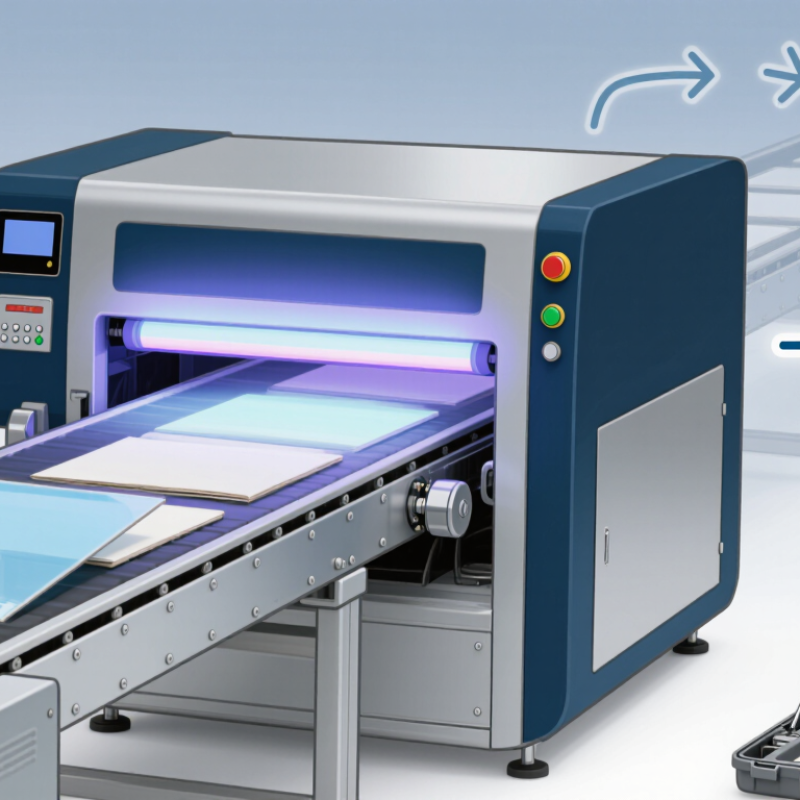
Start with the coating, not the machine. Check its technical data for the UV wavelength range, required dose, and recommended exposure time. A coating that feels dry may still be undercured beneath the surface. Ask the supplier for test conditions, then verify them on your own line. Small differences matter.
Next, consider the substrate. Paper, plastic film, wood, and metal reflect and absorb UV light differently. A glossy plastic sheet may heat up quickly, while a textured wooden panel can leave shadows in recessed areas. Test a representative sample, including its thickest or most detailed section. Watch for poor adhesion, surface tack, discoloration, or warping. Not every test will be clean.
Production speed shapes the choice, too. Note the line speed, working width, shift length, and space available around the conveyor. The curing unit must deliver enough energy at the actual operating speed, not just in a showroom test. Consider ventilation, cooling, lamp maintenance, and how easily operators can monitor output. A rushed trial can miss defects. Keep records of settings and results; they make later adjustments more reliable.
Match the lamp to the coating’s photoinitiator, not just the machine’s advertised power. UV coatings respond to specific wavelengths; many UV-LED systems emit in narrow bands around 365, 385, 395, or 405 nm, while mercury lamps provide a broader spectrum. The U.S. Department of Energy’s 2022 Solid-State Lighting R&D Opportunities report describes LEDs as narrow-band sources, a distinction that matters when a coating’s initiator cannot absorb the lamp’s output. Check the coating supplier’s wavelength guidance, then verify it against the machine’s measured spectrum. A label saying “high intensity” is not enough.
Next, consider film thickness, line speed, and heat sensitivity. Shorter wavelengths may cure the surface while leaving deeper layers under-cured; thicker or pigmented coatings can make this more likely. Ask for irradiance and dose measurements at the actual working distance, not only at the lamp window. RadTech’s UV/EB technology guidance also emphasizes matching process conditions to the formulation. Test a real coated sample, then inspect the surface and adhesion after curing. It takes a little time. But a tack-free surface can still hide a weak cure, and I have seen that assumption waste production runs. Check the substrate temperature, too; some materials warp before the coating looks wrong.
How to Choose a UV Coating Curing Machine?
Compare Machine Types, Capacity, and Process Controls
Choose the curing method around the coating and production line, not just the machine’s rated power. Mercury-vapor lamps deliver broad-spectrum output and suit many established coatings. UV-LED systems provide narrower wavelengths, lower heat exposure, and instant switching, but only work well when the coating responds to their spectrum. Check the supplier’s measured irradiance and dose at the actual conveyor speed. A glossy test coupon proves little if a shadowed edge stays tacky. Small detail, big consequence.
Capacity means more than conveyor width. Match working width, line speed, and lamp coverage to the widest substrate you run. Ask for dose readings across the belt, including its center and edges, at both minimum and maximum speeds. MarketsandMarkets estimated the global UV-curable resins market at USD 5.3 billion in 2023, projecting USD 8.3 billion by 2028. This market estimate signals expanding use, but it does not guarantee that every coating or machine combination will perform reliably.
Process controls help make results repeatable. Look for adjustable power, speed interlocks, lamp-hour tracking, cooling alarms, and recorded process settings. For LED units, confirm wavelength compatibility; for mercury lamps, check cooling and reflector maintenance needs. Test your own coated material under production conditions, then inspect adhesion, gloss, and cure depth. A simple radiometer can reveal output drift before defects spread. Controls can still be mis-set, and operators need clear procedures. That part is easy to overlook.
Compare common UV curing machine configurations by typical use, throughput factors, and available process controls. Capacity and curing results depend on the coating, substrate, lamp configuration, and production settings; confirm requirements with curing trials.
| Machine type | Typical applications | Capacity considerations | Common process controls | Key advantages | Points to evaluate |
|---|---|---|---|---|---|
| Conveyorized UV system with mercury-vapor lamps | Continuous coating, printing, and finishing lines; compatible UV formulations | Throughput is primarily affected by conveyor speed, usable belt width, lamp power, and the number of curing zones. | Belt-speed adjustment, lamp power settings, exhaust or cooling monitoring, and optional UV-dose measurement | Suitable for continuous production and a broad range of conventional UV-curable materials | Requires attention to heat-sensitive substrates, lamp maintenance, ventilation, and compatible coating chemistry |
| Conveyorized UV LED system | Production lines using coatings formulated for the LED emission wavelength | Depends on LED irradiance, illuminated width, exposure time, lamp-to-part distance, and line speed. | LED output level, conveyor speed, temperature monitoring, and optional irradiance or dose verification | Instant on/off operation and generally lower infrared heat output than conventional mercury-vapor lamps | Confirm that the photoinitiator system responds to the LED wavelength and that the required dose reaches the full coating layer |
| Batch UV curing chamber | Small or varied production runs, parts that do not suit a conveyor, and laboratory or job-shop work | Batch size is limited by chamber dimensions, loading arrangement, lamp placement, and the need for even exposure. | Cycle timer, lamp power, interlocked door, cooling or exhaust monitoring, and recipe selection on some systems | Flexible for different part shapes and production quantities; does not require a continuous line | Check for shadowing, consistent part positioning, chamber ventilation, and repeatable loading procedures |
| UV flood-curing system | Flat panels, printed sheets, and multiple small parts presented together | Effective area and exposure time determine practical output; uniformity across the illuminated area should be verified. | Exposure timer, lamp intensity or power adjustment, work distance, and optional dose measurement | Can expose a broad area at once and accommodate items that are awkward to convey | Evaluate edge-to-center dose uniformity and whether parts need rotation or more than one exposure |
| Spot or focused UV curing system | Localized curing, small coated areas, assembly work, and precision applications | Output depends on spot size, irradiance at the work surface, exposure duration, and positioning accuracy. | Exposure timer, intensity setting, optical-head positioning, and optional foot-switch or automated triggering | Targets a limited area and can be integrated into manual or automated workstations | Not intended for broad-area curing; confirm spot coverage and avoid uneven results at the edges of the cured area |
| Requirement | What to confirm before purchase |
|---|---|
| Coating compatibility | Confirm the coating’s required UV wavelength range and curing dose with its technical data sheet or supplier. |
| Production rate | Estimate required parts per hour, exposure time, changeover time, and loading or unloading time. |
| Part size and geometry | Check usable curing area, clearance, part orientation, and whether recessed or shadowed surfaces need additional exposure. |
| Process verification | Ask how lamp output and delivered UV dose can be checked, recorded, and repeated during production. |
| Safety and facility needs | Review UV shielding, safety interlocks, ventilation, heat management, electrical supply, and maintenance access. |
Capacity figures should be established through trials using the actual coating, substrate, part geometry, and target cure criteria. UV dose is commonly expressed in mJ/cm², while irradiance is commonly expressed in W/cm² or mW/cm².
How to Choose a UV Coating Curing Machine?
Check the installation area before comparing lamp power. Measure the conveyor, service clearance, ceiling height, and distance to nearby heat-sensitive materials. Confirm the machine’s voltage, phase, and peak power draw against your electrical panel. Ask the supplier for ventilation and cooling requirements; a compact unit can still need substantial exhaust capacity. Record your existing line speed and coating width, then check that the proposed curing window matches both. Small mismatches matter.
Safety needs practical checks, not just a checkbox. The International Commission on Non-Ionizing Radiation Protection (ICNIRP) sets an actinic UV exposure limit of 30 J/m² over an eight-hour period. Use that benchmark when assessing shielding, interlocks, and operator access. Request measured irradiance data at the working distance, and verify that doors stop emission when opened. Also check lamp replacement procedures and cooling-down time. These details are easy to overlook.
Tips: Bring photos and equipment dimensions to the site review. Ask for a trial using your actual coating and substrate. Compare cure results at your target line speed, and inspect the edges for tackiness. I’ve seen a technically suitable unit struggle because the exhaust duct clashed with an overhead beam. Leave room for maintenance, too. A neat layout today can become awkward after the first lamp change.
Check installation, safety, and compatibility with existing equipment.
Common UV LED peak wavelengths include 365, 385, 395, and 405 nm. Confirm that the selected machine’s output matches the coating manufacturer’s curing requirements. Before installation, also verify available space, electrical supply, ventilation, guarding, and integration with the existing conveyor or production line. Use appropriate UV shielding and eye and skin protection.
When choosing a UV coating curing machine, compare total operating cost—not just the purchase price. Estimate electricity use across actual shifts, lamp or LED-module replacement, cooling, and rejected parts. Ask suppliers for measured power consumption at your required line speed and coating thickness. A machine that cures unevenly may waste coating and production time. Small costs add up.
Maintenance and supplier support affect uptime. Siemens’ 2024 True Cost of Downtime report found that unplanned downtime can cost large companies up to 11% of annual revenue. That figure is not specific to UV equipment, but it shows why response time matters. Check whether the supplier offers remote troubleshooting, stocked critical parts, operator training, and clear service intervals. Request references from facilities with similar coatings and operating hours. Some claims may look neat on a quote; real performance can be messier.
Tips: Ask for a written maintenance schedule and a sample cost-per-hour calculation. Confirm how quickly technical support responds, including outside standard business hours. Keep records of energy use, lamp hours, and cure-test results during your trial.


For those larger-sized parts, or smaller quantity runs, we have 2 independent powder coat booths and ovens. The quality, durability and affordability of today’s powder coating finishes make this the process of choice for world-class companies.
Powder coating advantages over other forms of coating are many. Materials used in the Powder coating process can be metals and non-metals that come in a multitude of thicknesses, textures, colors, etc. Another of Powder coating’s biggest advantages over conventional coatings is its ability to create finishes in many different textures. Powder Coating Booths allow us the ability to apply these advantages to large products.
Tri-State Fabricators runs a full-service conveyor line for painting. Wet painting can provide protection or decoration to many different part styles. From start to finish, every project is easier to undergo random and point-based inspection by our skilled painting team.
Advantages to our Wet Paint Line are these lines start with product prep and ends with a thorough inspection of a high quality finished product. Our ability to complete large and small projects with a superior finish and doing so in a timely and economical fashion. This passes along the savings in production to our customers. When powder coating ins not an option, our Wet Paint Line gets the job done right the first time.
When the parts get big and heavy we roll-out our custom paint racks and oversize booth. By utilizing our partnerships with all the major paint brands, we can match virtually any color with wet paint.
The advantages of having access to a Wet Paint Booth are many. Large projects of many different shapes can be loaded into the booth. The Wet Paint Booth offers an environment that is much more controlled than a typical parts painting operation.
Not only are they used because of their controlled environment, but they’re are also advantageous when it comes to applying paint to parts that are needed in industries that require specialty coatings such as medical, aerospace, etc.
Our military forces have some very high standards when it comes to the finish of their vehicles and equipment. From the first pre-treatment step to final coat, it takes a great deal of knowledge and experience to protect the men and women of our armed forces. They deserve only the best, and Tri-State Fabricators provides it.
All of our processes are closely monitored by our staff and management teams. Both of which are highly trained in the processes of metal fabrication and finishing. Tri-State Fabricators’ goal is to always fully satisfy each and every customer, including the military. We will always put a 110% into what we do.
Abrasive media blasting is an excellent way to remove old paint, rust, and increase the paint/powder adhesion. Glass beads produce a much smoother and brighter finish than angular abrasives; leaving the part clean yet without any dimensional change. Chemically inert and environmentally friendly, we can recycle our beads approximately 30 times; making them a more preferred method of metal cleaning or surface finishing.
Advantages to Glass Bead Blasting are many. Glass bead blast media is used when a project is needing rough surfaces need to become smooth for applications of coatings such as paint. It is typically used to clean paint and rust from a product surface without deforming the surface it is being used on. Overall, compared to many other blasting media, Glass Bead Blasting is a very economical choice and those savings are always passed on to our customers.
Tri-State Fabricators utilize a zinc phosphate wash to clean and etch the material to ensure the best paint adhesion possible. The unique design of our 3-stage wash system does the work like a 5-stage. From Cleaning and rinsing to conversion coating and post-treatment, Our Part Washing process is a complete service and works throughout the fabrication service and the finishing service.
Along with the previously mentioned benefits, Curing is a vital chemical reaction that leaves the product finish hard and relatively safe from mild abrasion and aggressive corrosion. This process can be done in more than one way; ambient air-dry or in curing ovens at temps that exceed 240°.
From fixing paint mistakes (someone else’s of course) to simply cleaning our paint line hooks, our burn-off oven is put to good use. After a quick burn-off, a little clean up, and a fresh coat of paint, your parts will look better than new.
Why does our Burn-Off Oven work so well? Because super heating the air around parts turns the materials into ashes. From paint and powder coatings to rubber and machining oils, high temps do the job without degrading the integrity of the part.
Masking is a vital part of producing high quality products. We have die-cut masking patterns to protect machined surfaces as well as a wide range of plugs and caps to protect threaded holes and bolts. We provide permanent and temporary masking.
Masking allows the selected sections of a product to be protected from a fabrication or finishing service. This can be with both chemicals when etching and tapes, paints when only finishing just a section of the product. Masking is great in aiding the customization process of a project.
Screen printing is a photographic process that transfers artwork onto a porous nylon screen which allows colored ink to flow through the screen and be deposited on an aluminum or plastic component. We can generally have just about any design created onto a screen for your parts.
Some of the advantages of Screen Printing are, brand recognition for your business displaying on your products, assembly instructions, product warnings/hazards, etc. Tri-State Fabricators produces Screen Printing of the highest quality so you know it’s durable.
Metal Finishing is the art of treating the exterior portion of product, often metal but can also be made of other materials, so that the surface is clean and free of any debris. Then the process of applying coats or either paint of powder coat takes place. This coating process improves the quality of the product in both appearance and resistance to wear and corrosion.
Tri-State Fabricators, Inc., understands that a project typically isn’t complete until a high-quality finish has been added to your product. This is why our painting and powder coating teams continuously inspect the products throughout the Metal Finishing process.