

Choosing an Anti Flammable Cabinet is a practical safety decision, not a matter of color or capacity alone. The right cabinet should suit the liquids stored, the quantities involved, and the way staff use them. A mismatch can leave important risks unaddressed.
The scale of workplace fire risk deserves attention. NFPA’s report Fires in Industrial and Manufacturing Properties, based on U.S. data from 2011–2015, estimated 37,910 fires annually in these properties. It also reported an average of 18 civilian deaths, 279 injuries, and $1.2 billion in direct property damage each year. These figures cover many fire causes; they do not mean flammable-liquid cabinets would prevent every incident. Still, they show why storage decisions belong in a broader fire-safety plan.
A useful comparison starts with cabinet capacity, construction, door design, labeling, and documented testing or listing. Check the manufacturer’s instructions and confirm that the cabinet is appropriate for the specific liquids and workplace conditions. OSHA’s flammable-liquids requirements in 29 CFR 1910.106 and NFPA 30 offer relevant technical references, but applicable requirements can vary by location and use. Small details matter. So does placement: a cabinet beside a heat source may undermine an otherwise careful choice. No cabinet replaces sound handling procedures, staff training, or routine inspection. That point is easy to overlook. The best selection is therefore one supported by product documentation, a realistic review of daily operations, and qualified safety advice where needed.
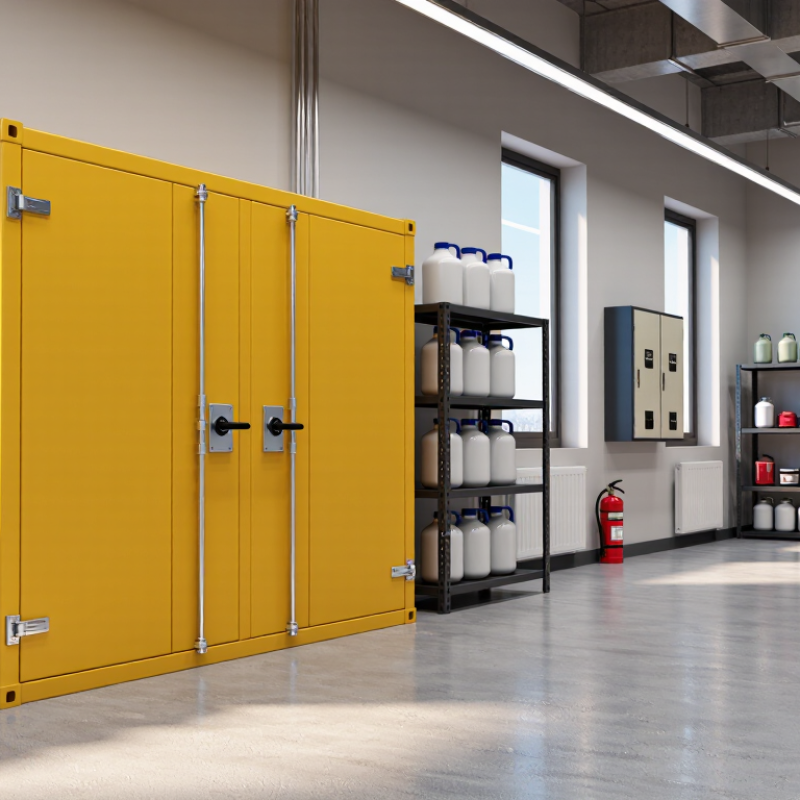
Before choosing a flammable-storage cabinet, list the materials it must contain. Record each product’s name, quantity, container type, and hazard information from its safety data sheet. Note whether it is a liquid, aerosol, or solvent-soaked material; these may need different storage arrangements. A label alone isn’t enough.
Match the cabinet to the actual hazards. Flammable liquids can release vapors that ignite near sparks, hot surfaces, or flames, so consider how much is stored and how containers will be closed. Check whether the cabinet’s construction and capacity suit the materials and container sizes. Oxidizers, corrosives, and reactive chemicals can create separate risks. Don’t assume one cabinet is suitable for every hazard.
Think about incompatibilities before grouping products. Keep chemicals apart when their safety data sheets warn against contact, and avoid placing containers where leaks could mix. Estimate peak storage, not just today’s inventory; a crowded shelf makes spills harder to spot and containers harder to remove. Keep frequently used items accessible, but don’t let convenience dictate unsafe placement. Review the cabinet maker’s specifications and applicable workplace guidance. It is easy to focus on the cabinet itself and overlook the substances inside—that deserves a second look.
Estimate capacity from the largest amount kept on site at one time, not the average weekly use. Record each container’s size and liquid category, then check the safety data sheet and cabinet rating. OSHA’s 29 CFR 1910.106 limits cabinets to 60 gallons of Category 1, 2, or 3 flammable liquids, or 120 gallons of Category 4 liquids. These are maximum limits, not practical fill targets. Keep room for safe handling. A modest spare-capacity margin can prevent overflow when deliveries arrive.
Choose a level, stable location near the work area, but away from heat, ignition sources, and busy walkways. Keep exits and electrical panels clear. NFPA 30 provides guidance for flammable-liquid storage; confirm its requirements alongside local fire codes and site procedures. Check that staff can open the cabinet fully and move containers without lifting them over other stock. A cabinet placed perfectly on paper can still be awkward in daily use. That detail is easy to miss. Recheck the location when workflows or inventory change.
When choosing an anti-flammable cabinet, compare its construction, materials, and tested fire performance—not just its color or capacity. NFPA’s report “Structure Fires in Industrial and Manufacturing Properties” estimated 37,910 fires annually in these properties from 2011 to 2015, causing about $1.2 billion in direct property damage each year. That broad industry figure is a reminder to assess storage risks carefully; it does not predict a specific cabinet’s performance.
Check the cabinet body, door, joints, and sill. OSHA’s construction criteria describe double-walled steel, at least 18-gauge sheet metal, and a 1.5-inch air space between walls. Look for secure seams, a raised liquid-retaining sill, and doors that close and latch reliably. For fire resistance, ask for documentation showing compliance with a recognized test or certification, such as UL 1275 or FM Approval Standard 6050. Test results matter. A heavy-looking cabinet alone proves little, and fire-test ratings should not be treated as a guarantee under every fire condition.
Tips: Compare the certification label with the manufacturer’s test documents. Check the door action and inspect seams for gaps. I still find labels easy to overlook; verify the exact model, not just the product family.
How to read this chart: EN 14470-1 classifies safety cabinets for flammable liquids by fire-resistance duration: Type 15, 30, 60, or 90 minutes. These are standardized test classifications—not guarantees of how long contents will remain safe in every real fire. Ratings apply to the tested cabinet as a complete assembly, so compare construction details such as double-walled steel, insulation, door-closing mechanisms, and spill-retaining sumps, and verify the cabinet’s certification and suitability for your local requirements.
How to Choose an Anti Flammable Cabinet?
Check Ventilation, Security, and Spill-Containment Features
Ventilation needs careful thought. A cabinet should not be vented automatically just because it has connection ports. Unapproved changes can affect its tested fire protection. Check the manufacturer’s instructions and confirm whether ventilation is needed for your specific materials and workspace. If a connection is required, use a compatible system installed as directed. Keep vents unobstructed.
Security matters, too. Choose a cabinet with a sturdy, easy-to-operate latch and a lock if access needs to be controlled. The door should close fully without forcing it. Check hinges and seals during routine inspections; a lock is less useful if the door does not sit properly. Keep the key accessible to authorized staff.
Spill containment should be practical, not just listed on a label. Look for a built-in sump that can catch leaks, and check that it is intact and accessible for cleanup. Store containers upright, with lids secure, and avoid overcrowding the shelves. Small drips are easy to overlook. I have found that busy teams can miss them, so a simple inspection routine helps. Match the cabinet’s capacity and construction to the containers being stored, and follow its care instructions.
| Feature | What to Check | Practical Guidance | Why It Matters |
|---|---|---|---|
| Intended liquid class and capacity | Confirm the cabinet is designed for the flammable or combustible liquids being stored, and check its stated capacity and applicable local requirements. | Under OSHA rules for covered workplaces, a cabinet may hold up to 60 gallons of Class I and Class II liquids combined, or up to 120 gallons of Class III liquids. Verify current local fire-code limits as well. | Storage limits depend on liquid classification, cabinet type, workplace rules, and local fire codes. |
| Cabinet construction | Look for a fire-resistant design, secure seams, and a door that closes and latches properly. Check the product documentation for applicable standards or certifications. | OSHA’s specified metal-cabinet construction includes at least 18-gauge sheet steel, double-wall construction with a 1½-inch air space, and a 2-inch raised bottom or liquid-tight sill. | Robust construction helps limit exposure of stored liquids to fire and helps contain leaks. |
| Ventilation | Check whether ventilation is required for the chemicals, workplace, or local authority. Inspect vent openings, plugs, and any connected exhaust system. | Do not assume a cabinet must be vented. If ventilation is needed, follow the cabinet manufacturer’s instructions and have the system designed and installed appropriately; do not modify the cabinet in a way that compromises its fire protection. | Improper venting can affect fire performance or spread hazardous vapors. Ventilation needs depend on the stored materials and site requirements. |
| Spill containment | Inspect the cabinet’s liquid-tight sump or raised bottom for damage, corrosion, debris, or signs of leakage. | OSHA’s metal-cabinet specification includes a 2-inch raised bottom or sill. Check the manufacturer’s stated sump volume and ensure it suits the quantity and containers stored. | Containment helps keep spills inside the cabinet and away from floors, drains, and ignition sources. |
| Door, latch, and closure | Open and close the door to confirm it moves freely and latches securely. Check self-closing features if required for the selected cabinet or applicable code. | Follow the cabinet instructions and local fire-code requirements; keep the door closed when the cabinet is not in use. | A properly closed and latched door supports the cabinet’s intended fire-protection performance. |
| Locking and access control | Check whether the cabinet has a lock, whether authorized staff can access it, and whether keys or access codes are controlled. | Choose a lock suited to the workplace’s security needs. Keep emergency access and safe handling procedures in mind. | Access control can reduce unauthorized handling, while practical access supports safe operations. |
| Labels and identification | Confirm hazard labels are visible and the cabinet is clearly identified for flammable-liquid storage. | Keep labels legible and consistent with the chemicals actually stored. Follow applicable workplace labeling rules. | Clear identification helps workers recognize hazards and follow handling procedures. |
| Placement and surroundings | Check the proposed location for heat, ignition sources, traffic, exits, drains, and access to emergency equipment. | Use the cabinet in a location and manner permitted by the manufacturer and local fire code. Keep aisles and required egress routes clear. | Suitable placement reduces exposure to ignition sources and avoids obstructing emergency access. |
Note: Requirements vary by jurisdiction, workplace, and the liquids being stored. Consult the current applicable fire code, occupational-safety rules, and cabinet manufacturer’s instructions before installation or use.
A cabinet’s label is only a starting point. Check its documentation for the applicable fire-safety standard, test information, and stated capacity. Requirements differ by location and by the liquids being stored, so confirm details with your facility’s safety lead or local authority. Match the cabinet’s intended use to the product labels and safety data sheets. A familiar shape is not proof of suitability. Keep the paperwork accessible.
Installation matters just as much. Set the cabinet on a stable, level surface, away from heat and likely impact. Follow the manufacturer’s instructions for clearances, ventilation, grounding, and anchoring; these details can vary by design. Keep doors and access routes clear. A cabinet that is awkward to reach may encourage unsafe workarounds. Check it in place, not just on a floor plan.
Build simple checks into routine work. Look for damaged seals, corrosion, blocked vents, and doors or latches that do not close smoothly. Small faults count. Never drill, alter, or repair safety features without approved guidance. Keep containers closed, compatible, and within the cabinet’s load limits. Record inspections and arrange prompt repairs when needed. A checklist can still miss a practical problem, so review the setup after changes in room use or stored materials.


For those larger-sized parts, or smaller quantity runs, we have 2 independent powder coat booths and ovens. The quality, durability and affordability of today’s powder coating finishes make this the process of choice for world-class companies.
Powder coating advantages over other forms of coating are many. Materials used in the Powder coating process can be metals and non-metals that come in a multitude of thicknesses, textures, colors, etc. Another of Powder coating’s biggest advantages over conventional coatings is its ability to create finishes in many different textures. Powder Coating Booths allow us the ability to apply these advantages to large products.
Tri-State Fabricators runs a full-service conveyor line for painting. Wet painting can provide protection or decoration to many different part styles. From start to finish, every project is easier to undergo random and point-based inspection by our skilled painting team.
Advantages to our Wet Paint Line are these lines start with product prep and ends with a thorough inspection of a high quality finished product. Our ability to complete large and small projects with a superior finish and doing so in a timely and economical fashion. This passes along the savings in production to our customers. When powder coating ins not an option, our Wet Paint Line gets the job done right the first time.
When the parts get big and heavy we roll-out our custom paint racks and oversize booth. By utilizing our partnerships with all the major paint brands, we can match virtually any color with wet paint.
The advantages of having access to a Wet Paint Booth are many. Large projects of many different shapes can be loaded into the booth. The Wet Paint Booth offers an environment that is much more controlled than a typical parts painting operation.
Not only are they used because of their controlled environment, but they’re are also advantageous when it comes to applying paint to parts that are needed in industries that require specialty coatings such as medical, aerospace, etc.
Our military forces have some very high standards when it comes to the finish of their vehicles and equipment. From the first pre-treatment step to final coat, it takes a great deal of knowledge and experience to protect the men and women of our armed forces. They deserve only the best, and Tri-State Fabricators provides it.
All of our processes are closely monitored by our staff and management teams. Both of which are highly trained in the processes of metal fabrication and finishing. Tri-State Fabricators’ goal is to always fully satisfy each and every customer, including the military. We will always put a 110% into what we do.
Abrasive media blasting is an excellent way to remove old paint, rust, and increase the paint/powder adhesion. Glass beads produce a much smoother and brighter finish than angular abrasives; leaving the part clean yet without any dimensional change. Chemically inert and environmentally friendly, we can recycle our beads approximately 30 times; making them a more preferred method of metal cleaning or surface finishing.
Advantages to Glass Bead Blasting are many. Glass bead blast media is used when a project is needing rough surfaces need to become smooth for applications of coatings such as paint. It is typically used to clean paint and rust from a product surface without deforming the surface it is being used on. Overall, compared to many other blasting media, Glass Bead Blasting is a very economical choice and those savings are always passed on to our customers.
Tri-State Fabricators utilize a zinc phosphate wash to clean and etch the material to ensure the best paint adhesion possible. The unique design of our 3-stage wash system does the work like a 5-stage. From Cleaning and rinsing to conversion coating and post-treatment, Our Part Washing process is a complete service and works throughout the fabrication service and the finishing service.
Along with the previously mentioned benefits, Curing is a vital chemical reaction that leaves the product finish hard and relatively safe from mild abrasion and aggressive corrosion. This process can be done in more than one way; ambient air-dry or in curing ovens at temps that exceed 240°.
From fixing paint mistakes (someone else’s of course) to simply cleaning our paint line hooks, our burn-off oven is put to good use. After a quick burn-off, a little clean up, and a fresh coat of paint, your parts will look better than new.
Why does our Burn-Off Oven work so well? Because super heating the air around parts turns the materials into ashes. From paint and powder coatings to rubber and machining oils, high temps do the job without degrading the integrity of the part.
Masking is a vital part of producing high quality products. We have die-cut masking patterns to protect machined surfaces as well as a wide range of plugs and caps to protect threaded holes and bolts. We provide permanent and temporary masking.
Masking allows the selected sections of a product to be protected from a fabrication or finishing service. This can be with both chemicals when etching and tapes, paints when only finishing just a section of the product. Masking is great in aiding the customization process of a project.
Screen printing is a photographic process that transfers artwork onto a porous nylon screen which allows colored ink to flow through the screen and be deposited on an aluminum or plastic component. We can generally have just about any design created onto a screen for your parts.
Some of the advantages of Screen Printing are, brand recognition for your business displaying on your products, assembly instructions, product warnings/hazards, etc. Tri-State Fabricators produces Screen Printing of the highest quality so you know it’s durable.
Metal Finishing is the art of treating the exterior portion of product, often metal but can also be made of other materials, so that the surface is clean and free of any debris. Then the process of applying coats or either paint of powder coat takes place. This coating process improves the quality of the product in both appearance and resistance to wear and corrosion.
Tri-State Fabricators, Inc., understands that a project typically isn’t complete until a high-quality finish has been added to your product. This is why our painting and powder coating teams continuously inspect the products throughout the Metal Finishing process.