


How to Choose Top China Shearing Machine Blades?

Choosing top China Shearing Machine Blades requires more than comparing prices or browsing attractive product photos. A reliable Shearing Machine Blade must match the machine model, cutting thickness, material grade, blade length, and working pressure. Mild steel, stainless steel, and aluminum create different wear patterns. Harder materials demand stronger alloys and carefully controlled heat treatment. Small errors matter. A blade installed with uneven clearance may leave burrs, curved edges, or visible marks on every sheet.

Experienced buyers usually examine hardness consistency, edge straightness, surface finishing, and tolerance records. Ask the manufacturer for material certificates, heat-treatment details, inspection reports, and practical cutting references. A professional supplier should explain whether blades use tool steel, alloy steel, or customized grades. They should also provide guidance for sharpening, installation, storage, and replacement intervals. Factory photographs can help, but they do not prove production quality. Verification remains essential.

The lowest quotation may appear efficient. It may become expensive after repeated sharpening or early edge failure. However, higher prices do not automatically guarantee better performance. This is where careful comparison becomes valuable. Review sample dimensions, test-cut results, warranty terms, and communication speed. No checklist is perfect. Even experienced purchasers can overlook machine vibration or incorrect clearance settings. A dependable China supplier should welcome technical questions and admit limitations when a blade is unsuitable. The following guide explores practical selection criteria, supplier evaluation methods, and common purchasing mistakes, helping manufacturers choose blades with greater confidence and fewer costly surprises.
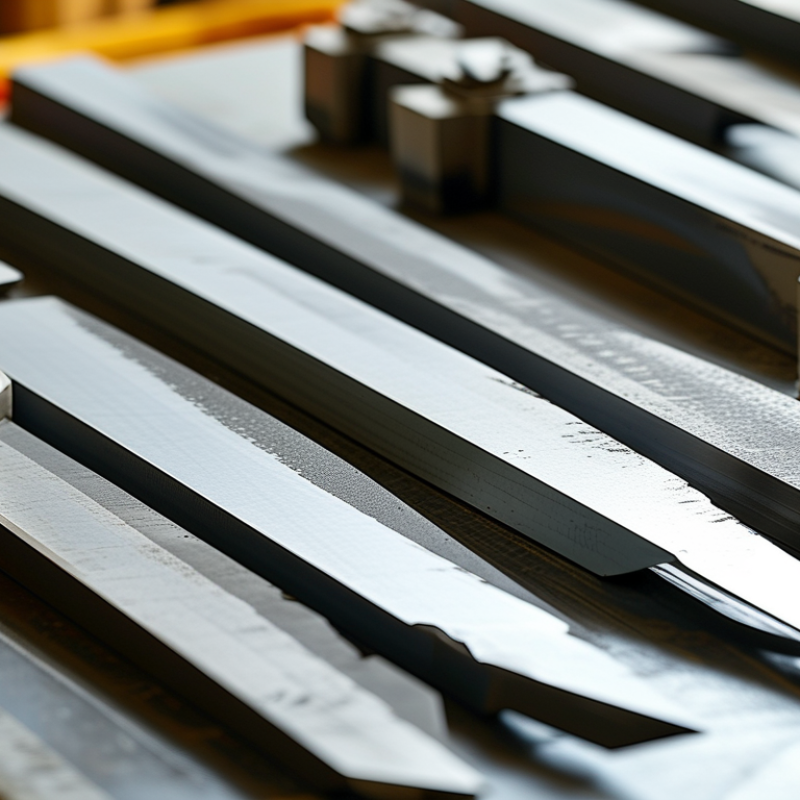
How to Choose Top China Shearing Machine Blades?

What Are China Shearing Machine Blades?

China shearing machine blades are replaceable cutting tools fitted to hydraulic or mechanical shears. They usually work as an upper blade and a lower blade. The moving edge descends, while the fixed edge supports the sheet. This creates a clean, straight cut through steel, aluminum, or stainless steel. “China” describes the manufacturing origin, not a special blade category.

Common materials include 9CrSi, 6CrW2Si, Cr12MoV, H13, and carbide-tipped grades. Material choice depends on thickness, hardness, cutting volume, and machine pressure. A 9CrSi blade may suit ordinary carbon steel. Harder alloys can better resist wear during repeated stainless-steel cutting. However, harder is not always better. Excessive hardness can increase chipping when clearance or alignment is wrong.

Industry data shows why consistency matters. The World Steel Association reported about 1.005 billion tonnes of crude steel production in China during 2024. The China Machine Tool Industry Association also continues to track strong demand for metal-forming equipment and replacement tooling. These figures indicate a large operating base, but they do not prove every blade has equal quality. In practical inspections, check edge straightness, hardness reports, grinding marks, and mounting-hole accuracy. A small burr can distort a 2-millimeter sheet. I have seen buyers focus on price and overlook cutting clearance. That mistake often produces rough edges, vibration, and premature blade damage.

How to Choose Top China Shearing Machine Blades? - What Are China Shearing Machine Blades?
Selection Dimension Common Options or Specifications What the Specification Means Recommended Selection Guidance
Blade Type Guillotine shear blades, swing-beam shear blades, rotary shear blades, straight blades, and segmented blades The blade geometry and mounting style must match the shearing machine structure and cutting method. Confirm the machine type, blade mounting pattern, cutting length, and whether the blade is one-piece or segmented before ordering.
Blade Material Alloy tool steel, cold-work tool steel, high-speed steel, and carbide-tipped designs Material selection affects wear resistance, toughness, impact resistance, and service life. Choose tougher tool steel for general mild-steel cutting and consider higher wear-resistance materials for abrasive or high-volume applications.
Typical Material Grades Common tool-steel grades include 9CrSi, Cr12MoV, D2, and H13-equivalent grades Different grades provide different balances of hardness, toughness, dimensional stability, and heat resistance. Use the grade recommended for the workpiece and cutting frequency; request the material certificate when traceability is important.
Heat Treatment Quenching and tempering, vacuum heat treatment, or controlled-atmosphere heat treatment Proper heat treatment develops the required hardness while reducing the risk of cracking, distortion, and premature edge failure. Ask for the heat-treatment method, measured hardness, and inspection record rather than relying only on the stated steel grade.
Hardness Many industrial shear blades are supplied approximately in the range of 56–62 HRC, depending on material and application Higher hardness generally improves wear resistance, while excessive hardness can reduce toughness and increase chipping risk. Select hardness according to the workpiece, thickness, impact level, and machine rigidity. Verify hardness at multiple points when required.
Cutting Material Low-carbon steel, stainless steel, galvanized sheet, aluminum, copper, and other non-ferrous sheet materials Workpiece chemistry, hardness, surface coating, and abrasiveness influence blade wear and edge damage. Provide the exact material type and tensile-strength range. Stainless and coated materials may require a more wear-resistant blade specification.
Maximum Cutting Thickness Determined by the machine capacity, blade strength, blade gap, material strength, and cutting length A blade is not selected by thickness alone; the machine must also generate sufficient cutting force and maintain correct clearance. Match the blade to the machine’s rated capacity and the actual material thickness. Do not exceed the manufacturer’s maximum cutting range.
Blade Length and Dimensions Specified by overall length, width, thickness, hole position, hole diameter, keyways, and segment size Dimensional compatibility ensures correct installation, clamping, alignment, and safe operation. Use an original drawing or a measured sample. Tolerances should be agreed before production, especially for mounting holes and blade thickness.
Cutting Edge Geometry Single bevel, double bevel, four-edge reversible design, serrated edge, or customized edge geometry Edge geometry influences cutting force, burr formation, edge strength, and the number of usable edges. Choose the geometry specified for the machine model and material. Reversible blades can reduce maintenance cost when all edges are accurately made.
Blade Clearance Machine-specific gap between the upper and lower blades; often adjusted according to material thickness and strength Incorrect clearance can cause excessive burrs, deformation, blade chipping, or unnecessary cutting force. Follow the machine maker’s clearance chart and check the adjustment mechanism after installation.
Dimensional Accuracy Controlled flatness, parallelism, straightness, thickness tolerance, and hole-position tolerance Accurate dimensions help maintain even blade contact and consistent cutting across the full cutting length. Request a dimensional inspection report for precision applications and specify the required tolerances on the drawing.
Surface Finish Ground cutting edge, polished working surfaces, and corrosion-protected non-cutting surfaces A smooth, accurately ground edge reduces friction and helps limit burrs, scratches, and localized stress. Check the cutting edge for grinding burns, visible cracks, dents, and uneven finishing before installation.
Coating or Surface Treatment Uncoated tool steel, nitriding, chrome treatment, or selected hard coatings for specialized applications Surface treatment can improve wear resistance, corrosion resistance, or friction behavior, but it must be compatible with the base material. Use coatings only when their thickness, adhesion, operating temperature, and effect on edge geometry are suitable for the application.
Quality Documentation Material certificate, hardness report, dimensional inspection report, heat-treatment record, and inspection images Documentation provides evidence that the supplied blades meet the agreed technical requirements. Request the required documents before production and define acceptance criteria for hardness, dimensions, edge condition, and packaging.
Packaging and Storage Rust-preventive oil, protective wrapping, edge guards, rigid cases, and moisture-resistant packing Proper packaging protects precision edges from corrosion, impact, and deformation during transport and storage. Confirm that cutting edges are separately protected and that the blades are secured against movement inside the package.
Supplier Evaluation Technical capability, production equipment, inspection process, delivery consistency, and after-sales support A reliable supplier should be able to reproduce dimensions, heat treatment, edge quality, and documentation from batch to batch. Compare technical responses and sample inspection results rather than judging only by price. A trial order can reduce compatibility risk.
Maintenance and Service Life Regular cleaning, correct blade clearance, timely edge rotation, professional sharpening, and proper storage Service life depends on both blade quality and operating conditions, including alignment, lubrication, material contamination, and cutting load. Follow a maintenance schedule, inspect burrs and edge damage regularly, and sharpen or replace blades before severe damage occurs.
China shearing machine blades are industrial cutting tools manufactured for guillotine, swing-beam, rotary, and related shearing equipment. The best choice should be based on machine compatibility, workpiece material, cutting thickness, blade material, heat treatment, dimensional accuracy, and documented quality control.

Which Blade Materials and Designs Suit Your Cutting Needs?

How to Choose Top China Shearing Machine Blades?

Which Blade Materials and Designs Suit Your Cutting Needs?

Choosing a shearing blade starts with the material you cut, not the machine’s price. For mild steel, alloy tool steel often provides a practical balance between toughness and wear resistance. Stainless steel usually needs stronger edge retention and careful clearance settings. Hardened tool steel can last longer, but excessive hardness may cause chipping under impact.

Think about the cutting details. A straight blade suits many guillotine shears, while segmented blades help reduce replacement costs. Four-edge designs can extend service life when the blade geometry allows safe turning. Check blade thickness, mounting holes, edge angle, and cutting length against your machine drawing. A small mismatch can create burrs, noise, or uneven cuts.

In production work, I prefer checking hardness across several points instead of trusting one test value. Heat treatment matters greatly. Ask for material certificates, dimensional reports, and a sample cutting trial. Inspect the first sheets for burr height and edge distortion. Coatings may improve wear resistance, but they cannot correct poor alignment or an unsuitable blade grade. I have seen blades with impressive hardness fail early because they were too brittle for interrupted cutting. The better choice is not always the hardest one. Review your scrap records, cutting thickness, daily cycles, and sharpening method before approving a blade design.

How to Evaluate Blade Size, Hardness, and Cutting Precision?

How to Choose Top China Shearing Machine Blades?

Blade size must match the machine, material thickness, and cutting angle. Measure the blade length, width, thickness, and mounting holes before ordering. A small mismatch can create vibration, uneven cuts, or dangerous installation pressure. In my workshop experience, confirming the drawing is more reliable than trusting a product photo. Ask for dimensional tolerances and a clear steel specification.

Hardness affects wear resistance, impact strength, and sharpening frequency. For mild steel, a balanced hardness may provide stable service life. Harder is not always better. Excessive hardness can make an edge brittle when the machine suffers from shock loads. Request a hardness report, preferably with the testing method and measured range. I once focused too heavily on hardness and overlooked toughness. That mistake caused premature edge chipping.

Cutting precision depends on more than a sharp edge. Check grinding quality, straightness, parallelism, and edge angle. A blade with a polished surface may still cut poorly if its geometry is inconsistent. Ask how the supplier controls heat treatment and final grinding. Trial cutting should use your actual sheet material, not a convenient sample. Inspect burr size, cut squareness, and edge deformation after repeated strokes. Keep measurement records. They expose problems that visual checks miss.

How to Compare Manufacturers, Quality Standards, and Custom Options?

Choosing top China shearing machine blades requires evidence, not attractive pricing. Compare manufacturers through process records, material certificates, inspection photos, and customer references. The World Steel Association reported 1.892 billion tonnes of global crude steel production in 2023. Large supply does not guarantee consistent blade quality. Ask whether each batch receives hardness testing, flatness checks, and edge inspection. I once treated a polished sample as proof. That was a mistake.

Quality standards need careful interpretation. The ISO Survey 2023 recorded 1,265,216 ISO 9001 certificates worldwide. However, ISO 9001 confirms a quality management system, not automatic blade performance. Request steel certificates aligned with ASTM A681 or EN ISO 4957 when tool steel is specified. Check hardness variation across the blade, not only one test point. Also verify straightness, burr control, and cutting-angle tolerance. ISO 2768 can guide general dimensions, but it cannot guarantee clean shearing.

Custom options should match the machine, material, and production rhythm. Confirm blade length, thickness, hole position, rake angle, clearance angle, and coating requirements. For stainless steel, thicker stock, or abrasive sheet, ask for a documented material recommendation. A serious manufacturer should provide a drawing before production and a trial piece afterward. Specify tolerances in writing. “Standard size” is often too vague. Batch traceability, replacement records, and realistic lead times matter more than promises. Small omissions can become expensive downtime.

How to Check Pricing, Service, and Long-Term Blade Performance?

Choosing top China shearing machine blades requires more than comparing the lowest quotation. A low price may exclude inspection, packaging, or replacement support. Request a clear quotation showing steel grade, hardness range, blade dimensions, grinding tolerance, and delivery time. Compare identical specifications, not attractive numbers. Ask whether the supplier provides material certificates and inspection records. These documents reveal professional control more reliably than polished sales language.

Service becomes important after installation. Confirm response times, technical guidance, and warranty conditions before placing an order. A reliable supplier should explain sharpening limits, installation torque, and suitable cutting materials.

In workshop trials, I have seen blades fail early because operators ignored alignment. The blade was blamed first. Sometimes, the machine setup was wrong. Request a sample or trial batch when possible. Check cut edges, burrs, vibration, and heat after repeated cycles.

Small records matter. Note the cutting length, material thickness, operating speed, and number of cuts. Long-term performance depends on stable hardness, accurate grinding, and resistance to chipping.

Ask how the supplier handles regrinding and future replacement. A slightly higher initial cost can be reasonable if the blade produces consistent cuts and fewer stoppages. Still, projected savings should be based on measured service life, not promises. Review actual usage after one month, then question any unexpected wear.

Powder Coat Booths

For those larger-sized parts, or smaller quantity runs, we have 2 independent powder coat booths and ovens. The quality, durability and affordability of today’s powder coating finishes make this the process of choice for world-class companies.

Powder coating advantages over other forms of coating are many. Materials used in the Powder coating process can be metals and non-metals that come in a multitude of thicknesses, textures, colors, etc. Another of Powder coating’s biggest advantages over conventional coatings is its ability to create finishes in many different textures. Powder Coating Booths allow us the ability to apply these advantages to large products.

Wet Paint Line

Tri-State Fabricators runs a full-service conveyor line for painting. Wet painting can provide protection or decoration to many different part styles. From start to finish, every project is easier to undergo random and point-based inspection by our skilled painting team.

Advantages to our Wet Paint Line are these lines start with product prep and ends with a thorough inspection of a high quality finished product. Our ability to complete large and small projects with a superior finish and doing so in a timely and economical fashion. This passes along the savings in production to our customers. When powder coating ins not an option, our Wet Paint Line gets the job done right the first time.

Wet Paint Booths

When the parts get big and heavy we roll-out our custom paint racks and oversize booth. By utilizing our partnerships with all the major paint brands, we can match virtually any color with wet paint.

The advantages of having access to a Wet Paint Booth are many. Large projects of many different shapes can be loaded into the booth. The Wet Paint Booth offers an environment that is much more controlled than a typical parts painting operation.

Not only are they used because of their controlled environment, but they’re are also advantageous when it comes to applying paint to parts that are needed in industries that require specialty coatings such as medical, aerospace, etc.

Military CARC

Our military forces have some very high standards when it comes to the finish of their vehicles and equipment. From the first pre-treatment step to final coat, it takes a great deal of knowledge and experience to protect the men and women of our armed forces. They deserve only the best, and Tri-State Fabricators provides it.

All of our processes are closely monitored by our staff and management teams. Both of which are highly trained in the processes of metal fabrication and finishing. Tri-State Fabricators’ goal is to always fully satisfy each and every customer, including the military. We will always put a 110% into what we do.

Glass-Bead Blasting

Abrasive media blasting is an excellent way to remove old paint, rust, and increase the paint/powder adhesion. Glass beads produce a much smoother and brighter finish than angular abrasives; leaving the part clean yet without any dimensional change. Chemically inert and environmentally friendly, we can recycle our beads approximately 30 times; making them a more preferred method of metal cleaning or surface finishing.

Advantages to Glass Bead Blasting are many. Glass bead blast media is used when a project is needing rough surfaces need to become smooth for applications of coatings such as paint. It is typically used to clean paint and rust from a product surface without deforming the surface it is being used on. Overall, compared to many other blasting media, Glass Bead Blasting is a very economical choice and those savings are always passed on to our customers.

Part Washing

Tri-State Fabricators utilize a zinc phosphate wash to clean and etch the material to ensure the best paint adhesion possible. The unique design of our 3-stage wash system does the work like a 5-stage. From Cleaning and rinsing to conversion coating and post-treatment, Our Part Washing process is a complete service and works throughout the fabrication service and the finishing service.

Along with the previously mentioned benefits, Curing is a vital chemical reaction that leaves the product finish hard and relatively safe from mild abrasion and aggressive corrosion. This process can be done in more than one way; ambient air-dry or in curing ovens at temps that exceed 240°.

Burn-Off Oven

From fixing paint mistakes (someone else’s of course) to simply cleaning our paint line hooks, our burn-off oven is put to good use. After a quick burn-off, a little clean up, and a fresh coat of paint, your parts will look better than new.

Why does our Burn-Off Oven work so well? Because super heating the air around parts turns the materials into ashes. From paint and powder coatings to rubber and machining oils, high temps do the job without degrading the integrity of the part.

Masking

Masking is a vital part of producing high quality products. We have die-cut masking patterns to protect machined surfaces as well as a wide range of plugs and caps to protect threaded holes and bolts. We provide permanent and temporary masking.

Masking allows the selected sections of a product to be protected from a fabrication or finishing service. This can be with both chemicals when etching and tapes, paints when only finishing just a section of the product. Masking is great in aiding the customization process of a project.

Screen Printing

Screen printing is a photographic process that transfers artwork onto a porous nylon screen which allows colored ink to flow through the screen and be deposited on an aluminum or plastic component. We can generally have just about any design created onto a screen for your parts.

Some of the advantages of Screen Printing are, brand recognition for your business displaying on your products, assembly instructions, product warnings/hazards, etc. Tri-State Fabricators produces Screen Printing of the highest quality so you know it’s durable.

Metal Finishing

Metal Finishing is the art of treating the exterior portion of product, often metal but can also be made of other materials, so that the surface is clean and free of any debris. Then the process of applying coats or either paint of powder coat takes place. This coating process improves the quality of the product in both appearance and resistance to wear and corrosion.

Tri-State Fabricators, Inc., understands that a project typically isn’t complete until a high-quality finish has been added to your product. This is why our painting and powder coating teams continuously inspect the products throughout the Metal Finishing process.

