Wattage
Typical range: 1,200–1,800 W

Choosing a Power Air Fryer is not just a matter of picking the largest basket or the highest wattage. Countertop space, household size, cooking habits, and cleanup all affect whether an appliance earns a regular place in your kitchen. The NPD Group reported that U.S. air fryer sales rose 76% in 2020, reflecting a sharp increase in consumer interest. That growth also brought more models, features, and confusing claims to compare.
Look beyond the headline numbers. Basket capacity should suit the portions you actually cook, while clear controls and dishwasher-safe parts can make daily use easier. Consumer Reports’ appliance testing emphasizes practical performance factors such as cooking results and ease of use. These matter more than flashy presets when you are making crisp vegetables on a weeknight or reheating leftovers without drying them out. Small details count.
This guide explains how to compare a Power Air Fryer by capacity, temperature range, functions, cleaning demands, and available space. It also considers the trade-offs between compact baskets and larger ovens, including how much counter room each design needs. No single model fits every kitchen. Even a well-reviewed fryer may disappoint if its basket is too small or awkward to wash. A careful comparison can help you choose a model that suits your real routine, not just its product-page promises.
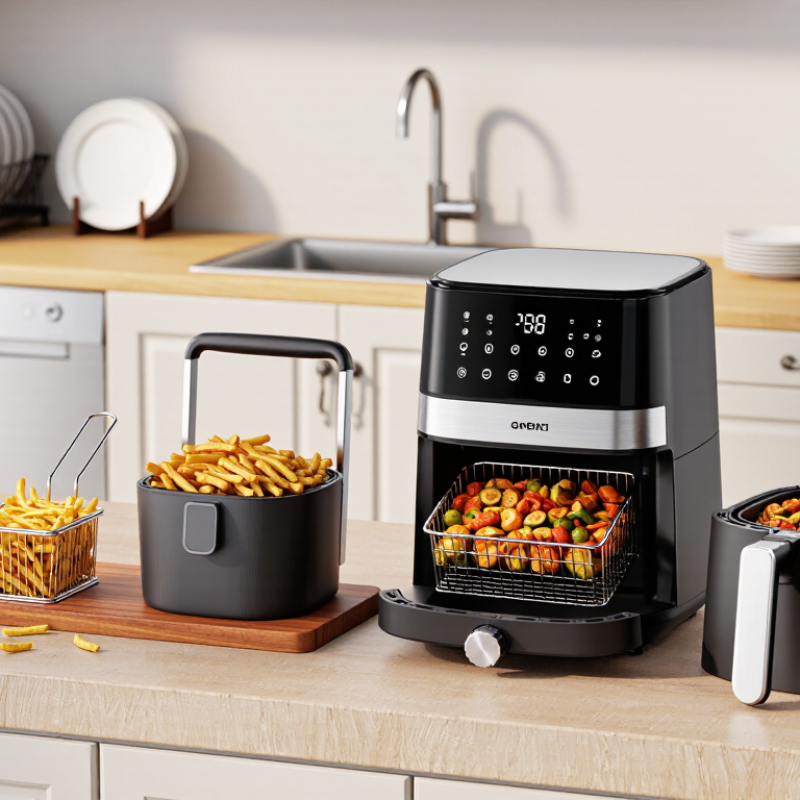
A power air fryer uses a heating element and a fan to move hot air around food. Its wattage indicates how much electrical power it draws, not whether it will cook every meal better. Higher wattage may support quicker heating, but results also depend on basket shape, airflow, and the amount of food inside. A crowded basket can leave fries pale in the middle. Leave space for air to circulate. Small detail, noticeable difference.
Look beyond the wattage label. Check the cooking capacity against your usual portions, and compare temperature range, timer controls, and preset options. Presets can save a few steps, but they are starting points, not guarantees; thick vegetables and frozen snacks may need different times. A clear display and responsive controls make adjustments easier while cooking. The basket should slide out smoothly and feel secure when full. Removable, dishwasher-safe parts can simplify cleanup, though hand-washing may help protect coatings. Also check the appliance’s dimensions, cord placement, and ventilation needs before choosing a countertop spot. Specifications rarely tell the whole story. A model that looks powerful on paper may still feel awkward in daily use.
| Feature | What to Check | Why It Matters | Practical Guidance |
|---|---|---|---|
| Rated power | Wattage listed on the appliance label or in its specifications. Many household air fryers are in the approximate 1,200–1,800 W range, though models vary. | Power affects how much electricity the appliance can draw while operating and can influence heating performance. Wattage alone does not determine cooking results. | Check that the appliance’s voltage and wattage suit your kitchen outlet and circuit. Compare power alongside capacity, airflow design, and cooking controls. |
| Capacity | Basket or cooking-chamber capacity, usually stated in quarts or liters. | A larger capacity can accommodate more food, but the amount that cooks evenly depends on the shape of the basket and how the food is arranged. | Choose a size that fits your usual portions. Avoid overcrowding; food generally cooks more evenly when hot air can circulate around it. |
| Temperature range | Minimum and maximum selectable temperatures, shown in °F or °C. | A suitable range supports different tasks, such as gently reheating food or cooking at higher temperatures for browning. | Look for clear temperature settings and a range that covers the recipes you expect to prepare. Check whether the display uses Fahrenheit, Celsius, or both. |
| Temperature and timer controls | Control type, adjustment increments, timer range, and whether settings can be changed during cooking. | Fine, easy-to-read controls make it simpler to follow recipes and adjust cooking without relying on preset programs. | Choose controls that are intuitive for the people who will use the appliance. A clear display and straightforward adjustments are useful everyday features. |
| Air circulation and cooking space | Basket layout, food-contact surface area, and whether the design allows space around food. | Air-frying relies on circulating heated air. A crowded basket can block airflow and lead to less even browning. | Consider the shape and usable area, not just the advertised capacity. Plan to cook in batches when necessary. |
| Cooking functions | Available modes, such as air fry, roast, bake, reheat, or dehydrate, if included. | Extra modes can add versatility, but their usefulness depends on the foods and recipes you make. | Prioritize functions you will use regularly. Presets are convenient starting points, but cooking time and results can vary with food size and quantity. |
| Preheating and reminders | Whether preheating is required or recommended and whether the appliance signals when to shake or turn food. | Following the instructions for preheating and moving food can help produce more consistent results. | Check the user manual for guidance. A shake reminder is helpful, but it does not replace checking food for doneness. |
| Cleaning and materials | Removable parts, cleaning instructions, dishwasher guidance, and the condition of any nonstick surface. | Simple cleanup can make frequent use easier. Abrasive tools or unsuitable cleaning methods may damage coated surfaces. | Confirm which parts are dishwasher-safe in the manual. Let components cool before cleaning and use nonabrasive tools where recommended. |
| Safety and placement | Stable footing, handle design, ventilation requirements, cord placement, and safety instructions. | The appliance becomes hot and needs a suitable position with the clearances specified by its manufacturer. | Use it on a stable, heat-resistant surface, keep vents unobstructed, and follow the manual’s instructions for safe operation. |
| Energy use | Rated wattage and the length of typical cooking sessions. | Electricity use depends on power and operating time. A higher wattage does not by itself indicate the energy used for a particular meal. | For a rough estimate, multiply kilowatts by operating hours, then by your electricity price per kilowatt-hour. Actual use varies with the cooking cycle. |
Basket capacity should match the meals you actually cook, not just the number of people at home. The U.S. Census Bureau’s 2020 Census reported an average household size of 2.54 people. For one or two diners, a compact 3–4-quart basket may handle vegetables and a couple of chicken portions. A household of three or four may prefer 5–6 quarts, especially when serving everyone at once. These are starting points, not guarantees.
Check the basket’s usable floor area, too. A wide basket can spread food into a single layer, while a taller, narrower one may stack pieces and slow browning. Capacity labels do not always tell the whole story. Frozen fries need room to move; crowded wings may need turning or another cooking round. I’ve found that a slightly larger basket can save time, but it also takes up more counter space and can be awkward to wash. Measure your storage spot before buying.
Tips: Match capacity to your busiest usual meal, not an occasional gathering. Cook a small batch first and check how evenly it browns. If you often cook two foods at once, look for a divider or plan on separate batches.
When comparing power, check wattage alongside basket capacity rather than treating a bigger number as an automatic win. On similarly sized fryers, higher wattage can help restore heat after you add cold food. It may also shorten preheating, though insulation and airflow matter too. For a small countertop unit, consider whether its power draw suits the outlet and other appliances you use nearby. Check the manual.
Temperature range affects more than crisping. A lower minimum can help with gentle warming or drying, while a high maximum is useful for browning foods such as potato wedges. Look for clear temperature increments, not just an impressive top setting. A fryer that adjusts in small steps gives you more control over delicate items, but the displayed temperature may not match every spot inside the basket. Not always.
Cooking programs can simplify routine meals. Presets for vegetables, fish, or frozen foods offer a convenient starting point, especially when you are learning the appliance. Still, preset times may not account for portion size, thickness, or how crowded the basket is. Treat them as suggestions, then check the food and adjust as needed. I would value responsive manual controls over a long list of programs; extra buttons can look useful and still leave you guessing.
Compare wattage, temperature range, and cooking programs. These are general buying benchmarks; specifications vary by model.
Typical range: 1,200–1,800 W
Typical range: 175–400°F
Common range: 6–12 presets
Higher wattage can support faster heating, but cooking results also depend on basket size and airflow. A wider temperature range adds flexibility, while presets offer convenience; check that the manual includes the settings you need.
When choosing a power air fryer, inspect safety details before comparing presets. Look for a stable, heat-resistant handle, a secure basket lock, and controls that are easy to read. Keep the appliance’s required clearance in mind; vents blocked by a backsplash or crowded counter can trap heat.
NFPA’s 2023 Home Cooking Fires report found that cooking equipment was involved in 49% of reported U.S. home fires during 2017–2021. That figure covers cooking equipment broadly, not air fryers alone, but it makes basic heat and placement checks worthwhile.
Cleaning and build quality matter after the first week, not just on display. Check whether the basket and tray detach easily, and follow the manual’s guidance on dishwasher use. A soft sponge is safer for nonstick surfaces than a metal scrubber.
Look closely at basket seams, coating, and the point where the handle meets the body. A polished finish can still hide flimsy construction. That part is easy to overlook.
For electrical safety, UL 1026 sets requirements for household electric cooking appliances; certification to an applicable standard is a useful check, though it cannot replace careful use.
Tips:
Before buying, lift the unit if possible. Does it wobble? Check that the cord reaches a clear counter space without stretching. After cooking, let the basket cool before washing, and dry it fully to discourage lingering moisture. Small habits help. I would still inspect the coating regularly; wear can be gradual and easy to miss.
Price is only the opening figure. Grand View Research estimated the global air fryer market at about US$1.3 billion in 2023, showing strong consumer demand. That demand creates more choices, but not always better value. In practical kitchen testing, compare usable basket space, heating speed, controls, and cleaning effort. A cheap 4-liter model may suit one person. A family may need a larger basket, but it can consume more electricity and counter space. Which? testing has reported that air fryers often use less energy than ovens for small portions. Batch size still changes the result.
Warranty quality deserves equal attention. Check the coverage period, excluded parts, return window, and repair process. The Federal Trade Commission advises consumers to read written warranty terms before purchase. A longer warranty can justify a higher price, especially when the heating element and control panel are covered. However, warranty length alone proves little. Some coverage is inconvenient or limited. I have seen buyers overvalue digital presets and underestimate replacement accessories. That’s an easy mistake.
Tips: Calculate the cost per use. Add the appliance price, expected electricity, and replacement parts. Choose physical controls if reliability matters more than appearance. Confirm the basket’s dimensions, not just its advertised capacity. Leave space around the appliance for ventilation. Food safety still matters; the U.S. Department of Agriculture recommends checking poultry with a thermometer at 165°F. Fancy features cannot correct uneven loading. Temperature claims may also be optimistic. Test one familiar recipe before trusting every preset.


For those larger-sized parts, or smaller quantity runs, we have 2 independent powder coat booths and ovens. The quality, durability and affordability of today’s powder coating finishes make this the process of choice for world-class companies.
Powder coating advantages over other forms of coating are many. Materials used in the Powder coating process can be metals and non-metals that come in a multitude of thicknesses, textures, colors, etc. Another of Powder coating’s biggest advantages over conventional coatings is its ability to create finishes in many different textures. Powder Coating Booths allow us the ability to apply these advantages to large products.
Tri-State Fabricators runs a full-service conveyor line for painting. Wet painting can provide protection or decoration to many different part styles. From start to finish, every project is easier to undergo random and point-based inspection by our skilled painting team.
Advantages to our Wet Paint Line are these lines start with product prep and ends with a thorough inspection of a high quality finished product. Our ability to complete large and small projects with a superior finish and doing so in a timely and economical fashion. This passes along the savings in production to our customers. When powder coating ins not an option, our Wet Paint Line gets the job done right the first time.
When the parts get big and heavy we roll-out our custom paint racks and oversize booth. By utilizing our partnerships with all the major paint brands, we can match virtually any color with wet paint.
The advantages of having access to a Wet Paint Booth are many. Large projects of many different shapes can be loaded into the booth. The Wet Paint Booth offers an environment that is much more controlled than a typical parts painting operation.
Not only are they used because of their controlled environment, but they’re are also advantageous when it comes to applying paint to parts that are needed in industries that require specialty coatings such as medical, aerospace, etc.
Our military forces have some very high standards when it comes to the finish of their vehicles and equipment. From the first pre-treatment step to final coat, it takes a great deal of knowledge and experience to protect the men and women of our armed forces. They deserve only the best, and Tri-State Fabricators provides it.
All of our processes are closely monitored by our staff and management teams. Both of which are highly trained in the processes of metal fabrication and finishing. Tri-State Fabricators’ goal is to always fully satisfy each and every customer, including the military. We will always put a 110% into what we do.
Abrasive media blasting is an excellent way to remove old paint, rust, and increase the paint/powder adhesion. Glass beads produce a much smoother and brighter finish than angular abrasives; leaving the part clean yet without any dimensional change. Chemically inert and environmentally friendly, we can recycle our beads approximately 30 times; making them a more preferred method of metal cleaning or surface finishing.
Advantages to Glass Bead Blasting are many. Glass bead blast media is used when a project is needing rough surfaces need to become smooth for applications of coatings such as paint. It is typically used to clean paint and rust from a product surface without deforming the surface it is being used on. Overall, compared to many other blasting media, Glass Bead Blasting is a very economical choice and those savings are always passed on to our customers.
Tri-State Fabricators utilize a zinc phosphate wash to clean and etch the material to ensure the best paint adhesion possible. The unique design of our 3-stage wash system does the work like a 5-stage. From Cleaning and rinsing to conversion coating and post-treatment, Our Part Washing process is a complete service and works throughout the fabrication service and the finishing service.
Along with the previously mentioned benefits, Curing is a vital chemical reaction that leaves the product finish hard and relatively safe from mild abrasion and aggressive corrosion. This process can be done in more than one way; ambient air-dry or in curing ovens at temps that exceed 240°.
From fixing paint mistakes (someone else’s of course) to simply cleaning our paint line hooks, our burn-off oven is put to good use. After a quick burn-off, a little clean up, and a fresh coat of paint, your parts will look better than new.
Why does our Burn-Off Oven work so well? Because super heating the air around parts turns the materials into ashes. From paint and powder coatings to rubber and machining oils, high temps do the job without degrading the integrity of the part.
Masking is a vital part of producing high quality products. We have die-cut masking patterns to protect machined surfaces as well as a wide range of plugs and caps to protect threaded holes and bolts. We provide permanent and temporary masking.
Masking allows the selected sections of a product to be protected from a fabrication or finishing service. This can be with both chemicals when etching and tapes, paints when only finishing just a section of the product. Masking is great in aiding the customization process of a project.
Screen printing is a photographic process that transfers artwork onto a porous nylon screen which allows colored ink to flow through the screen and be deposited on an aluminum or plastic component. We can generally have just about any design created onto a screen for your parts.
Some of the advantages of Screen Printing are, brand recognition for your business displaying on your products, assembly instructions, product warnings/hazards, etc. Tri-State Fabricators produces Screen Printing of the highest quality so you know it’s durable.
Metal Finishing is the art of treating the exterior portion of product, often metal but can also be made of other materials, so that the surface is clean and free of any debris. Then the process of applying coats or either paint of powder coat takes place. This coating process improves the quality of the product in both appearance and resistance to wear and corrosion.
Tri-State Fabricators, Inc., understands that a project typically isn’t complete until a high-quality finish has been added to your product. This is why our painting and powder coating teams continuously inspect the products throughout the Metal Finishing process.