Choosing a Transformer Production Line is a practical decision with long-term consequences. It affects product quality, operating costs, worker safety, and delivery performance. A line that looks impressive in a showroom may perform differently in a real factory. Dust, humidity, unstable power, limited floor space, and changing order sizes can expose hidden weaknesses.
Experienced manufacturers usually begin with the transformer types, voltage ranges, core dimensions, and expected annual output. These details guide decisions about winding machines, core cutting systems, insulation equipment, drying ovens, assembly stations, and testing instruments. Production speed matters, but consistency matters more. A winding machine that produces uneven tension can create costly defects later. Small errors become expensive.
Ask practical questions.
Can operators maintain the equipment without waiting weeks for overseas technicians? Are replacement parts available locally? Does the supplier provide installation training, process documentation, and reliable after-sales support? Independent test reports, factory references, and performance records deserve careful review. Claims alone are not enough.
A reliable evaluation should include a factory visit, sample production, energy consumption data, noise levels, and a realistic maintenance schedule. Buyers should also compare automation with actual labor skills. Full automation may appear efficient, yet it can be unsuitable for smaller batches or frequent design changes. I have seen projects focus heavily on output capacity while underestimating commissioning time. That mistake can delay production for months.
The best Transformer Production Line is not always the fastest or most expensive. It should match technical requirements, workforce capability, quality targets, and future expansion plans. Leave room for honest uncertainty. A thoughtful decision protects investment and supports stable production.
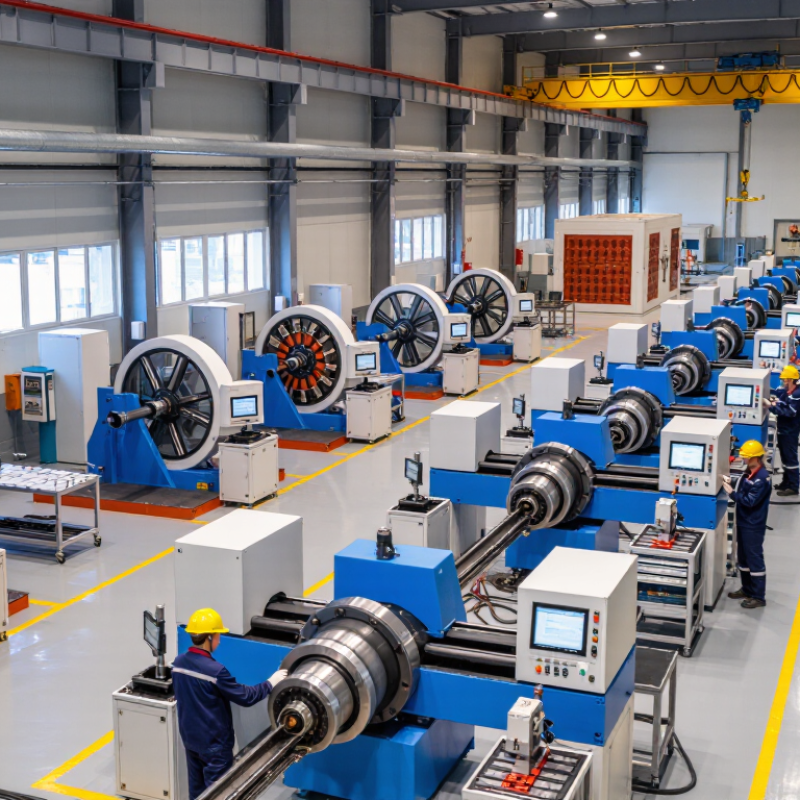
Choosing a transformer production line starts with a precise product definition. IEC 60076 provides the technical framework for power transformers, including insulation, temperature rise, tests, and performance requirements. Identify the transformer type before discussing machinery. It may be oil-immersed or dry-type, single-phase or three-phase, and designed for distribution or power service. Each choice affects winding equipment, drying systems, assembly space, and testing capacity.
The rating must describe more than a single MVA value. Record rated power, high- and low-voltage levels, connection symbol, impedance, insulation level, cooling method, and permitted temperature rise. For example, a 10 MVA transformer rated at 33/11 kV needs different production controls from a smaller 400 kVA unit. Frequency is equally important. State 50 Hz or 60 Hz clearly, because frequency influences core design, flux density, losses, and verification tests. A vague frequency assumption can create expensive rework.
Choosing a transformer production line starts with the output range, not the machine catalog. For 10–100 kVA units, a compact core cutting line, simple winding equipment, and a manual or semi-automatic tank station may be sufficient. These transformers often use smaller conductors and lighter tanks. Operators can correct winding tension quickly. That matters. However, manual work can create unwanted variation.
From 100 to 400 kVA, specify controlled core joining, coil winding, drying, and tank fabrication. Step-lap core assembly can reduce losses when joints are accurate. Foil or wire winding should match conductor size, insulation design, and short-circuit requirements. Add tension monitoring and dimensional checks. A line may look fast on paper. It may still bottleneck during drying or testing.
For 400–1,000 kVA, production usually needs heavier handling, automated winding control, vacuum drying, and consistent tank welding. The core line should move larger laminations without damaging their edges. Coil equipment must maintain pressure and alignment across longer windings. Tank processes require leak testing, bushing positioning, surface preparation, and controlled coating.
I have seen lines optimized for winding but slowed by crane movement. Layout is production equipment too. Review daily volume, product variety, and available floor space before choosing. A perfect design rarely survives unchanged. Pilot runs reveal more than brochures.
How to Choose a Transformer Production Line?
Compare Automation Levels Using Cycle Time, OEE, and Labor Requirements
Choosing a transformer production line requires more than comparing machine speeds. Cycle time shows how long one unit takes under defined conditions. Measure loading, winding, assembly, testing, and changeovers separately. A quoted cycle time may exclude material handling or inspection. Small delays accumulate.
OEE provides a more realistic view. It combines availability, performance, and quality. Record unplanned stops, reduced speeds, and rejected units during representative production runs. An automated line may produce one transformer every few minutes, yet frequent sensor faults can reduce availability. Manual lines can appear slower, but skilled workers may recover from product variations more quickly. The comparison must use the same product mix and shift length.
Labor requirements also change with automation level. Count operators, material handlers, inspectors, technicians, and supervisors. Semi-automated equipment may need more hands-on work, but it can simplify maintenance and changeovers. Highly automated equipment often reduces direct labor while increasing programming and troubleshooting demands. Training time matters. So does ergonomic risk.
Use measured data rather than sales estimates. Pilot testing helps. My experience suggests that early calculations often overlook rework and waiting time. That is worth challenging. A line with excellent theoretical speed may perform poorly when copper sizes, insulation designs, or order quantities change. Leave practical space for maintenance access, operator movement, and future product adjustments.
| Production Line Type | Typical Manufacturing Scope | Nominal Cycle Time (min/unit) | Expected OEE | Direct Labor (operators/shift) | Estimated Output (units/shift) | Changeover Time (min) | Best-Fit Production Profile |
|---|---|---|---|---|---|---|---|
| Manual | Coil preparation, winding, core assembly, connection, and inspection performed mainly by operators | 45–70 | 45–60% | 12–20 | 5–8 | 30–60 | Low-volume production, frequent product variation, and limited initial capital |
| Semi-Automated | Automated winding or cutting combined with manual loading, assembly, testing, and material handling | 25–45 | 55–70% | 8–14 | 8–14 | 20–40 | Medium-volume production with several transformer ratings and moderate customization |
| Highly Automated | Integrated winding, taping, cutting, transfer, assembly support, testing, and production tracking | 12–25 | 65–80% | 4–8 | 14–28 | 15–30 | Stable product families, repeatable demand, and a strong need to reduce labor per unit |
| Advanced Flexible | Automated material flow, programmable processing, inline inspection, digital traceability, and robotic handling | 8–18 | 70–85% | 3–6 | 20–40 | 10–20 | High-volume production requiring consistent quality, traceability, and rapid recipe changes |
A credible production line must prove its dielectric testing range, not merely advertise it. Verify 50 Hz and 60 Hz testing with calibrated voltage and frequency records. The test bay should support impulse levels from 2 kV to 2,500 kV, matching the transformer design and insulation class. IEC 60076-3:2013+A1:2018 defines insulation, dielectric, and impulse-test requirements for power transformers. Ask for recent test certificates, calibration dates, and waveform records. Paperwork matters.
Impulse testing needs more than a powerful generator. Check the measuring divider, grounding layout, control system, and response time. A clean impulse trace should show repeatable front time, peak voltage, and oscillation control.
CIGRE Technical Brochure 642, Transformer Reliability Survey, identifies windings, insulation systems, and bushings as recurring transformer failure areas. That evidence makes impulse and applied-voltage testing practical risk controls, not decorative specifications.
Frequency testing also deserves a physical check. Watch the transformer during a 50/60 Hz test: listen for abnormal vibration, inspect temperature rise, and record partial-discharge behavior where required. IEC 60076-1 and IEC 60076-3 should appear in the line’s quality documents. Do not accept a claimed 2,500 kV capability without matching test-object dimensions and safety clearances. I would also question a perfect factory demonstration. Real production includes setup errors, sensor drift, and retesting. A reliable line exposes those weaknesses before shipment.
How to Choose a Transformer Production Line?
A suitable transformer production line should match output volume, product range, and inspection discipline. Capacity is not only a daily unit number. It also includes core cutting speed, winding stations, drying time, assembly space, and testing queues. The U.S. Department of Energy reported that about 70% of distribution transformers were at least 25 years old. This aging infrastructure increases demand for dependable replacement equipment and consistent production quality.
Quality controls must be visible at each critical stage. A line should record conductor dimensions, winding tension, insulation materials, torque values, vacuum pressure, and oil test results. Factory acceptance tests should cover ratio, resistance, losses, insulation strength, and partial discharge where required. ISO Survey 2023 recorded more than 1.2 million ISO 9001 certificates worldwide. Certification alone proves little, however. A rushed checklist can still hide a weak process.
Tips: Ask for sample production records, not only brochures. Check whether each serial number links to material batches, operators, calibration dates, test results, and approved corrections. Use barcode scanning at winding and assembly stations. Keep electronic records with controlled access. A paper backup is useful, but paper systems are easy to misplace. During a factory visit, follow one transformer from steel receipt to final test. If operators cannot explain a failed result, stop and investigate. Capacity claims deserve skepticism. Wider production lines may create more defects when training and inspection lag behind.


For those larger-sized parts, or smaller quantity runs, we have 2 independent powder coat booths and ovens. The quality, durability and affordability of today’s powder coating finishes make this the process of choice for world-class companies.
Powder coating advantages over other forms of coating are many. Materials used in the Powder coating process can be metals and non-metals that come in a multitude of thicknesses, textures, colors, etc. Another of Powder coating’s biggest advantages over conventional coatings is its ability to create finishes in many different textures. Powder Coating Booths allow us the ability to apply these advantages to large products.
Tri-State Fabricators runs a full-service conveyor line for painting. Wet painting can provide protection or decoration to many different part styles. From start to finish, every project is easier to undergo random and point-based inspection by our skilled painting team.
Advantages to our Wet Paint Line are these lines start with product prep and ends with a thorough inspection of a high quality finished product. Our ability to complete large and small projects with a superior finish and doing so in a timely and economical fashion. This passes along the savings in production to our customers. When powder coating ins not an option, our Wet Paint Line gets the job done right the first time.
When the parts get big and heavy we roll-out our custom paint racks and oversize booth. By utilizing our partnerships with all the major paint brands, we can match virtually any color with wet paint.
The advantages of having access to a Wet Paint Booth are many. Large projects of many different shapes can be loaded into the booth. The Wet Paint Booth offers an environment that is much more controlled than a typical parts painting operation.
Not only are they used because of their controlled environment, but they’re are also advantageous when it comes to applying paint to parts that are needed in industries that require specialty coatings such as medical, aerospace, etc.
Our military forces have some very high standards when it comes to the finish of their vehicles and equipment. From the first pre-treatment step to final coat, it takes a great deal of knowledge and experience to protect the men and women of our armed forces. They deserve only the best, and Tri-State Fabricators provides it.
All of our processes are closely monitored by our staff and management teams. Both of which are highly trained in the processes of metal fabrication and finishing. Tri-State Fabricators’ goal is to always fully satisfy each and every customer, including the military. We will always put a 110% into what we do.
Abrasive media blasting is an excellent way to remove old paint, rust, and increase the paint/powder adhesion. Glass beads produce a much smoother and brighter finish than angular abrasives; leaving the part clean yet without any dimensional change. Chemically inert and environmentally friendly, we can recycle our beads approximately 30 times; making them a more preferred method of metal cleaning or surface finishing.
Advantages to Glass Bead Blasting are many. Glass bead blast media is used when a project is needing rough surfaces need to become smooth for applications of coatings such as paint. It is typically used to clean paint and rust from a product surface without deforming the surface it is being used on. Overall, compared to many other blasting media, Glass Bead Blasting is a very economical choice and those savings are always passed on to our customers.
Tri-State Fabricators utilize a zinc phosphate wash to clean and etch the material to ensure the best paint adhesion possible. The unique design of our 3-stage wash system does the work like a 5-stage. From Cleaning and rinsing to conversion coating and post-treatment, Our Part Washing process is a complete service and works throughout the fabrication service and the finishing service.
Along with the previously mentioned benefits, Curing is a vital chemical reaction that leaves the product finish hard and relatively safe from mild abrasion and aggressive corrosion. This process can be done in more than one way; ambient air-dry or in curing ovens at temps that exceed 240°.
From fixing paint mistakes (someone else’s of course) to simply cleaning our paint line hooks, our burn-off oven is put to good use. After a quick burn-off, a little clean up, and a fresh coat of paint, your parts will look better than new.
Why does our Burn-Off Oven work so well? Because super heating the air around parts turns the materials into ashes. From paint and powder coatings to rubber and machining oils, high temps do the job without degrading the integrity of the part.
Masking is a vital part of producing high quality products. We have die-cut masking patterns to protect machined surfaces as well as a wide range of plugs and caps to protect threaded holes and bolts. We provide permanent and temporary masking.
Masking allows the selected sections of a product to be protected from a fabrication or finishing service. This can be with both chemicals when etching and tapes, paints when only finishing just a section of the product. Masking is great in aiding the customization process of a project.
Screen printing is a photographic process that transfers artwork onto a porous nylon screen which allows colored ink to flow through the screen and be deposited on an aluminum or plastic component. We can generally have just about any design created onto a screen for your parts.
Some of the advantages of Screen Printing are, brand recognition for your business displaying on your products, assembly instructions, product warnings/hazards, etc. Tri-State Fabricators produces Screen Printing of the highest quality so you know it’s durable.
Metal Finishing is the art of treating the exterior portion of product, often metal but can also be made of other materials, so that the surface is clean and free of any debris. Then the process of applying coats or either paint of powder coat takes place. This coating process improves the quality of the product in both appearance and resistance to wear and corrosion.
Tri-State Fabricators, Inc., understands that a project typically isn’t complete until a high-quality finish has been added to your product. This is why our painting and powder coating teams continuously inspect the products throughout the Metal Finishing process.