


How to Prevent White Powder Migration in Apparel Packaging Films | Non-Migratory Slip Technology

How to Prevent White Powder Migration in Apparel Packaging Films

Why More Film Converters Are Moving Toward Non-Migratory Slip Technology

For premium apparel packaging films, surface cleanliness has become just as important as slip performance.

This is especially true for black or dark-colored garments, where even slight white powder transfer may lead to:

• Customer complaints

• Packaging rejection

• Reduced visual quality

• Brand image concerns

In recent years, many apparel packaging film converters have encountered the same challenge: Traditional slip agents can lower COF, but excessive migration may also create blooming, powder residue, and unstable surface performance.

As premium apparel brands continue raising packaging standards, converters are increasingly looking for cleaner and more stable slip solutions.

What Causes White Powder Migration in PE Packaging Films?

White powder migration is commonly associated with migratory slip additives, particularly traditional amide-based slip systems.

These additives reduce friction by gradually migrating to the film surface. However, excessive migration may create visible blooming over time.

In actual blown film operations, this may result in:

• Surface powder residue
• Reduced transparency
• Surface haze
• Unstable COF performance
• Garment contamination risks

For apparel packaging films, this issue becomes more visible during high-speed packaging and long-term storage applications.

Dark garments tend to make powder contamination easier to detect, which is why premium apparel brands are often highly sensitive to film cleanliness.

Why Stable COF Is Critical in High-Speed Packaging Lines

Many converters focus heavily on achieving low initial COF values.

However, in actual packaging operations, unstable COF often creates more problems than slightly higher friction levels.

Unstable COF may contribute to:

• Inconsistent film feeding
• Packaging speed fluctuation
• Blocking during storage
• Poor handling consistency
• Reduced packaging efficiency

For high-speed apparel packaging lines, long-term COF stability is often more important than aggressive short-term slip reduction.

What Is a Non-Migratory Slip Additive?

A non-migratory slip additive is a film additive designed to reduce friction while minimizing excessive surface migration and blooming behavior in polyethylene films.

Compared with traditional migratory slip systems, non-migratory technologies are increasingly used to help improve:

• Film surface cleanliness
• Transparency retention
• COF stability
• Packaging consistency
• Long-term handling performance

As packaging standards continue evolving, non-migratory slip technology is becoming an important direction for premium flexible packaging films.

SILIKE has introduced the SILIMER series of non-migration film super slip Masterbatch, which features copolymerized polysiloxanes with active organic functional groups.  With a small molecular weight and low surface energy, it facilitates seamless migration to the surface of plastics. The active functional groups play a crucial role by anchoring in plastics, preventing any undesired precipitation.

Traditional Slip Agents vs Non-Migratory Slip Technology

Property Traditional Amide Slip Agents Non-Migratory Slip Technology
Slip mechanism Surface migration Controlled surface behavior
Powder migration risk Higher Lower
Surface blooming More noticeable Reduced
COF stability May fluctuate over time More stable
Transparency retention May decrease during storage Better consistency
Film surface cleanliness Lower Improved

Real Application Case: Apparel Packaging Film Converter

A converter specializing in premium apparel packaging films recently evaluated slip and anti-blocking masterbatch SILIMER 6104MB1 during blown film production trials.

Customer Requirements

The converter needed a slip solution capable of balancing:

• High transparency
• Stable low COF
• Clean film surfaces
• Reduced migration behavior
• Reliable packaging efficiency

Before evaluating the slip and anti-blocking additive SILIMER 6104MB1, multiple slip agents had been tested. However, balancing slip performance, transparency, and non-migration remained difficult.

Blown Film Trial Results

Trial Conditions

• Application: Apparel packaging PE film
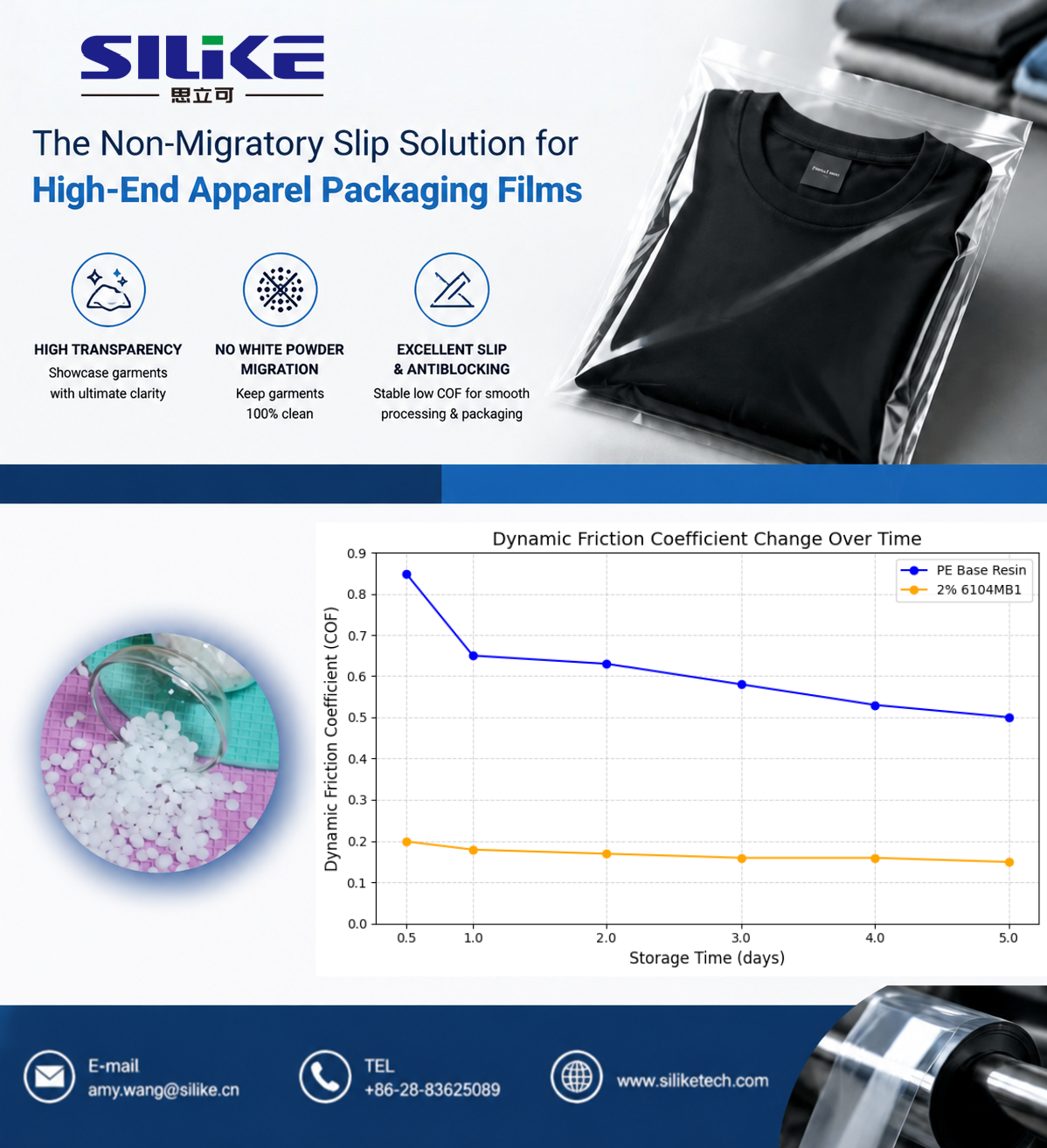
•Addition level: 2% SILIMER 6104MB1

Observed Performance

During production trials:

• Dynamic COF decreased significantly within 0.5 hours
• Stable low COF was maintained from Day 1 to Day 5
• Slip and antiblocking performance remained stable
• Film transparency stayed visually excellent
https://www.siliketech.com/silimer-6104mb1-slip-anti-blocking-masterbatch-for-packaging-apparel-films-product/

More importantly, during actual packaging operations involving black garments:

• No obvious white powder migration was observed
• Film surfaces remained visually cleaner
• Packaging appearance met premium market expectations

In practical blown film processing, cleaner film surfaces also helped improve handling consistency during packaging operations.

Why More Converters Are Evaluating Non-Migratory Slip Technology

As premium apparel packaging standards continue increasing, converters are paying closer attention to:

 Migration control
 Surface cleanliness
 Long-term COF stability
 Transparency retention
 Packaging consistency

For many converters, reducing downstream packaging complaints is becoming just as important as improving slip performance itself.

Industry Trend: Cleaner Packaging Films Are Becoming a Competitive Advantage

In the past, low COF alone was often considered sufficient for packaging films.

Today, premium apparel brands are evaluating packaging quality more comprehensively, including:

• Surface cleanliness
• Optical appearance
• Packaging consistency
• Contamination risk control
• Long-term storage performance

As a result, many converters are gradually shifting from traditional migratory slip systems toward cleaner non-blooming technologies.

FAQ

What causes white powder migration in packaging films?

White powder migration is typically caused by excessive surface blooming of migratory slip additives in polyethylene films.

Why is stable COF important in blown film packaging?

Stable COF helps improve machinability, packaging consistency, and high-speed line performance during storage and packaging operations.

What are the advantages of non-migratory slip additives?

Non-migratory slip technologies may help improve film cleanliness, reduce blooming behavior, stabilize COF, and maintain better transparency.

How does SILIMER 6104MB1 help apparel packaging films?

SILIMER 6104MB1 helps improve slip stability while reducing surface migration behavior in polyethylene blown film applications.

Conclusion

For apparel packaging film converters, balancing slip performance, transparency, and film cleanliness is becoming increasingly important.

Traditional migratory slip systems may create challenges such as:

• White powder migration
• Surface blooming
• Unstable COF
• Reduced optical appearance

As premium packaging standards continue evolving, non-migratory slip technology is becoming an increasingly valuable solution direction for blown film applications.

Non-migratory slip additive SILIMER 6104MB1 provides a practical approach for improving:

 Surface cleanliness
  Slip stability
  Transparency retention
  Packaging consistency
  High-speed packaging performance

in premium apparel packaging films.

Looking for a Cleaner Slip & Anti-blocking Solution for Apparel Packaging Films?

If your blown film applications are experiencing:

• White powder migration
• COF instability
• Surface blooming
• Transparency reduction
• Packaging inconsistency

…it may be time to evaluate non-migratory slip technology——SILIMER Series – Non-Migratory Super Slip & Anti-Blocking Masterbatch

Recommended Evaluation Support

• COF testing guidance
• Migration control evaluation
•  Blown film formulation recommendations
• Application testing support
• Sample evaluation for apparel packaging films

Welcome to visit the website at www.siliketech.com or contact Amy Wang directly via email at sale@levvymetal.com.

Powder Coat Booths

For those larger-sized parts, or smaller quantity runs, we have 2 independent powder coat booths and ovens. The quality, durability and affordability of today’s powder coating finishes make this the process of choice for world-class companies.

Powder coating advantages over other forms of coating are many. Materials used in the Powder coating process can be metals and non-metals that come in a multitude of thicknesses, textures, colors, etc. Another of Powder coating’s biggest advantages over conventional coatings is its ability to create finishes in many different textures. Powder Coating Booths allow us the ability to apply these advantages to large products.

Wet Paint Line

Tri-State Fabricators runs a full-service conveyor line for painting. Wet painting can provide protection or decoration to many different part styles. From start to finish, every project is easier to undergo random and point-based inspection by our skilled painting team.

Advantages to our Wet Paint Line are these lines start with product prep and ends with a thorough inspection of a high quality finished product. Our ability to complete large and small projects with a superior finish and doing so in a timely and economical fashion. This passes along the savings in production to our customers. When powder coating ins not an option, our Wet Paint Line gets the job done right the first time.

Wet Paint Booths

When the parts get big and heavy we roll-out our custom paint racks and oversize booth. By utilizing our partnerships with all the major paint brands, we can match virtually any color with wet paint.

The advantages of having access to a Wet Paint Booth are many. Large projects of many different shapes can be loaded into the booth. The Wet Paint Booth offers an environment that is much more controlled than a typical parts painting operation.

Not only are they used because of their controlled environment, but they’re are also advantageous when it comes to applying paint to parts that are needed in industries that require specialty coatings such as medical, aerospace, etc.

Military CARC

Our military forces have some very high standards when it comes to the finish of their vehicles and equipment. From the first pre-treatment step to final coat, it takes a great deal of knowledge and experience to protect the men and women of our armed forces. They deserve only the best, and Tri-State Fabricators provides it.

All of our processes are closely monitored by our staff and management teams. Both of which are highly trained in the processes of metal fabrication and finishing. Tri-State Fabricators’ goal is to always fully satisfy each and every customer, including the military. We will always put a 110% into what we do.

Glass-Bead Blasting

Abrasive media blasting is an excellent way to remove old paint, rust, and increase the paint/powder adhesion. Glass beads produce a much smoother and brighter finish than angular abrasives; leaving the part clean yet without any dimensional change. Chemically inert and environmentally friendly, we can recycle our beads approximately 30 times; making them a more preferred method of metal cleaning or surface finishing.

Advantages to Glass Bead Blasting are many. Glass bead blast media is used when a project is needing rough surfaces need to become smooth for applications of coatings such as paint. It is typically used to clean paint and rust from a product surface without deforming the surface it is being used on. Overall, compared to many other blasting media, Glass Bead Blasting is a very economical choice and those savings are always passed on to our customers.

Part Washing

Tri-State Fabricators utilize a zinc phosphate wash to clean and etch the material to ensure the best paint adhesion possible. The unique design of our 3-stage wash system does the work like a 5-stage. From Cleaning and rinsing to conversion coating and post-treatment, Our Part Washing process is a complete service and works throughout the fabrication service and the finishing service.

Along with the previously mentioned benefits, Curing is a vital chemical reaction that leaves the product finish hard and relatively safe from mild abrasion and aggressive corrosion. This process can be done in more than one way; ambient air-dry or in curing ovens at temps that exceed 240°.

Burn-Off Oven

From fixing paint mistakes (someone else’s of course) to simply cleaning our paint line hooks, our burn-off oven is put to good use. After a quick burn-off, a little clean up, and a fresh coat of paint, your parts will look better than new.

Why does our Burn-Off Oven work so well? Because super heating the air around parts turns the materials into ashes. From paint and powder coatings to rubber and machining oils, high temps do the job without degrading the integrity of the part.

Masking

Masking is a vital part of producing high quality products. We have die-cut masking patterns to protect machined surfaces as well as a wide range of plugs and caps to protect threaded holes and bolts. We provide permanent and temporary masking.

Masking allows the selected sections of a product to be protected from a fabrication or finishing service. This can be with both chemicals when etching and tapes, paints when only finishing just a section of the product. Masking is great in aiding the customization process of a project.

Screen Printing

Screen printing is a photographic process that transfers artwork onto a porous nylon screen which allows colored ink to flow through the screen and be deposited on an aluminum or plastic component. We can generally have just about any design created onto a screen for your parts.

Some of the advantages of Screen Printing are, brand recognition for your business displaying on your products, assembly instructions, product warnings/hazards, etc. Tri-State Fabricators produces Screen Printing of the highest quality so you know it’s durable.

Metal Finishing

Metal Finishing is the art of treating the exterior portion of product, often metal but can also be made of other materials, so that the surface is clean and free of any debris. Then the process of applying coats or either paint of powder coat takes place. This coating process improves the quality of the product in both appearance and resistance to wear and corrosion.

Tri-State Fabricators, Inc., understands that a project typically isn’t complete until a high-quality finish has been added to your product. This is why our painting and powder coating teams continuously inspect the products throughout the Metal Finishing process.

