
Si-TPV 3100 Series Enables Next-Generation Comfort Interfaces in a Globally Evolving Climate Control Landscape

Rethinking thermal comfort in an era of climate volatility and rising cooling demand

Across the world, climate systems are experiencing increasing variability, with more frequent and intense heatwaves in some regions and colder-than-average seasonal anomalies in others. This growing instability is reshaping how societies approach indoor climate control, energy consumption, and personal thermal comfort.

At the same time, global discussions around climate change and energy transition continue to influence how heating and cooling systems are designed, adopted, and integrated into daily life. Rather than focusing on a single direction of temperature change, the broader trend reflects a more dynamic and unpredictable thermal environment, where both cooling and heating demands may fluctuate more sharply over time.

In this context, air conditioning and related climate-control technologies are evolving from purely environmental systems into human-centric comfort infrastructures.

From environmental control to personal thermal experience

Traditionally, HVAC systems were designed to regulate entire indoor environments. However, emerging market behavior and technology development show a gradual shift toward:

  • Localized thermal comfort
  • Portable cooling and heating devices
  • Wearable climate regulation systems
  • Smart, on-demand environmental control

This evolution reflects a broader idea:

Comfort is increasingly defined at the individual level rather than the room level.

As a result, the user interface and physical touchpoints of climate-control systems are becoming just as important as the core mechanical systems themselves.

Si-TPV 3100 Series: material support for comfort-driven interaction systems

Within this transformation, Si-TPV 3100 Series is positioned as a material solution for the human interaction layer of climate-control ecosystems, rather than the cooling or heating mechanism itself.

Its relevance lies in applications where users physically interact with devices that manage thermal comfort, including:

Si-TPV (Dynamic Vulcanizate Thermoplastic Silicone-based Elastomer) provides a versatile solution by combining silicone-like softness with thermoplastic processing advantages.
1. Smart climate control interfaces
2. Portable cooling and heating devices
3. Personal and wearable thermal comfort systems

Modern HVAC systems are increasingly integrated into smart home ecosystems, requiring intuitive and frequently used control elements such as:

Remote controllers

Touch-based interfaces

Adjustment knobs and handheld devices

These components benefit from enhanced tactile comfort and improved user experience under repeated daily interaction.
 
 
Material role: enhancing the “touchpoint layer” of climate systems

Material role: enhancing the “touchpoint layer” of climate systems

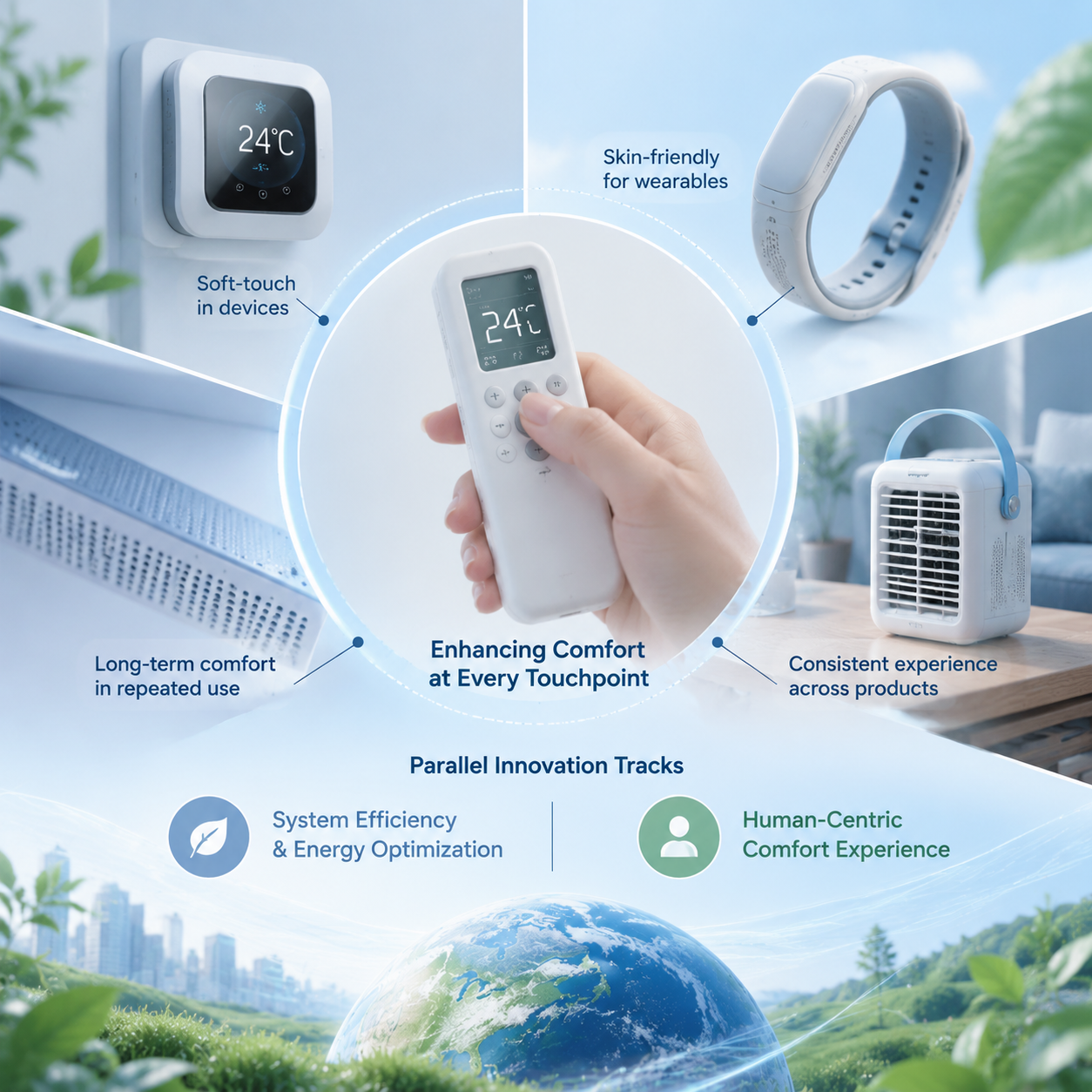
Rather than acting as a structural or functional cooling material, Si-TPV 3100 Series is aligned with the interface and experience layer of climate-control technologies.

Its application focus is centered on improving:

Soft-touch perception in handheld devices

Skin-friendly interaction surfaces in wearable systems

Long-term comfort in repeated-contact components

User experience consistency across climate-related products

In this sense, material innovation contributes not to temperature regulation itself, but to how users experience and interact with thermal comfort technologies.

Industry outlook: comfort experience as a parallel innovation track

As global climate conditions become more variable and energy systems continue to evolve, the climate-control industry is developing along two parallel tracks:

System efficiency and energy optimization

Human-centric comfort experience enhancement

While the first focuses on energy and performance, the second emphasizes usability, ergonomics, and sensory experience.

In this second dimension, advanced thermoplastic elastomer systems such as Si-TPV 3100 Series are increasingly relevant to:

Smart home climate interfaces

Portable environmental control devices

Wearable thermal comfort solutions

The evolution of climate-control technologies is no longer defined solely by temperature regulation capacity, but also by how seamlessly these systems integrate into human behavior, daily interaction, and physical comfort expectations.

As a result, materials that enhance tactile experience and interface quality are becoming an important part of the broader climate technology ecosystem.

As climate control technologies continue to evolve toward more human-centric and experience-driven solutions, material innovation is playing an increasingly important role in shaping how users interact with smart environments. Si-TPV 3100 Series supports this transition by enhancing the comfort, tactility, and usability of key touchpoints across smart home systems, portable devices, and wearable thermal solutions.

For more information on material solutions and application development, please feel free to contact our team.

Contact

SILIKE Silicone Materials Team
Website: https://www.si-tpv.com/
Email: sale@levvymetal.com
Inquiry: Available via official website contact form

Powder Coat Booths

For those larger-sized parts, or smaller quantity runs, we have 2 independent powder coat booths and ovens. The quality, durability and affordability of today’s powder coating finishes make this the process of choice for world-class companies.

Powder coating advantages over other forms of coating are many. Materials used in the Powder coating process can be metals and non-metals that come in a multitude of thicknesses, textures, colors, etc. Another of Powder coating’s biggest advantages over conventional coatings is its ability to create finishes in many different textures. Powder Coating Booths allow us the ability to apply these advantages to large products.

Wet Paint Line

Tri-State Fabricators runs a full-service conveyor line for painting. Wet painting can provide protection or decoration to many different part styles. From start to finish, every project is easier to undergo random and point-based inspection by our skilled painting team.

Advantages to our Wet Paint Line are these lines start with product prep and ends with a thorough inspection of a high quality finished product. Our ability to complete large and small projects with a superior finish and doing so in a timely and economical fashion. This passes along the savings in production to our customers. When powder coating ins not an option, our Wet Paint Line gets the job done right the first time.

Wet Paint Booths

When the parts get big and heavy we roll-out our custom paint racks and oversize booth. By utilizing our partnerships with all the major paint brands, we can match virtually any color with wet paint.

The advantages of having access to a Wet Paint Booth are many. Large projects of many different shapes can be loaded into the booth. The Wet Paint Booth offers an environment that is much more controlled than a typical parts painting operation.

Not only are they used because of their controlled environment, but they’re are also advantageous when it comes to applying paint to parts that are needed in industries that require specialty coatings such as medical, aerospace, etc.

Military CARC

Our military forces have some very high standards when it comes to the finish of their vehicles and equipment. From the first pre-treatment step to final coat, it takes a great deal of knowledge and experience to protect the men and women of our armed forces. They deserve only the best, and Tri-State Fabricators provides it.

All of our processes are closely monitored by our staff and management teams. Both of which are highly trained in the processes of metal fabrication and finishing. Tri-State Fabricators’ goal is to always fully satisfy each and every customer, including the military. We will always put a 110% into what we do.

Glass-Bead Blasting

Abrasive media blasting is an excellent way to remove old paint, rust, and increase the paint/powder adhesion. Glass beads produce a much smoother and brighter finish than angular abrasives; leaving the part clean yet without any dimensional change. Chemically inert and environmentally friendly, we can recycle our beads approximately 30 times; making them a more preferred method of metal cleaning or surface finishing.

Advantages to Glass Bead Blasting are many. Glass bead blast media is used when a project is needing rough surfaces need to become smooth for applications of coatings such as paint. It is typically used to clean paint and rust from a product surface without deforming the surface it is being used on. Overall, compared to many other blasting media, Glass Bead Blasting is a very economical choice and those savings are always passed on to our customers.

Part Washing

Tri-State Fabricators utilize a zinc phosphate wash to clean and etch the material to ensure the best paint adhesion possible. The unique design of our 3-stage wash system does the work like a 5-stage. From Cleaning and rinsing to conversion coating and post-treatment, Our Part Washing process is a complete service and works throughout the fabrication service and the finishing service.

Along with the previously mentioned benefits, Curing is a vital chemical reaction that leaves the product finish hard and relatively safe from mild abrasion and aggressive corrosion. This process can be done in more than one way; ambient air-dry or in curing ovens at temps that exceed 240°.

Burn-Off Oven

From fixing paint mistakes (someone else’s of course) to simply cleaning our paint line hooks, our burn-off oven is put to good use. After a quick burn-off, a little clean up, and a fresh coat of paint, your parts will look better than new.

Why does our Burn-Off Oven work so well? Because super heating the air around parts turns the materials into ashes. From paint and powder coatings to rubber and machining oils, high temps do the job without degrading the integrity of the part.

Masking

Masking is a vital part of producing high quality products. We have die-cut masking patterns to protect machined surfaces as well as a wide range of plugs and caps to protect threaded holes and bolts. We provide permanent and temporary masking.

Masking allows the selected sections of a product to be protected from a fabrication or finishing service. This can be with both chemicals when etching and tapes, paints when only finishing just a section of the product. Masking is great in aiding the customization process of a project.

Screen Printing

Screen printing is a photographic process that transfers artwork onto a porous nylon screen which allows colored ink to flow through the screen and be deposited on an aluminum or plastic component. We can generally have just about any design created onto a screen for your parts.

Some of the advantages of Screen Printing are, brand recognition for your business displaying on your products, assembly instructions, product warnings/hazards, etc. Tri-State Fabricators produces Screen Printing of the highest quality so you know it’s durable.

Metal Finishing

Metal Finishing is the art of treating the exterior portion of product, often metal but can also be made of other materials, so that the surface is clean and free of any debris. Then the process of applying coats or either paint of powder coat takes place. This coating process improves the quality of the product in both appearance and resistance to wear and corrosion.

Tri-State Fabricators, Inc., understands that a project typically isn’t complete until a high-quality finish has been added to your product. This is why our painting and powder coating teams continuously inspect the products throughout the Metal Finishing process.