


10 Tips for Choosing Hydraulic Piston Seals

Hydraulic Piston Seals may look like small components, but they control leakage, pressure retention, and smooth cylinder movement. A poor choice can leave oil on the workshop floor, score a piston, or stop a machine during a demanding shift. The right seal depends on more than its diameter. Pressure, temperature, fluid compatibility, speed, and installation conditions all matter.

A composite industry voice, hydraulic sealing specialist Alex Morgan, offers this illustrative principle: “A seal succeeds when its material, groove, and operating conditions work together.” This is an editorially created quotation, not a sourced statement from a real expert. Still, the principle reflects a practical lesson: even a premium seal can fail in a worn groove or with an incompatible fluid. Small details matter.

This guide presents 10 tips for choosing Hydraulic Piston Seals with those real-world conditions in mind. It covers seal materials, profile selection, operating limits, surface finish, and installation checks. A careful review of the equipment manual and supplier specifications can prevent costly guesswork. Yet specifications do not tell the whole story. Existing wear, temperature swings, and unexpected pressure spikes may complicate the choice. That is the catch. Use the tips as a structured starting point, then confirm critical selections with a qualified seal supplier or hydraulic engineer. A little uncertainty is worth acknowledging; the wrong assumption can be expensive.
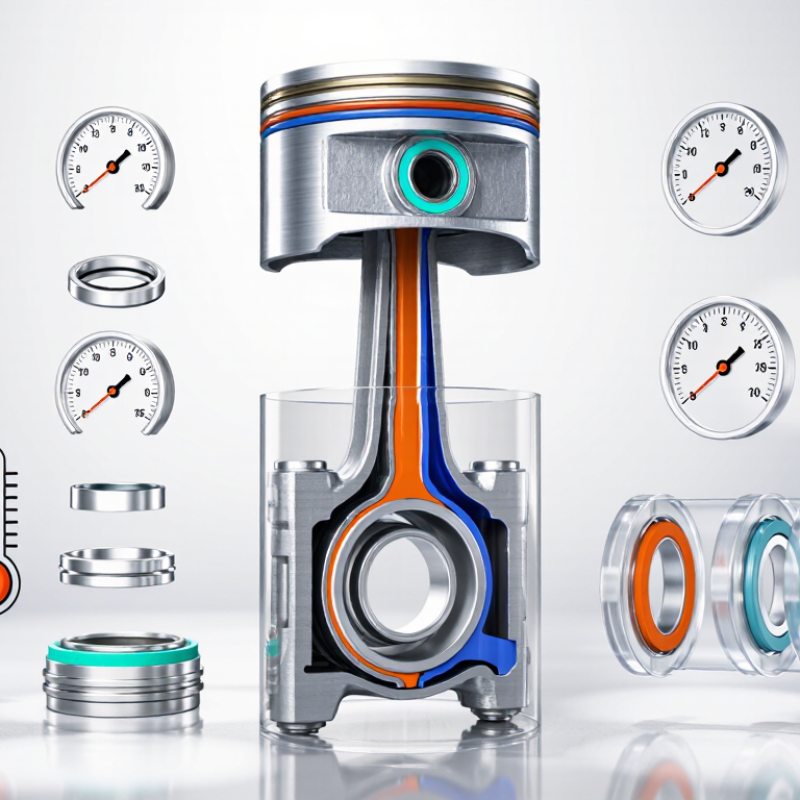
10 Tips for Choosing Hydraulic Piston Seals

Define Operating Duty: Pressure up to 35 MPa, Speed, Stroke, and Temperature

Define the full duty before choosing a hydraulic piston seal. A peak pressure of 35 MPa equals 350 bar. ISO 6022:2018 specifies a 25 MPa nominal-pressure series for hydraulic cylinders, making 35 MPa a useful warning to check the cylinder, seal clearance, and extrusion risk together. That comparison is a screening point, not a seal failure threshold. Record pressure spikes during startup, reversal, and impact—not just steady pressure. ISO 10771-1:2015 describes fatigue testing for pressure-containing components, a reminder that repeated cycles deserve attention. Static ratings alone can mislead.

Measure loaded piston speed, stroke length, cycle frequency, and dwell time. For example, a 0.5 m stroke at 0.2 m/s takes 2.5 seconds in one direction. Faster travel can increase frictional heating; long strokes also expose the seal to more sliding distance. Small detail. It matters. Note fluid temperature at the seal, including cold starts and heat after repeated cycles. Then check the proposed seal’s limits against the actual fluid, surface finish, and extrusion gap. Real machines rarely match a neat test bench. Leave margin for the duty you measured, and revisit assumptions when field temperatures or pressure peaks differ.

10 Tips for Choosing Hydraulic Piston Seals — Define Operating Duty: Pressure up to 35 MPa, Speed, Stroke, and Temperature
Operating Dimension Example Duty What to Specify Seal Selection and Design Check
Maximum pressure Up to 35 MPa (350 bar) Peak and continuous pressure, pressure spikes, and whether pressure acts in one or both directions Confirm the seal profile, material, and extrusion-gap limits at the maximum pressure. Check the gland and piston dimensions against the seal supplier’s design data.
Operating speed 0.1–0.5 m/s as an example reciprocating range Average and peak speed, direction changes, and time spent at each speed Check friction, heat generation, lubrication, and wear at the actual pressure and speed combination. Do not assess speed as an independent limit.
Stroke length 500 mm per working stroke as an example duty Full stroke, stroke frequency, dwell time, and total daily operating time Long or frequent strokes can increase frictional heat and wear. Evaluate the complete motion cycle and ensure the seal remains lubricated throughout travel.
Fluid temperature 20–80°C operating range; record any short-duration peaks Minimum start-up temperature, normal fluid temperature, and maximum peak temperature Choose an elastomer or thermoplastic compatible with both the fluid and the full temperature range. Temperature capability depends on the specific compound and seal design.
Hydraulic fluid For example, mineral-oil-based hydraulic fluid Fluid type, additives, water content, and any change of fluid during service Verify material compatibility with the exact fluid. Fluids such as water-glycol or phosphate ester may require different seal materials.
Extrusion gap and clearance Measure the maximum clearance at operating pressure and temperature Piston-to-bore clearance, tolerance stack-up, side loading, and housing deflection High pressure can force seal material into an excessive gap. Confirm extrusion resistance and consider a suitable backup ring when the design requires one.
Surface finish and alignment Use the cylinder and piston finish specified for the selected seal profile Surface roughness, lead, scratches, bore roundness, and rod or piston alignment Finish requirements vary by seal material and profile. Check the seal manufacturer’s surface-finish guidance and inspect for damage that could create a leak path.
Duty-cycle validation Example: repeated extension and retraction under changing load Pressure, speed, stroke, temperature, and cycle frequency together Validate the combined duty in the intended cylinder or a representative test setup. A seal suitable for each individual condition may not suit their combined effects.
Example screening values are for defining an application duty, not guaranteed seal ratings. Confirm final limits with the seal design data and the complete cylinder specification.

Match Piston Seal Profiles to ISO 7425-1 Housing Dimensions

ISO 7425-1 provides housing dimensions for piston seals with elastomer-energized plastic sealing faces. Use it to check the groove dimensions against the selected seal profile, not as proof that the seal suits every cylinder. Confirm the standard edition and compare its tolerances with the seal manufacturer’s data. Small differences matter.

Tips: Measure the bore and groove carefully. Check groove width, depth, corner radii, and the clearance between piston and cylinder. A caliper may help with an initial check, but critical dimensions need suitable measuring equipment. Keep the values and tolerances on the drawing. Don’t rely on nominal dimensions alone.

A profile that fits the housing still needs to suit pressure, temperature, fluid, and movement speed. Consider installation space, too; a sharp edge can damage a sealing lip during assembly. A clean drawing can feel reassuring, but it may not show wear, surface finish, or real operating conditions. Verify those details before selecting the final profile, and review the fit after assembly.

Compare Typical Elastomer Limits: NBR −30 to +100 °C, FKM −20 to +200 °C

10 Tips for Choosing Hydraulic Piston Seals

Temperature is a selection limit, not a performance guarantee. Common engineering reference tables place NBR service ranges near −30 to +100 °C and FKM near −20 to +200 °C. Actual limits shift with compound, pressure, fluid, and exposure time. A seal near its upper limit may harden, lose elasticity, or wear faster. Check the compound’s data sheet, not just the polymer name. Small details matter.

Use these ranges as screening values. ISO 23936-2 addresses qualification of elastomeric materials for oil and gas environments, while ASTM D573 evaluates rubber deterioration in heated air. Neither standard makes a generic temperature range safe for every hydraulic cylinder. Fluid compatibility matters: an elastomer that tolerates heat may still swell in the chosen oil. Consider cold starts, too. NBR near −30 °C can stiffen, and brief movement may damage a seal before the oil warms.

Compare peak temperature with the actual seal-groove temperature, measured during a representative duty cycle. Include pressure spikes, dwell time, and frictional heating. A cylinder running at 90 °C continuously is not equivalent to one reaching 90 °C briefly. Ask suppliers for test conditions and compound-specific limits, then verify them in the intended fluid. Charts simplify things. They also leave room for error.

Check Fluid Compatibility Against ISO 11158 Hydraulic Fluid Classes

ISO 11158 classifies hydraulic fluids by performance, not by seal compatibility. Common classes include HH, HL, HM, HV, and HG. That distinction matters. HM fluids include anti-wear properties, while HV fluids are designed for improved viscosity-temperature behavior. Formulations and additives can vary within a class. An unsuitable fluid may cause a piston seal to swell, harden, or lose its sealing performance. Check the fluid data sheet against the seal material’s documented limits, rather than relying on the class label alone.

Tips: Confirm the exact fluid formulation, seal material, and operating temperature range. Check viscosity grade and additives, too. For example, a polyurethane seal exposed to a fluid outside its approved temperature range may not behave as expected. HG fluids can contain friction modifiers, so verify those additives with the seal supplier. If a system changes from HM to HV, reassess the pairing—even if both fluids look similar. Small tests help.

Where practical, follow supplier guidance for a compatibility test before full service. Record the seal’s dimensions and condition before and after exposure. Look for swelling, surface changes, or loss of flexibility. This check is easy to rush. A clean-looking sample alone does not prove long-term compatibility.

Assess Extrusion Gaps, Backup Rings, and Cylinder Surface Finish

Extrusion gaps deserve a worst-case check, not a nominal drawing check. Pressure, temperature, bore tolerance, and piston eccentricity all affect the opening behind the seal. ISO 5597:2018 standardizes housing dimensions for piston and rod seals, but it does not replace a pressure-specific clearance review. Match the maximum radial gap to seal material, hardness, and operating pressure. Backup rings can reduce extrusion risk when clearance is unavoidable. They cannot fix a poorly controlled gap. Small gaps matter.

Cylinder finish matters just as much. A honed bore with Ra around 0.1–0.4 μm is a useful starting range in hydraulic sealing guidance, not a universal acceptance limit. Check the seal design’s specified Ra and Rz, then verify the actual bore with a calibrated instrument. ISO 21920-2:2021 defines profile surface-texture parameters, including Ra. Look for scratches, torn metal, and sharp port edges; a single burr can damage a new seal during assembly. Keep the measurement record with the cylinder inspection. It is easy to overlook Rz when focusing only on Ra, and that deserves a second look.

Typical Surface-Finish Targets for Hydraulic Seals

Common guidance for sliding surfaces and seal grooves, shown as Ra ranges in micrometres (µm).

These are typical reference ranges, not universal limits; confirm the finish required for the specific seal design and material. When assessing piston seals, also check extrusion clearance against operating pressure and use backup rings where the design requires them.

Powder Coat Booths

For those larger-sized parts, or smaller quantity runs, we have 2 independent powder coat booths and ovens. The quality, durability and affordability of today’s powder coating finishes make this the process of choice for world-class companies.

Powder coating advantages over other forms of coating are many. Materials used in the Powder coating process can be metals and non-metals that come in a multitude of thicknesses, textures, colors, etc. Another of Powder coating’s biggest advantages over conventional coatings is its ability to create finishes in many different textures. Powder Coating Booths allow us the ability to apply these advantages to large products.

Wet Paint Line

Tri-State Fabricators runs a full-service conveyor line for painting. Wet painting can provide protection or decoration to many different part styles. From start to finish, every project is easier to undergo random and point-based inspection by our skilled painting team.

Advantages to our Wet Paint Line are these lines start with product prep and ends with a thorough inspection of a high quality finished product. Our ability to complete large and small projects with a superior finish and doing so in a timely and economical fashion. This passes along the savings in production to our customers. When powder coating ins not an option, our Wet Paint Line gets the job done right the first time.

Wet Paint Booths

When the parts get big and heavy we roll-out our custom paint racks and oversize booth. By utilizing our partnerships with all the major paint brands, we can match virtually any color with wet paint.

The advantages of having access to a Wet Paint Booth are many. Large projects of many different shapes can be loaded into the booth. The Wet Paint Booth offers an environment that is much more controlled than a typical parts painting operation.

Not only are they used because of their controlled environment, but they’re are also advantageous when it comes to applying paint to parts that are needed in industries that require specialty coatings such as medical, aerospace, etc.

Military CARC

Our military forces have some very high standards when it comes to the finish of their vehicles and equipment. From the first pre-treatment step to final coat, it takes a great deal of knowledge and experience to protect the men and women of our armed forces. They deserve only the best, and Tri-State Fabricators provides it.

All of our processes are closely monitored by our staff and management teams. Both of which are highly trained in the processes of metal fabrication and finishing. Tri-State Fabricators’ goal is to always fully satisfy each and every customer, including the military. We will always put a 110% into what we do.

Glass-Bead Blasting

Abrasive media blasting is an excellent way to remove old paint, rust, and increase the paint/powder adhesion. Glass beads produce a much smoother and brighter finish than angular abrasives; leaving the part clean yet without any dimensional change. Chemically inert and environmentally friendly, we can recycle our beads approximately 30 times; making them a more preferred method of metal cleaning or surface finishing.

Advantages to Glass Bead Blasting are many. Glass bead blast media is used when a project is needing rough surfaces need to become smooth for applications of coatings such as paint. It is typically used to clean paint and rust from a product surface without deforming the surface it is being used on. Overall, compared to many other blasting media, Glass Bead Blasting is a very economical choice and those savings are always passed on to our customers.

Part Washing

Tri-State Fabricators utilize a zinc phosphate wash to clean and etch the material to ensure the best paint adhesion possible. The unique design of our 3-stage wash system does the work like a 5-stage. From Cleaning and rinsing to conversion coating and post-treatment, Our Part Washing process is a complete service and works throughout the fabrication service and the finishing service.

Along with the previously mentioned benefits, Curing is a vital chemical reaction that leaves the product finish hard and relatively safe from mild abrasion and aggressive corrosion. This process can be done in more than one way; ambient air-dry or in curing ovens at temps that exceed 240°.

Burn-Off Oven

From fixing paint mistakes (someone else’s of course) to simply cleaning our paint line hooks, our burn-off oven is put to good use. After a quick burn-off, a little clean up, and a fresh coat of paint, your parts will look better than new.

Why does our Burn-Off Oven work so well? Because super heating the air around parts turns the materials into ashes. From paint and powder coatings to rubber and machining oils, high temps do the job without degrading the integrity of the part.

Masking

Masking is a vital part of producing high quality products. We have die-cut masking patterns to protect machined surfaces as well as a wide range of plugs and caps to protect threaded holes and bolts. We provide permanent and temporary masking.

Masking allows the selected sections of a product to be protected from a fabrication or finishing service. This can be with both chemicals when etching and tapes, paints when only finishing just a section of the product. Masking is great in aiding the customization process of a project.

Screen Printing

Screen printing is a photographic process that transfers artwork onto a porous nylon screen which allows colored ink to flow through the screen and be deposited on an aluminum or plastic component. We can generally have just about any design created onto a screen for your parts.

Some of the advantages of Screen Printing are, brand recognition for your business displaying on your products, assembly instructions, product warnings/hazards, etc. Tri-State Fabricators produces Screen Printing of the highest quality so you know it’s durable.

Metal Finishing

Metal Finishing is the art of treating the exterior portion of product, often metal but can also be made of other materials, so that the surface is clean and free of any debris. Then the process of applying coats or either paint of powder coat takes place. This coating process improves the quality of the product in both appearance and resistance to wear and corrosion.

Tri-State Fabricators, Inc., understands that a project typically isn’t complete until a high-quality finish has been added to your product. This is why our painting and powder coating teams continuously inspect the products throughout the Metal Finishing process.

