Top 10 Flywheel Housing Manufacturers Worldwide
Flywheel Housing remains a critical, often overlooked component in modern powertrain systems. It connects the engine block, transmission, starter, and clutch assembly. A few millimeters of misalignment can create vibration, noise, oil leakage, or premature bearing wear. These failures become expensive when equipment operates in mines, ports, farms, or remote construction sites.
Global production data explains why this component still matters. The International Organization of Motor Vehicle Manufacturers reported approximately 93.5 million vehicles produced worldwide in 2023. The International Energy Agency also recorded nearly 14 million electric vehicle sales that year. Electrification is advancing, but internal combustion engines remain essential across commercial vehicles, marine systems, agricultural machinery, and off-highway equipment. Research reports from MarketsandMarkets and Grand View Research continue to identify engine components and powertrain systems as substantial industrial markets.
MIT engine expert John B. Heywood has often observed, “The internal combustion engine will be with us for a long time.” His point deserves a practical reading. The market is changing, not disappearing. This article examines the Top 10 Flywheel Housing Manufacturers Worldwide, focusing on casting quality, dimensional control, material strength, machining capability, and global service support. Company scale alone is not enough. Supplier reliability matters more when a housing must survive heat cycles, torsional loads, and continuous vibration.
No ranking is perfect. Public data differs between manufacturers, and some private suppliers disclose very little. That limitation should be acknowledged. The following overview therefore combines industry reputation, technical capability, production reach, and application experience.
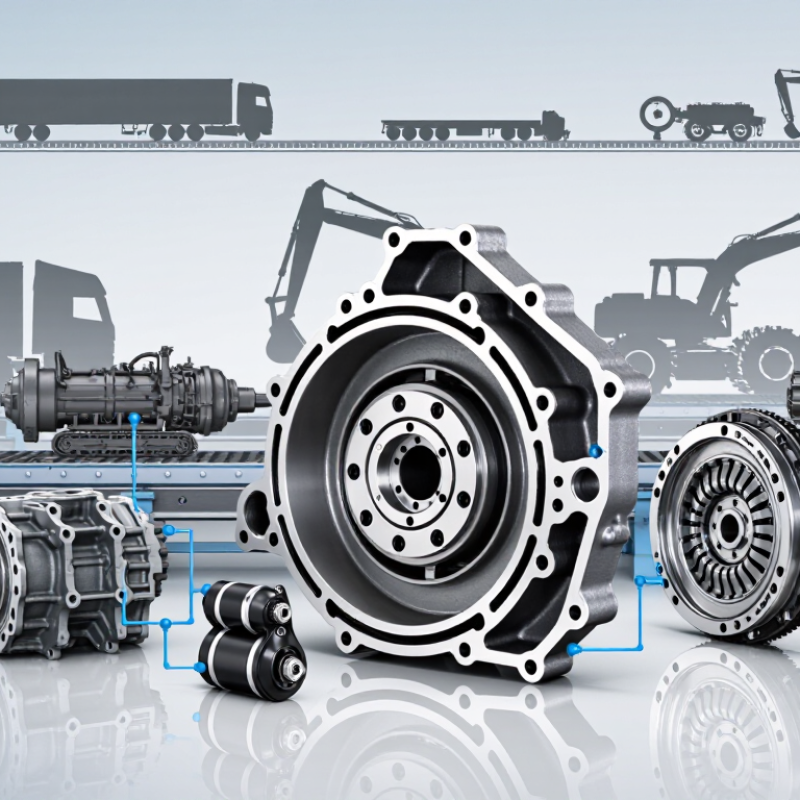
Definition and Role of Flywheel Housings in Powertrain Systems
A flywheel housing is the structural enclosure between an engine and a transmission. It surrounds the flywheel and clutch, while preserving a precise connection between major powertrain components. Its primary duties include alignment, protection, noise control, and support for related seals or sensors. It also helps contain debris if a rotating part fails. That protective function demands serious engineering.
During operation, the housing carries vibration, heat, and torsional loads. Machining accuracy matters because even small alignment errors can accelerate clutch wear. Manufacturers typically select cast iron, aluminum alloys, or engineered composites according to strength, weight, temperature, and production needs. Cooling passages and inspection openings may improve service access, but every opening can affect stiffness or sealing. Designers must balance these competing demands rather than chase minimum weight alone. That balance is not easy.
In real workshops, technicians inspect bolt patterns, dowel locations, cracks, oil leakage, and contact marks around the mounting flange. They also check abnormal vibration after installation, because a housing can appear sound while hiding a fitment problem. Reliable suppliers document material grades, dimensional tolerances, heat treatment, and inspection results. Those records support traceability and safer maintenance decisions. Still, specifications do not replace judgment. A drawing may be correct, yet field conditions can expose weaknesses. That is where careful feedback should improve the next design.
Top 10 Flywheel Housing Manufacturers Worldwide — Definition and Role in Powertrain Systems
Flywheel housings enclose and support the flywheel and clutch area, helping align powertrain components and contain debris. The chart shows approximate material densities commonly relevant to housing design; it is not a manufacturer ranking.
Approximate reference values: magnesium alloys 1.74, aluminum alloys 2.70, cast iron 7.20, and steel 7.85 g/cm³. Actual density varies by alloy and grade.
Criteria for Ranking the Top 10 Manufacturers Worldwide
A credible ranking of the top flywheel housing manufacturers should measure more than production volume. OICA reported approximately 93.5 million motor vehicles produced worldwide in 2023, indicating the scale and diversity of the market these components serve. The ranking should assess documented manufacturing capacity, geographic reach, and experience supplying different engine and transmission configurations. Evidence matters: audited company disclosures and traceable product specifications are stronger indicators than unsupported marketing claims.
Quality and engineering deserve equal weight. Compare material specifications, dimensional tolerances, machining capability, and documented inspection processes. SAE standards can help frame technical comparisons, but compliance claims should be verified against current documentation. After-sales support, delivery reliability, and the ability to provide application-specific housings also distinguish suppliers. No single public dataset covers every manufacturer, so rankings should disclose their sources and acknowledge gaps. That is less tidy, but more honest.
Tips: Check whether published certifications apply to the actual production site. Request sample inspection records, drawings, and lead-time data. Treat broad claims cautiously. A polished catalogue is not proof of consistent quality.
Profiles of the Top 10 Flywheel Housing Manufacturers
The ten manufacturers profiled here represent different approaches to producing flywheel housings for commercial vehicles, industrial engines, and agricultural machinery. Their strengths are easier to compare through engineering capability, manufacturing scale, and application focus than through a simple ranking. A housing must align the engine and transmission while containing noise and resisting vibration. Small dimensional errors can complicate assembly.
Some manufacturers emphasize high-volume casting, using controlled cooling and machining to maintain repeatable dimensions. Others focus on custom or lower-volume work, where drawings may be adapted for older engines or specialized equipment. That flexibility can be valuable, but it may also mean longer lead times. Details matter.
A useful profile should examine material choices, machining processes, inspection methods, and support for replacement parts. Buyers can also ask how suppliers verify mounting faces and bolt-hole positions, since these affect fit during installation. Public information is not always consistent, and a polished catalogue cannot confirm production quality by itself. This comparison therefore treats stated capabilities as a starting point, not proof. The right supplier depends on operating conditions, required tolerances, order volume, and the availability of technical documentation.
Materials, Manufacturing Methods, and Engineering Technologies
Flywheel housings protect the clutch and flywheel while helping maintain alignment between the engine and transmission. Their material choice affects weight, heat transfer, vibration, and resistance to impact. Cast iron remains useful where stiffness and damping matter, though it adds considerable mass. Aluminum alloys can reduce weight and conduct heat quickly, but designers must account for lower stiffness and local stress concentrations. No material is best in every application.
Manufacturing begins with a housing geometry designed around bolt locations, access openings, and clearance for moving parts. Sand casting can produce complex shapes, while permanent-mold casting may offer more consistent surfaces in suitable production runs. After casting, machining creates accurate mating faces and mounting holes. Even small deviations can complicate installation. That sounds obvious, yet it is easy to underestimate.
Engineering checks may include dimensional inspection, crack detection, and analysis of vibration and thermal behavior. Finite-element models help identify highly stressed regions, but they depend on realistic inputs and still need validation against physical parts. Engineers may add ribs for stiffness, then discover that thicker sections increase weight or create uneven cooling during casting. This tradeoff deserves another look. A dependable housing is not simply strong; it must fit precisely, dissipate heat appropriately, and remain manufacturable at a consistent quality level.
Industry Applications, Global Markets, and Supplier Comparison
Flywheel housings serve heavy trucks, buses, agricultural machinery, construction equipment, and stationary power systems. They protect the clutch and flywheel while aligning the engine and transmission. Fit matters. A small alignment error can cause vibration, uneven clutch wear, or difficult installation. OICA reported approximately 93.5 million motor vehicles produced worldwide in 2023, indicating the scale of the broader vehicle supply chain. That figure does not measure flywheel housing demand directly, however; replacement cycles and equipment types vary widely.
Global markets differ in what buyers prioritize. Vehicle and machinery production supports demand in Asia, Europe, and the Americas, while aftermarket needs depend on fleet age and repair practices. The International Energy Agency reported that electric car sales exceeded 14 million in 2023. This shift may reshape some powertrain demand, but it does not remove the need for housings in conventional vehicles and many industrial engines. Change is uneven.
Supplier comparisons should examine more than unit price. Buyers can assess material specifications, casting consistency, machining tolerances, corrosion protection, testing records, and delivery capacity. For example, a housing used in a dusty quarry faces different vibration and service demands from one fitted to a city bus. ISO quality-system certification can help evaluate manufacturing controls, but it cannot replace component-level inspection. Ask for dimensional reports and application-specific validation. A low quote is tempting; poor fit can cost more later. Industry reports provide useful context, yet public data rarely isolates this component’s market, so forecasts deserve caution.





