


Top 10 Rubber Timing Belts Manufacturers Worldwide

Rubber Timing Belts keep engines, conveyors, packaging machines, and robotic systems synchronized. Their teeth must engage cleanly with matching pulleys. A small mismatch can create vibration, noise, or costly downtime. This article introduces the Top 10 Rubber Timing Belts Manufacturers Worldwide and examines what separates dependable suppliers from ordinary producers.

Dr. Robert W. Thomson, a respected belt-drive engineering author, stated, “A timing belt transfers motion through positive tooth engagement, not friction.” That principle remains practical today. Buyers should examine rubber compound quality, tooth accuracy, tensile cords, temperature resistance, and documented testing. Manufacturer experience also matters. A supplier that understands oil exposure, dust, repeated bending, and sudden loads can recommend a safer belt profile.

The ranking considers product range, manufacturing capability, quality control, technical support, and global availability. It also recognizes that “largest” does not always mean “best.” A smaller specialist may deliver better customization or faster engineering support. That difference is easy to miss.

Real-world performance tells the deeper story. A belt running inside a warm machine cabinet faces different demands than one operating near coolant spray. Installation quality matters, too. Even a premium belt may fail after incorrect tensioning or pulley alignment. This is where product claims need careful review. Some information remains difficult to compare across brands, especially when testing methods differ. Readers should verify specifications, certifications, warranty terms, and application guidance before purchasing. The following manufacturers provide a useful starting point, not an absolute verdict.
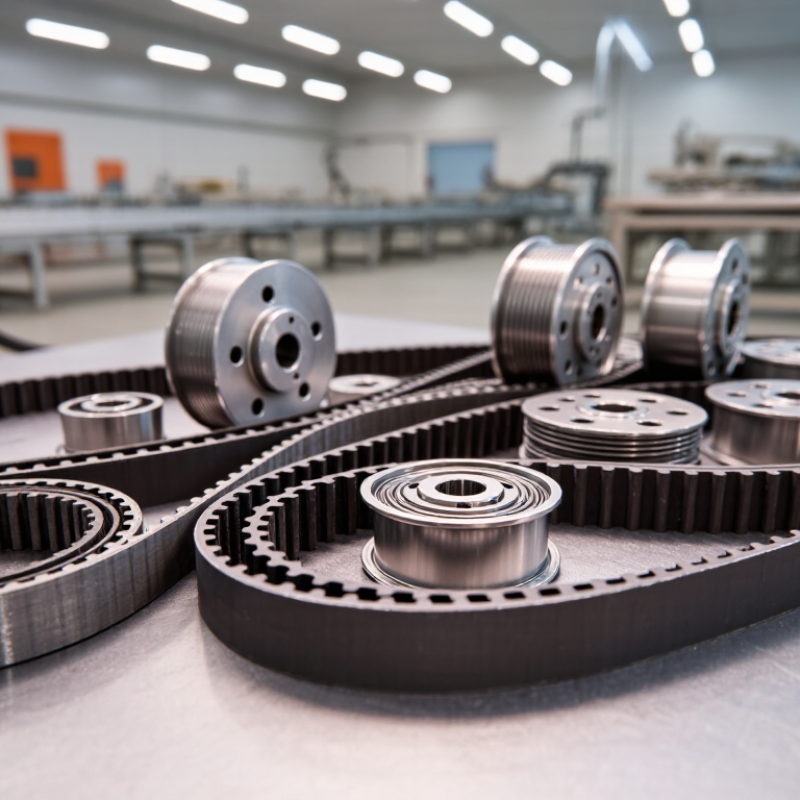
Top 10 Rubber Timing Belts Manufacturers Worldwide

Rubber Timing Belts: Definition, Structure, and Key Functions

Rubber timing belts are toothed power-transmission components that synchronize rotating shafts. Unlike smooth belts, their teeth engage with matching pulley grooves. This positive engagement limits slipping during operation. In engines, packaging machines, and automated equipment, timing accuracy can be critical.

A typical belt contains a rubber body, embedded tensile cords, and molded teeth. The rubber compound provides flexibility and resistance to heat, oil, and wear. Tensile cords carry the pulling load, often using fiberglass, aramid, or similar reinforcement. Tooth facing materials reduce friction and protect the tooth profile. Small dimensional errors matter. A belt that looks acceptable may still create vibration, noise, or timing drift.

Tips: Check tooth wear, edge damage, surface cracks, and unusual dust during maintenance. Confirm the correct pitch, width, length, and pulley profile before replacement. Keep tension within the equipment maker’s specification; excessive tension can damage bearings. Clean installation is important because grit can alter tooth engagement. From practical inspections, alignment is often overlooked, although it strongly affects service life. No belt lasts forever. Temperature, contamination, shock loads, and poor storage can shorten its working period. A careful inspection record is more reliable than appearance alone, yet even experienced technicians should question assumptions when operating conditions change.


Criteria for Ranking Global Rubber Timing Belt Manufacturers

Ranking global rubber timing belt manufacturers requires more than comparing catalog prices or factory size. The strongest evaluation begins with material consistency, tooth geometry, tensile strength, and resistance to heat, oil, ozone, and repeated flexing. A reliable manufacturer should provide test data for these properties, not vague performance claims. Dimensional accuracy also matters. Even a small pitch variation can create vibration, noise, or premature wear in a high-speed drive.

Production experience deserves close attention. Reviewers should examine mold control, reinforcement quality, curing stability, and inspection methods across different production batches. Traceability is essential. Each belt should connect to documented materials, machinery settings, and test results. Independent certifications can support credibility, but they should not replace practical verification. Sample belts should be checked under realistic loads, temperature cycles, and pulley conditions. Field feedback from maintenance teams often reveals problems that laboratory reports miss.

Technical support and supply reliability also influence the ranking. Manufacturers should offer clear installation guidance, compatible dimensions, replacement advice, and responsive engineering assistance. Stable lead times matter when one failed belt can stop a production line. Environmental management and responsible workplace practices add further value, especially for international buyers. No ranking is perfect. Public information may be incomplete, and test conditions can differ. A careful assessment should disclose these limits instead of presenting every score as absolute. Real performance sometimes surprises even experienced evaluators.

Worldwide Market Overview and Major Manufacturing Regions

Global timing belt manufacturing is concentrated where automotive assembly, polymer expertise, and export infrastructure overlap. East Asia remains the largest production base. Industry databases generally place the region ahead in output, although estimates differ by product scope. MarketsandMarkets estimates the global timing belt market at roughly US$7 billion in 2024, with growth toward 2029. That expansion is uneven. China, Japan, South Korea, and Taiwan support dense supplier networks, precision molding, and high-volume vehicle production.

Europe remains influential in engineered belts for passenger cars, commercial vehicles, and industrial machinery. The European Automobile Manufacturers’ Association reported more than 15 million motor vehicles produced in Europe during 2023. This manufacturing depth supports strict dimensional control, heat-resistant compounds, and shorter delivery routes.

North America has a different advantage. Its producers often focus on replacement demand, industrial distribution, and proximity to large vehicle assembly plants. The United States also benefits from established testing laboratories and technical service teams. Market geography is not perfectly neat.

India and Southeast Asia are expanding their roles through lower-cost production, improving rubber processing, and growing vehicle ownership. UN Comtrade data shows active cross-border trade in vulcanized rubber transmission belts, though customs categories combine several belt types. That limitation matters. A shipment record may not represent a complete timing belt. Buyers should compare tooth geometry, tensile cords, temperature ratings, and validation methods instead of relying on country rankings alone. Some market reports also blend automotive and industrial applications, which can inflate apparent demand. Field experience suggests supplier resilience depends on tooling control and material consistency, not factory size alone.

Profiles of the Top 10 Rubber Timing Belt Manufacturers

Profiles of the Top 10 Rubber Timing Belt Manufacturers

The leading rubber timing belt manufacturers differ in materials, testing depth, and production focus. One specializes in high-temperature belts for industrial ovens and chemical processing lines. Another serves automotive suppliers with tightly controlled tooth profiles and automated inspection. A third focuses on compact belts used in printers, medical devices, and laboratory equipment. These manufacturers usually combine fiberglass tension cords with neoprene or polyurethane-based rubber compounds. Small dimensional changes matter. Even a fraction of a millimeter can affect synchronization.

A fourth manufacturer is known for heavy-duty conveyor and packaging applications. Its belts often use reinforced backings for abrasive workplaces. The fifth emphasizes low-noise operation, which suits office machines and light automation. A sixth supplies custom-molded belts, supporting unusual lengths, tooth shapes, and pulley arrangements. The seventh maintains regional factories near major transport hubs, reducing delivery delays. The eighth invests heavily in fatigue testing, measuring belt performance after repeated starts and stops. The ninth provides replacement belts for older machinery, where accurate reverse engineering is essential. The tenth combines standard catalog products with engineering support for demanding installations.

Reliable producers should show test methods, batch records, and clear material specifications. Certifications help, but they do not replace practical evidence. A polished catalog is not proof. I would still request samples, tensile data, temperature ratings, and dimensional tolerances before approval. Some manufacturers communicate well but offer limited field history. Others have excellent durability yet provide slower technical support. That difference can become expensive during an unexpected shutdown.

Product Comparison, Industry Applications, and Selection Factors

Top 10 Rubber Timing Belts Manufacturers Worldwide: Product Comparison, Industry Applications, and Selection Factors

Rubber timing belts differ in tooth profile, tensile cord, compound, and temperature range. A laboratory-grade belt may use fiberglass, aramid, or steel reinforcement. Each choice changes stretch, noise, and service life. The Freedonia Group’s 2024 analysis identifies automotive replacement demand as a major driver for power-transmission components. Industrial users also need stable performance under dust, oil mist, and repeated shock loads.

Compare the top ten manufacturers by measurable specifications, not catalogue length. Check pitch accuracy, allowable tension, operating temperature, and rated service hours. Some belts suit compact engines, while wider profiles handle conveyors, packaging lines, and robotic equipment. MarketsandMarkets forecasts continued growth in the industrial automation market through 2028, supporting demand for precise synchronous drives. That trend matters. Automation exposes poor alignment quickly.

Selection should begin with the driven load and duty cycle. Measure pulley diameter, center distance, speed, and starting torque. Confirm chemical exposure before choosing a rubber compound. A belt running beside hot metal may need a high-temperature formulation. In food-processing areas, cleanability and approved materials become practical concerns. Installation space also matters. A narrower belt may fit better, but it can reduce load capacity. A spreadsheet can still mislead. Field technicians should inspect tooth wear, edge fraying, and unusual vibration after installation. Reported life often differs from real life because tensioning, alignment, and maintenance habits vary.

Powder Coat Booths

For those larger-sized parts, or smaller quantity runs, we have 2 independent powder coat booths and ovens. The quality, durability and affordability of today’s powder coating finishes make this the process of choice for world-class companies.

Powder coating advantages over other forms of coating are many. Materials used in the Powder coating process can be metals and non-metals that come in a multitude of thicknesses, textures, colors, etc. Another of Powder coating’s biggest advantages over conventional coatings is its ability to create finishes in many different textures. Powder Coating Booths allow us the ability to apply these advantages to large products.

Wet Paint Line

Tri-State Fabricators runs a full-service conveyor line for painting. Wet painting can provide protection or decoration to many different part styles. From start to finish, every project is easier to undergo random and point-based inspection by our skilled painting team.

Advantages to our Wet Paint Line are these lines start with product prep and ends with a thorough inspection of a high quality finished product. Our ability to complete large and small projects with a superior finish and doing so in a timely and economical fashion. This passes along the savings in production to our customers. When powder coating ins not an option, our Wet Paint Line gets the job done right the first time.

Wet Paint Booths

When the parts get big and heavy we roll-out our custom paint racks and oversize booth. By utilizing our partnerships with all the major paint brands, we can match virtually any color with wet paint.

The advantages of having access to a Wet Paint Booth are many. Large projects of many different shapes can be loaded into the booth. The Wet Paint Booth offers an environment that is much more controlled than a typical parts painting operation.

Not only are they used because of their controlled environment, but they’re are also advantageous when it comes to applying paint to parts that are needed in industries that require specialty coatings such as medical, aerospace, etc.

Military CARC

Our military forces have some very high standards when it comes to the finish of their vehicles and equipment. From the first pre-treatment step to final coat, it takes a great deal of knowledge and experience to protect the men and women of our armed forces. They deserve only the best, and Tri-State Fabricators provides it.

All of our processes are closely monitored by our staff and management teams. Both of which are highly trained in the processes of metal fabrication and finishing. Tri-State Fabricators’ goal is to always fully satisfy each and every customer, including the military. We will always put a 110% into what we do.

Glass-Bead Blasting

Abrasive media blasting is an excellent way to remove old paint, rust, and increase the paint/powder adhesion. Glass beads produce a much smoother and brighter finish than angular abrasives; leaving the part clean yet without any dimensional change. Chemically inert and environmentally friendly, we can recycle our beads approximately 30 times; making them a more preferred method of metal cleaning or surface finishing.

Advantages to Glass Bead Blasting are many. Glass bead blast media is used when a project is needing rough surfaces need to become smooth for applications of coatings such as paint. It is typically used to clean paint and rust from a product surface without deforming the surface it is being used on. Overall, compared to many other blasting media, Glass Bead Blasting is a very economical choice and those savings are always passed on to our customers.

Part Washing

Tri-State Fabricators utilize a zinc phosphate wash to clean and etch the material to ensure the best paint adhesion possible. The unique design of our 3-stage wash system does the work like a 5-stage. From Cleaning and rinsing to conversion coating and post-treatment, Our Part Washing process is a complete service and works throughout the fabrication service and the finishing service.

Along with the previously mentioned benefits, Curing is a vital chemical reaction that leaves the product finish hard and relatively safe from mild abrasion and aggressive corrosion. This process can be done in more than one way; ambient air-dry or in curing ovens at temps that exceed 240°.

Burn-Off Oven

From fixing paint mistakes (someone else’s of course) to simply cleaning our paint line hooks, our burn-off oven is put to good use. After a quick burn-off, a little clean up, and a fresh coat of paint, your parts will look better than new.

Why does our Burn-Off Oven work so well? Because super heating the air around parts turns the materials into ashes. From paint and powder coatings to rubber and machining oils, high temps do the job without degrading the integrity of the part.

Masking

Masking is a vital part of producing high quality products. We have die-cut masking patterns to protect machined surfaces as well as a wide range of plugs and caps to protect threaded holes and bolts. We provide permanent and temporary masking.

Masking allows the selected sections of a product to be protected from a fabrication or finishing service. This can be with both chemicals when etching and tapes, paints when only finishing just a section of the product. Masking is great in aiding the customization process of a project.

Screen Printing

Screen printing is a photographic process that transfers artwork onto a porous nylon screen which allows colored ink to flow through the screen and be deposited on an aluminum or plastic component. We can generally have just about any design created onto a screen for your parts.

Some of the advantages of Screen Printing are, brand recognition for your business displaying on your products, assembly instructions, product warnings/hazards, etc. Tri-State Fabricators produces Screen Printing of the highest quality so you know it’s durable.

Metal Finishing

Metal Finishing is the art of treating the exterior portion of product, often metal but can also be made of other materials, so that the surface is clean and free of any debris. Then the process of applying coats or either paint of powder coat takes place. This coating process improves the quality of the product in both appearance and resistance to wear and corrosion.

Tri-State Fabricators, Inc., understands that a project typically isn’t complete until a high-quality finish has been added to your product. This is why our painting and powder coating teams continuously inspect the products throughout the Metal Finishing process.
