


The 2026 discussion around Bone Filling Container types reflects a larger shift in regenerative medicine. Grand View Research has reported steady growth in the global bone grafts and substitutes market, supported by orthopedic procedures, dental reconstruction, and an aging population. Its market analysis also highlights the importance of delivery convenience, product stability, and surgical efficiency. These trends make container selection more than a packaging decision.
Common formats include prefilled syringes, sterile cups, cartridges, vials, and flexible tubes. Each design serves a different handling situation. A syringe may support controlled placement into a narrow defect. A cup can provide quicker access during open surgery. A vial may protect particulate graft material during storage and transport. Small details matter, such as cap security, label readability, and whether the container opens cleanly with gloved hands.
Safety remains central. ISO 13485 supports quality management for medical devices, while ISO 10993 guides biological evaluation of patient-contacting materials. FDA device guidance also emphasizes risk-based evaluation, sterility, usability, and packaging integrity. Industry reports offer useful market direction, but they cannot replace clinical validation or supplier audits.
No single format wins every case. That assumption can fail. Surgeons may prefer one-hand handling, while logistics teams prioritize seal strength and shelf life. My view is practical: the best Bone Filling Container balances clinical control, material compatibility, traceability, and waste reduction. The final choice should follow the graft material, procedure, sterilization method, and documented user feedback. Evidence should lead. Trends should not.
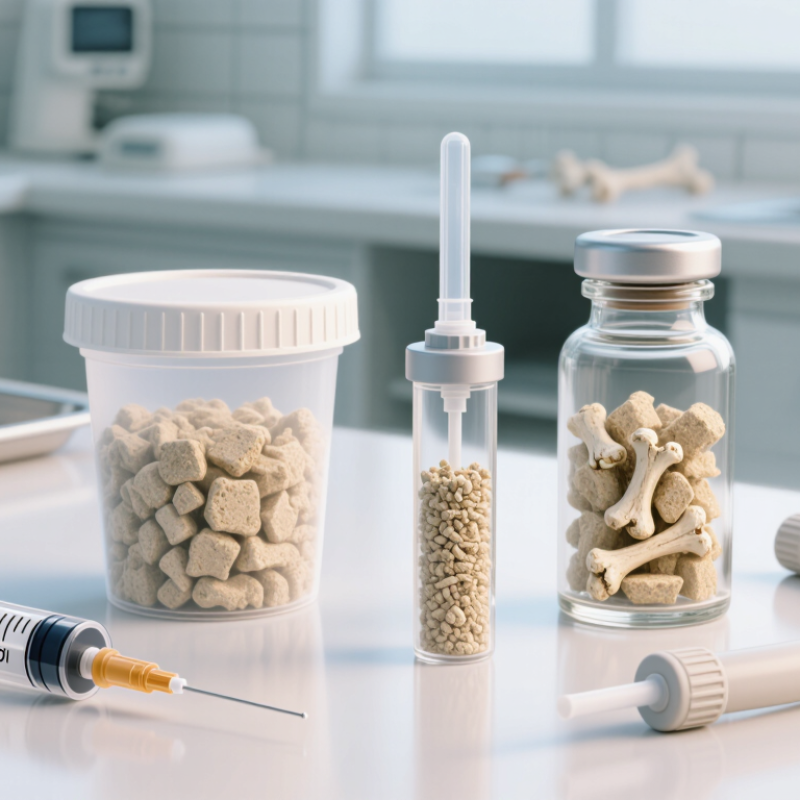
Bone filling containers hold bone graft materials before and during dental or orthopedic procedures. They help protect the material from contamination, moisture, and accidental loss. Common types include sterile cups, small jars, syringes, cartridges, and compartment trays. Each design suits a different workflow. A cup supports quick mixing. A syringe allows controlled placement into a narrow defect. Cartridges can improve portion control, but they may create extra waste.
These containers are used to maintain material identity and handling accuracy. Clear walls help clinicians inspect the graft visually. Secure lids reduce exposure during preparation. Some containers include measurement marks, while others provide separate sections for different materials. In 2026, selection should focus on sterility assurance, biocompatibility, leak resistance, and traceability. Packaging claims should match validated testing, not attractive wording. No container is perfect. Even a well-designed package can slow treatment if its opening is awkward. That practical detail is sometimes overlooked.
Tips: Choose a size that matches the planned graft volume. Check the seal before opening. Keep the container within the sterile field when appropriate. Follow the manufacturer’s storage and handling instructions. Record relevant lot information for reliable clinical documentation. When comparing types, ask whether the container reduces transfers, because every unnecessary transfer increases handling risk. A simple design may perform better than a complicated one.
Bone filling containers are classified first by design. Open trays expose graft material for direct packing, while perforated cages allow fluid exchange and controlled containment. Closed sleeves reduce particle loss during placement. Flexible pouches conform to irregular defects, but they may wrinkle under compression. Delivery-integrated syringes improve speed and precision. They can also limit tactile feedback.
Material creates a second classification. Titanium and other metals provide rigidity and radiographic visibility. PEEK offers a lightweight, imaging-friendly structure. Ceramic containers resist heat and chemical changes, but they can be brittle. Collagen and synthetic polymers provide softer handling and, in some designs, gradual resorption. Material choice should match defect size, mechanical loading, sterilization method, and imaging requirements.
Market data supports this expanding design focus. Fortune Business Insights estimated the global bone grafts and substitutes market at about 3.3 billion dollars in 2023, with continued growth through 2032. Grand View Research also reports sustained demand for synthetic and biomaterial-based graft solutions. These reports usually track graft products, not containers alone, so their figures cannot be treated as container sales.
That distinction matters. In procurement reviews, the most useful comparison is often practical: pore size, folding behavior, visibility under imaging, and resistance to migration. No single design fits every defect. That sounds obvious, yet product comparisons still overlook handling under wet conditions.
In 2026, sterile syringes remain common bone filling containers for small, controlled procedures. Their narrow tips support accurate placement into prepared cavities. Preloaded formats can reduce handling and limit exposure before use. However, thick graft materials may resist smooth delivery, especially when moisture changes their texture.
Rigid vials are widely used for granules, powders, and particulate graft materials. Their transparent walls help staff inspect fill levels and material condition. Some include screw or snap closures with tamper evidence. Vials also stack efficiently during storage. They can be less convenient when the material must be transferred into another applicator.
Flexible sterile pouches are useful for lightweight graft materials and larger fill volumes. They require less storage space and can open quickly on a sterile field. Multilayer films may protect contents from moisture and oxygen. Still, pouch opening takes practice. A careless tear can scatter fine particles. Not ideal.
Blister trays and molded single-use cups are also common in 2026. They can organize several components, such as graft material, mixing tools, or measuring scoops. Their shaped cavities reduce movement during transport. Hospitals often assess seal strength, peel performance, labeling clarity, and compatibility with sterilization methods. Container choice should match particle size, moisture sensitivity, delivery method, and the clinician’s workflow. A container that looks efficient in testing may feel awkward during a real procedure. Feedback from operating-room staff remains essential.
Rigid cartridges offer the cleanest handling for bone-filling procedures. Their closed pathway limits direct contact, while clear walls help clinicians check volume and air pockets. A 2023 systematic review in the Journal of Hospital Infection linked poor device handling with higher contamination risk in surgical settings. Small details matter.
Flexible sterile pouches are lighter and easier to store. However, they can fold during transfer, making accurate filling less predictable. Syringe-style containers support controlled placement, especially in narrow cavities, but their plungers may require more force with dense graft material. Mixing cups provide visibility and quick access, yet open exposure increases the need for disciplined aseptic technique. WHO’s Global Guidelines for Surgical Site Infection Prevention report that surgical-site infections affect about 11% of patients in low- and middle-income settings, reinforcing the value of minimizing unnecessary exposure.
Storage performance also differs. Rigid containers resist crushing and stacking pressure better than soft pouches. Flexible formats save space but need protective secondary packaging. ISO 11607-1 emphasizes maintaining sterile-barrier integrity throughout transport and storage. Temperature, humidity, and expiry dates still require verification against the supplier’s validated instructions. In practice, the “best” container is not always the most advanced one. We sometimes underestimate grip, labeling, and opening force. A container that looks efficient may slow the procedure when gloves are wet or visibility is poor.
Professionals should select bone filling containers by procedure, material behavior, and handling risk—not appearance.
Common choices include prefilled syringes, sterile vials, mixing bowls, cartridges, and compartment trays.
A syringe supports controlled delivery into narrow defects. A bowl gives surgeons more freedom when mixing granular graft materials.
However, that freedom can increase exposure time and contamination opportunities.
Market data supports careful specification.
Grand View Research estimated the global bone grafts and substitutes market at about USD 3.3 billion in 2023, with continued growth through 2030.
MarketsandMarkets also projected strong expansion, although its figures differ because product categories vary.
This mismatch matters. Procurement teams should compare report definitions before using market growth to justify capacity or container changes.
Experienced teams should test container compatibility with moisture, powders, liquids, and mixing instruments.
They should review seal integrity, extractables, labeling space, and opening force.
ISO 11607 guidance is relevant for sterile barrier packaging, while ISO 10993 supports biological safety evaluation.
The container should also remain stable during transport, storage, and operating-room handling.
Small details matter. A slippery cap can delay preparation. A narrow neck can waste expensive graft material.
Yet selection is not always perfect; simulated-use testing may miss hurried, gloved handling. Professionals should record those failures, repeat usability trials, and verify shelf-life evidence before approval.


For those larger-sized parts, or smaller quantity runs, we have 2 independent powder coat booths and ovens. The quality, durability and affordability of today’s powder coating finishes make this the process of choice for world-class companies.
Powder coating advantages over other forms of coating are many. Materials used in the Powder coating process can be metals and non-metals that come in a multitude of thicknesses, textures, colors, etc. Another of Powder coating’s biggest advantages over conventional coatings is its ability to create finishes in many different textures. Powder Coating Booths allow us the ability to apply these advantages to large products.
Tri-State Fabricators runs a full-service conveyor line for painting. Wet painting can provide protection or decoration to many different part styles. From start to finish, every project is easier to undergo random and point-based inspection by our skilled painting team.
Advantages to our Wet Paint Line are these lines start with product prep and ends with a thorough inspection of a high quality finished product. Our ability to complete large and small projects with a superior finish and doing so in a timely and economical fashion. This passes along the savings in production to our customers. When powder coating ins not an option, our Wet Paint Line gets the job done right the first time.
When the parts get big and heavy we roll-out our custom paint racks and oversize booth. By utilizing our partnerships with all the major paint brands, we can match virtually any color with wet paint.
The advantages of having access to a Wet Paint Booth are many. Large projects of many different shapes can be loaded into the booth. The Wet Paint Booth offers an environment that is much more controlled than a typical parts painting operation.
Not only are they used because of their controlled environment, but they’re are also advantageous when it comes to applying paint to parts that are needed in industries that require specialty coatings such as medical, aerospace, etc.
Our military forces have some very high standards when it comes to the finish of their vehicles and equipment. From the first pre-treatment step to final coat, it takes a great deal of knowledge and experience to protect the men and women of our armed forces. They deserve only the best, and Tri-State Fabricators provides it.
All of our processes are closely monitored by our staff and management teams. Both of which are highly trained in the processes of metal fabrication and finishing. Tri-State Fabricators’ goal is to always fully satisfy each and every customer, including the military. We will always put a 110% into what we do.
Abrasive media blasting is an excellent way to remove old paint, rust, and increase the paint/powder adhesion. Glass beads produce a much smoother and brighter finish than angular abrasives; leaving the part clean yet without any dimensional change. Chemically inert and environmentally friendly, we can recycle our beads approximately 30 times; making them a more preferred method of metal cleaning or surface finishing.
Advantages to Glass Bead Blasting are many. Glass bead blast media is used when a project is needing rough surfaces need to become smooth for applications of coatings such as paint. It is typically used to clean paint and rust from a product surface without deforming the surface it is being used on. Overall, compared to many other blasting media, Glass Bead Blasting is a very economical choice and those savings are always passed on to our customers.
Tri-State Fabricators utilize a zinc phosphate wash to clean and etch the material to ensure the best paint adhesion possible. The unique design of our 3-stage wash system does the work like a 5-stage. From Cleaning and rinsing to conversion coating and post-treatment, Our Part Washing process is a complete service and works throughout the fabrication service and the finishing service.
Along with the previously mentioned benefits, Curing is a vital chemical reaction that leaves the product finish hard and relatively safe from mild abrasion and aggressive corrosion. This process can be done in more than one way; ambient air-dry or in curing ovens at temps that exceed 240°.
From fixing paint mistakes (someone else’s of course) to simply cleaning our paint line hooks, our burn-off oven is put to good use. After a quick burn-off, a little clean up, and a fresh coat of paint, your parts will look better than new.
Why does our Burn-Off Oven work so well? Because super heating the air around parts turns the materials into ashes. From paint and powder coatings to rubber and machining oils, high temps do the job without degrading the integrity of the part.
Masking is a vital part of producing high quality products. We have die-cut masking patterns to protect machined surfaces as well as a wide range of plugs and caps to protect threaded holes and bolts. We provide permanent and temporary masking.
Masking allows the selected sections of a product to be protected from a fabrication or finishing service. This can be with both chemicals when etching and tapes, paints when only finishing just a section of the product. Masking is great in aiding the customization process of a project.
Screen printing is a photographic process that transfers artwork onto a porous nylon screen which allows colored ink to flow through the screen and be deposited on an aluminum or plastic component. We can generally have just about any design created onto a screen for your parts.
Some of the advantages of Screen Printing are, brand recognition for your business displaying on your products, assembly instructions, product warnings/hazards, etc. Tri-State Fabricators produces Screen Printing of the highest quality so you know it’s durable.
Metal Finishing is the art of treating the exterior portion of product, often metal but can also be made of other materials, so that the surface is clean and free of any debris. Then the process of applying coats or either paint of powder coat takes place. This coating process improves the quality of the product in both appearance and resistance to wear and corrosion.
Tri-State Fabricators, Inc., understands that a project typically isn’t complete until a high-quality finish has been added to your product. This is why our painting and powder coating teams continuously inspect the products throughout the Metal Finishing process.

