

China has become a major production base for Geo Synthetic Materials, serving transport, water, mining, waste management, and coastal engineering projects. This guide examines leading Chinese manufacturers through practical evidence, not advertising claims. The strongest suppliers usually show stable polymer sourcing, modern extrusion lines, laboratory testing, and consistent quality records.
Professor Robert M. Koerner, a respected geosynthetics researcher, defines them as “planar products manufactured from polymeric materials.” That simple description hides important differences. A geomembrane may need low permeability and strong seam performance, while a geogrid must provide reliable tensile reinforcement beneath roads. Buyers should compare resin quality, thickness tolerance, puncture resistance, weld testing, factory capacity, and technical support.
Site performance matters.
A manufacturer may offer attractive prices, yet weak documentation can create expensive problems during installation. Reliable companies normally provide inspection reports, test certificates, production samples, and clear technical data. They should also explain performance under ultraviolet exposure, temperature changes, chemical contact, and long-term loading. International standards, including ASTM and ISO methods, can support comparison, but certificates alone do not prove field success.
No ranking is perfect. Product quality may vary between factories, batches, and project applications. That limitation deserves attention. This overview therefore treats “top” as a combination of manufacturing experience, engineering capability, verified quality control, export reliability, and responsive after-sales service. Readers should still request recent reports and independent inspections before making a final purchasing decision.
Geosynthetic materials are engineered polymer products used with soil, rock, or water. Common types include geotextiles, geomembranes, geogrids, geonets, and geocomposites. They improve separation, filtration, drainage, reinforcement, and containment. A woven geotextile, for example, can separate soft subgrade from crushed stone beneath a road. A geomembrane can restrict leakage from reservoirs or engineered waste facilities.
Their use is expanding with infrastructure development and climate adaptation. Grand View Research estimated the global geosynthetics market at about USD 13.9 billion in 2023. It also projected a 6.3% compound annual growth rate from 2024 to 2030. MarketsandMarkets reported a similar growth direction, linking demand to roads, railways, mining, and water management. In China, manufacturers commonly supply materials for highways, high-speed rail foundations, landfill liners, artificial lakes, and coastal protection. Site conditions still decide the correct product.
Material selection is not a catalogue exercise. Soil chemistry, ultraviolet exposure, temperature, puncture risk, and installation quality all matter. A stronger membrane may still fail if seams are poorly welded. That detail is often underestimated. The International Geosynthetics Society stresses design, testing, and field inspection as essential controls. Market forecasts are useful, but they cannot replace project-specific engineering. Some applications remain difficult, especially where settlement and aggressive chemicals occur together.
China Top Geosynthetic Materials Manufacturers?
China’s geosynthetic manufacturing industry is organized as a connected production network rather than a single factory system. Polymer suppliers provide resin, additives, and reinforcing fibers. Converters then produce geomembranes, geotextiles, geogrids, geocells, and drainage composites. Many facilities operate near industrial clusters, where transport, skilled labor, and testing services are easier to access.
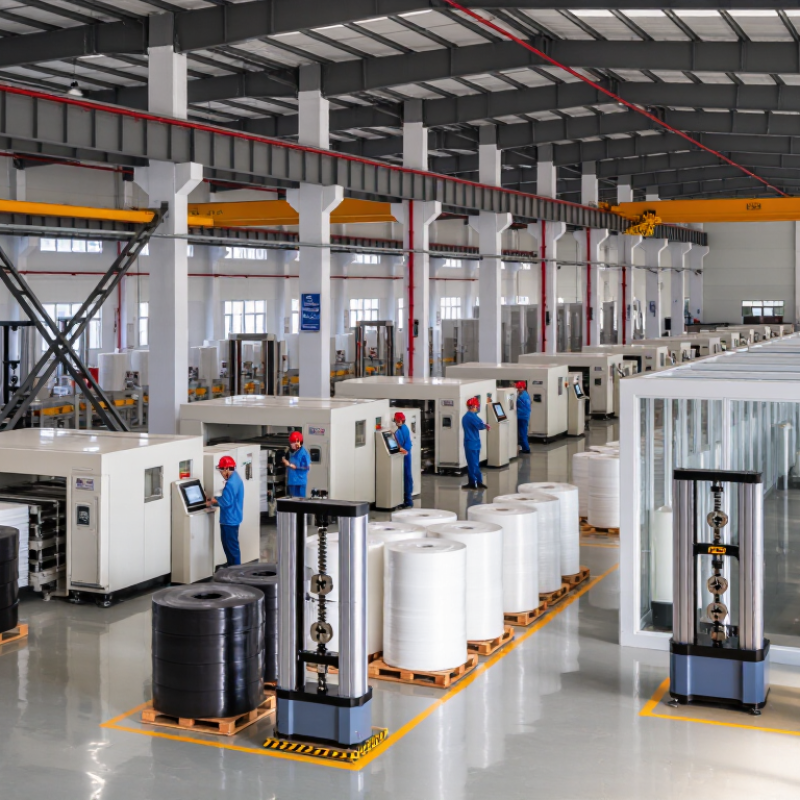
The process is highly specialized. Extrusion lines form smooth or textured geomembranes, while needle-punching equipment creates nonwoven geotextiles. Weaving and coating lines support reinforcement products. Experienced manufacturers monitor thickness, tensile strength, puncture resistance, and seam performance during production. Reliable suppliers also keep batch records, calibration documents, and sample-retention systems. These details matter on landfill, mining, reservoir, and road projects.
Not every factory has the same technical depth. Some focus on high-volume standard products, while others develop materials for demanding temperatures, chemicals, or uneven ground. Independent laboratories and engineering contractors help verify performance before installation. Factory audits can reveal practical issues, such as inconsistent roll edges or weak packaging. Small flaws can become expensive site problems.
The industry still has room to improve. Product specifications may look complete, yet field conditions often expose overlooked risks. A responsible manufacturer studies soil movement, drainage pressure, climate, and installation methods before recommending a material. This collaboration links raw-material producers, testing agencies, fabricators, installers, and project owners. That structure gives China’s geosynthetic sector both scale and technical flexibility, although quality can vary between production lines.
| Industry Area | Data Dimension | Typical China Industry Characteristics and Verifiable Technical Data |
|---|---|---|
| Raw Materials | Primary polymers | Polypropylene (PP), high-density polyethylene (HDPE), polyethylene (PE), polyester (PET), polyvinyl chloride (PVC), and polyamide are the principal polymers used in geotextiles, geomembranes, geogrids, geocells, and related products. |
| Material Selection | Performance priorities | Material selection is generally based on tensile strength, puncture resistance, tear resistance, chemical compatibility, ultraviolet stability, permeability, creep resistance, and expected service life. |
| Product Structure | Main product families | The manufacturing industry is commonly organized into woven geotextiles, nonwoven geotextiles, filament geotextiles, short-fiber geotextiles, composite drainage products, geomembranes, geogrids, geocells, geosynthetic clay liners, and erosion-control products. |
| Manufacturing Process | Geotextile production | Woven products are produced by tape or filament extrusion followed by weaving. Nonwoven products are typically manufactured through spunbond, needle-punching, thermal bonding, or combinations of these processes. |
| Manufacturing Process | Geomembrane production | HDPE and other polymer geomembranes are commonly produced by flat-die extrusion or blown-film extrusion. Manufacturing controls include polymer compounding, thickness control, surface treatment, and roll winding. |
| Manufacturing Process | Geogrid production | Geogrids are manufactured mainly by extrusion and stretching of polymer sheets, or by weaving and coating high-strength polymer yarns. Biaxial and uniaxial structures are selected according to the required load direction. |
| Product Dimensions | Typical geotextile mass range | Common commercial geotextiles are often supplied in approximate mass ranges of 100–1,200 g/m², with the selected range depending on filtration, separation, drainage, reinforcement, or protection requirements. |
| Product Dimensions | Typical geomembrane thickness | Geomembranes are commonly supplied in thicknesses of approximately 0.5–3.0 mm. Landfill, mining, wastewater, and high-load containment projects may specify thicker materials or multi-layer structures. |
| Product Dimensions | Typical roll logistics | Roll width, roll length, core diameter, and roll weight are normally customized to installation equipment and transport limitations. Large rolls can reduce field seams but require suitable lifting and handling equipment. |
| Quality Control | Physical testing | Routine testing may include mass per unit area, thickness, tensile strength, elongation, trapezoid tear, puncture resistance, apparent opening size, permittivity, and water permeability, depending on the product type. |
| Quality Control | Geomembrane testing | Typical controls include thickness, tensile properties, tear resistance, puncture resistance, carbon black content, carbon black dispersion, oven aging, oxidative induction time, and stress-crack resistance for relevant polyethylene products. |
| International Standards | Frequently referenced standards | International projects commonly reference ISO, ASTM, EN, and GRI specifications. Chinese projects may also use applicable GB and CJ standards. The exact test method should be agreed in the technical specification before production. |
| Certification | Management systems | Manufacturers serving infrastructure and export markets commonly operate quality-management systems based on ISO 9001. Environmental and occupational-health systems may be managed under ISO 14001 and ISO 45001, respectively, where required by customers or projects. |
| Application Markets | Civil infrastructure | Major use cases include highway and railway subgrade reinforcement, retaining structures, foundation separation, drainage layers, soft-soil improvement, bridge approach construction, and slope stabilization. |
| Application Markets | Environmental containment | Geosynthetics are used in municipal solid-waste landfills, leachate collection systems, wastewater ponds, industrial lagoons, landfill caps, contaminated-site remediation, and secondary containment systems. |
| Application Markets | Water and hydraulic engineering | Typical applications include reservoirs, canals, aquaculture ponds, irrigation channels, flood-control works, artificial lakes, tunnel waterproofing systems, and seepage-control structures. |
| Application Markets | Mining and energy | Products are used for heap-leach pads, tailings facilities, coal storage areas, ash ponds, oil and gas containment, photovoltaic-site drainage, and other projects requiring soil reinforcement or liquid containment. |
| Industry Organization | Upstream–midstream–downstream structure | The industry typically includes polymer and additive suppliers upstream; extrusion, weaving, nonwoven, coating, laminating, and composite-product manufacturers in the middle; and engineering contractors, distributors, installers, consultants, and asset owners downstream. |
| Manufacturing Models | Production orientation | Suppliers generally operate through standard-product production, project-specific customization, or a combination of both. Customization may involve polymer formulation, width, thickness, surface texture, roll length, color, packaging, and test requirements. |
| Project Delivery | Technical coordination | Large projects usually require coordination among the material manufacturer, designer, installer, testing laboratory, and project owner. Product selection should be linked to site conditions, design loads, chemical exposure, installation method, and required design life. |
| Supply Chain | Domestic and export logistics | China’s manufacturing base supports containerized export, project-based bulk shipments, and domestic distribution through regional warehouses and construction-material channels. Packaging and roll dimensions are important factors in freight cost and installation efficiency. |
| Sustainability | Resource and lifecycle considerations | Relevant considerations include recycled polymer content where technically suitable, reduction of installation waste, resistance to premature failure, repairability, product traceability, and end-of-life management. Recycled content should not compromise specified performance. |
| Buyer Evaluation | Key supplier-selection criteria | Buyers commonly assess conformity to specifications, stable raw-material sourcing, production capacity, process controls, laboratory capability, batch traceability, technical support, installation guidance, export experience, and documented test results. |
China’s leading geosynthetic manufacturers are usually identified by verified production capability, not advertising claims. They supply geomembranes, geotextiles, geogrids, geocells, and drainage composites for landfills, reservoirs, railways, and mining sites. Strong producers typically operate modern extrusion or needle-punching lines, maintain laboratory testing, and follow recognized quality systems. Production consistency matters more than impressive brochures.
Site audits often reveal the real difference. Engineers check resin records, welding performance, roll dimensions, tensile strength, puncture resistance, and storage conditions. Reliable manufacturers can provide batch reports and traceable inspection documents. They also understand project details, such as ultraviolet exposure, settlement, chemical contact, and installation temperature. Technical support should continue after delivery.
Not every large factory is equally suitable. Some offer competitive pricing but limited field guidance. Others have excellent testing equipment but slower customization. This weakness deserves attention. Buyers should compare recent project references, independent test results, production capacity, and export experience before selecting a supplier. Factory visits remain useful, although they cannot replace independent verification. The market is broad, and leadership can change as technology, capacity, and environmental requirements develop.
Chinese geosynthetic manufacturers offer a broad range of products for roads, landfills, reservoirs, mining areas, and coastal works. Common options include woven and nonwoven geotextiles, HDPE geomembranes, geogrids, geocells, geosynthetic clay liners, and composite drainage systems. Each product serves a different purpose. Geotextiles separate and filter soil, while geomembranes create low-permeability barriers. Geogrids improve soil reinforcement beneath roads and retaining structures.
Production technology has become more specialized. Many factories use automated extrusion lines for stable membrane thickness and controlled welding performance. Needle-punching equipment helps create consistent geotextile weight and strength. Some facilities combine infrared inspection, electronic thickness monitoring, and air-pressure testing during production. For large projects, manufacturers can adjust roll widths, fabric weights, surface textures, and additive formulas. This reduces cutting waste on site.
Quality control needs more than a product catalog. Reliable suppliers normally provide tensile strength, puncture resistance, tear strength, permeability, and seam-peel data. Independent laboratory testing adds useful confidence. Still, specifications can look better than field performance. Installation conditions, ultraviolet exposure, soil movement, and welding skills may change the result. A careful buyer should review factory records, sample tests, raw-material traceability, and technical support. No factory is perfect. Even a strong product can fail when the design ignores drainage or uneven ground.
Evaluating Chinese geosynthetic material suppliers requires more than comparing prices. Buyers should inspect production records, testing procedures, and export experience. A polished factory tour can mislead. Request recent batch data, not only catalog values.
Check whether the supplier can provide test reports for tensile strength, puncture resistance, seam performance, permeability, and dimensional stability. Reports should identify the tested batch and laboratory method. Compare these results with project specifications and applicable standards. Ask for production samples, then arrange independent testing before signing a large contract. Small differences in thickness can affect long-term performance.
Traceability matters. Reliable suppliers should explain how raw materials are received, stored, blended, and recorded. Review calibration records for testing equipment. Observe packaging, labeling, and moisture protection during loading. Communication also reveals technical maturity. Engineers should answer installation questions clearly, including welding temperatures, overlap requirements, and site storage limits. Be cautious when every answer sounds perfect. Delayed replies or vague warranties deserve written clarification. A supplier may pass a document review yet fail under uneven site conditions. Buyers should therefore assess quality consistency across several batches, inspect references from comparable climates, and define acceptance criteria before production begins.
Suggested procurement weighting for comparing geosynthetic material suppliers. The framework emphasizes measurable product quality, compliance, manufacturing control, and delivery reliability rather than company size or brand visibility.
Buyers should verify each category through test reports, applicable ASTM/ISO/EN standards, factory quality-control records, production samples, delivery history, and clearly documented commercial terms. The percentages are a practical evaluation framework and can be adjusted for project-specific risks.


For those larger-sized parts, or smaller quantity runs, we have 2 independent powder coat booths and ovens. The quality, durability and affordability of today’s powder coating finishes make this the process of choice for world-class companies.
Powder coating advantages over other forms of coating are many. Materials used in the Powder coating process can be metals and non-metals that come in a multitude of thicknesses, textures, colors, etc. Another of Powder coating’s biggest advantages over conventional coatings is its ability to create finishes in many different textures. Powder Coating Booths allow us the ability to apply these advantages to large products.
Tri-State Fabricators runs a full-service conveyor line for painting. Wet painting can provide protection or decoration to many different part styles. From start to finish, every project is easier to undergo random and point-based inspection by our skilled painting team.
Advantages to our Wet Paint Line are these lines start with product prep and ends with a thorough inspection of a high quality finished product. Our ability to complete large and small projects with a superior finish and doing so in a timely and economical fashion. This passes along the savings in production to our customers. When powder coating ins not an option, our Wet Paint Line gets the job done right the first time.
When the parts get big and heavy we roll-out our custom paint racks and oversize booth. By utilizing our partnerships with all the major paint brands, we can match virtually any color with wet paint.
The advantages of having access to a Wet Paint Booth are many. Large projects of many different shapes can be loaded into the booth. The Wet Paint Booth offers an environment that is much more controlled than a typical parts painting operation.
Not only are they used because of their controlled environment, but they’re are also advantageous when it comes to applying paint to parts that are needed in industries that require specialty coatings such as medical, aerospace, etc.
Our military forces have some very high standards when it comes to the finish of their vehicles and equipment. From the first pre-treatment step to final coat, it takes a great deal of knowledge and experience to protect the men and women of our armed forces. They deserve only the best, and Tri-State Fabricators provides it.
All of our processes are closely monitored by our staff and management teams. Both of which are highly trained in the processes of metal fabrication and finishing. Tri-State Fabricators’ goal is to always fully satisfy each and every customer, including the military. We will always put a 110% into what we do.
Abrasive media blasting is an excellent way to remove old paint, rust, and increase the paint/powder adhesion. Glass beads produce a much smoother and brighter finish than angular abrasives; leaving the part clean yet without any dimensional change. Chemically inert and environmentally friendly, we can recycle our beads approximately 30 times; making them a more preferred method of metal cleaning or surface finishing.
Advantages to Glass Bead Blasting are many. Glass bead blast media is used when a project is needing rough surfaces need to become smooth for applications of coatings such as paint. It is typically used to clean paint and rust from a product surface without deforming the surface it is being used on. Overall, compared to many other blasting media, Glass Bead Blasting is a very economical choice and those savings are always passed on to our customers.
Tri-State Fabricators utilize a zinc phosphate wash to clean and etch the material to ensure the best paint adhesion possible. The unique design of our 3-stage wash system does the work like a 5-stage. From Cleaning and rinsing to conversion coating and post-treatment, Our Part Washing process is a complete service and works throughout the fabrication service and the finishing service.
Along with the previously mentioned benefits, Curing is a vital chemical reaction that leaves the product finish hard and relatively safe from mild abrasion and aggressive corrosion. This process can be done in more than one way; ambient air-dry or in curing ovens at temps that exceed 240°.
From fixing paint mistakes (someone else’s of course) to simply cleaning our paint line hooks, our burn-off oven is put to good use. After a quick burn-off, a little clean up, and a fresh coat of paint, your parts will look better than new.
Why does our Burn-Off Oven work so well? Because super heating the air around parts turns the materials into ashes. From paint and powder coatings to rubber and machining oils, high temps do the job without degrading the integrity of the part.
Masking is a vital part of producing high quality products. We have die-cut masking patterns to protect machined surfaces as well as a wide range of plugs and caps to protect threaded holes and bolts. We provide permanent and temporary masking.
Masking allows the selected sections of a product to be protected from a fabrication or finishing service. This can be with both chemicals when etching and tapes, paints when only finishing just a section of the product. Masking is great in aiding the customization process of a project.
Screen printing is a photographic process that transfers artwork onto a porous nylon screen which allows colored ink to flow through the screen and be deposited on an aluminum or plastic component. We can generally have just about any design created onto a screen for your parts.
Some of the advantages of Screen Printing are, brand recognition for your business displaying on your products, assembly instructions, product warnings/hazards, etc. Tri-State Fabricators produces Screen Printing of the highest quality so you know it’s durable.
Metal Finishing is the art of treating the exterior portion of product, often metal but can also be made of other materials, so that the surface is clean and free of any debris. Then the process of applying coats or either paint of powder coat takes place. This coating process improves the quality of the product in both appearance and resistance to wear and corrosion.
Tri-State Fabricators, Inc., understands that a project typically isn’t complete until a high-quality finish has been added to your product. This is why our painting and powder coating teams continuously inspect the products throughout the Metal Finishing process.