


Global buyers are no longer choosing a ring light by brightness alone. An Rgb Ring Light must deliver accurate colors, stable output, safe heat control, and dependable international support. Those details matter during long livestreams, product demonstrations, and studio sessions.
MarketsandMarkets estimates that the global smart lighting market may grow from USD 20.2 billion in 2024 to USD 40.6 billion by 2029. Grand View Research also reported a strong expansion in the wider LED lighting market. These figures suggest rising demand for connected, adjustable lighting. They do not guarantee that every supplier offers professional quality. That distinction deserves attention.
Light affects perception and visual comfort. Dr. Mariana Figueiro, a leading lighting researcher, has stated, “Light is the most powerful synchronizer of the circadian system.” Her research focuses on human health, not ring-light purchasing. Still, her observation encourages buyers to examine color temperature, flicker, and exposure time more carefully.
This guide introduces leading Rgb Ring Light suppliers for global buyers. It considers product consistency, RGB color control, CRI performance, dimming accuracy, mounting systems, certifications, warranty terms, and export experience. Factory videos can look impressive. Samples may reveal more. Buyers should request measured specifications, not only marketing claims.
Some suppliers will appear stronger than others. That is normal. Price remains important, but the cheapest unit can create replacement costs, color inconsistency, or delayed shipments. A practical comparison should include total ownership costs, regional voltage compatibility, packaging quality, and after-sales response. No single ranking can fit every studio, retailer, or content creator. That limitation is worth remembering.
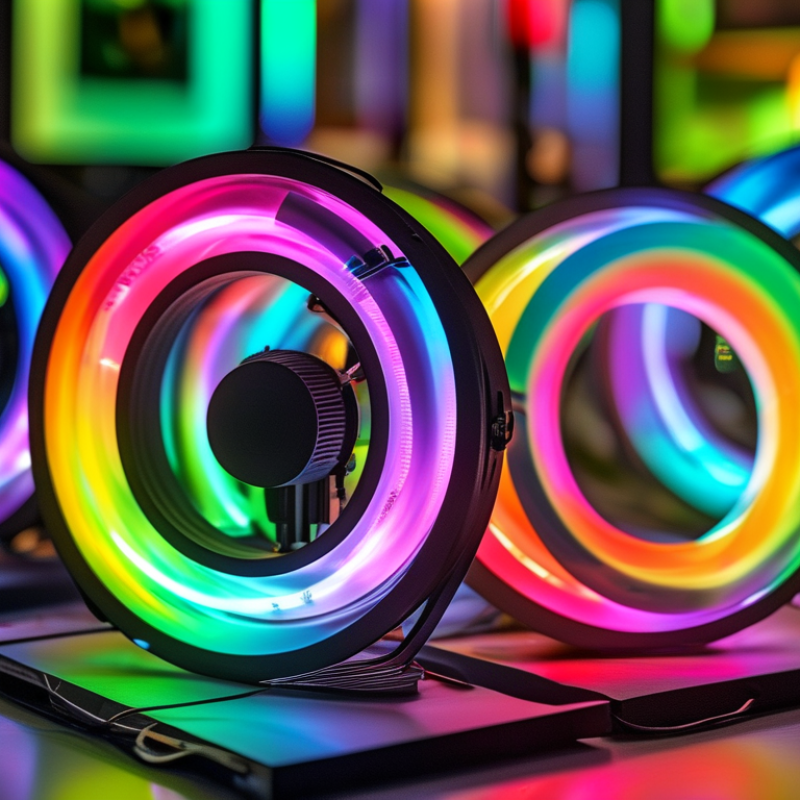
A reliable RGB ring light supplier does more than quote a low factory price. Global buyers need consistent color output, safe power design, and clear production evidence. Ask for measured color temperature, brightness range, CRI data, and beam performance. A serious supplier should provide samples from current production, not a specially polished unit. In my sourcing experience, small differences become obvious when several lights film the same face. Skin tones shift, shadows harden, and editing time increases. That is costly.
Reliability also appears in communication. The supplier should confirm plug types, voltage options, packaging tests, spare-part support, and realistic lead times. Written specifications should match the sample and inspection report. Check whether the diffuser, tripod joints, controller, and USB or adapter connections survive repeated use. Certifications may support confidence, but buyers should verify their scope and validity. I would not treat a certificate alone as proof of quality. That shortcut often fails.
Tips: Request a pre-shipment video showing brightness changes and color modes. Test ten units, not one. Record defects and compare them with agreed tolerances. Ask how rejected units are handled. Leave room for doubt; supplier promises can sound precise while factory controls remain uneven. A dependable partner accepts reasonable inspections, explains failures, and improves the next batch. Perfect performance is rare. Transparent correction matters more.
For global buyers, an RGB ring light should be judged by measurable performance, not colorful marketing claims. Common sizes range from 10 to 18 inches, with larger models creating softer facial illumination. Check the LED power rating, not only the advertised brightness. A 12-inch unit may deliver 18 to 30 watts in real use. That difference affects camera exposure and heat.
Color accuracy matters for cosmetics, product photography, and online teaching. Look for a CRI of 95 or higher, plus a TLCI rating when video quality is important. Adjustable white light should cover about 2700K to 6500K. RGB controls should offer hue, saturation, and brightness adjustment. Smooth dimming is essential. Visible steps can distract viewers. In practical testing, a stable 1% to 100% dimming range performs better than simple three-level controls. The control method also matters, including buttons, remote access, or app compatibility.
Global buyers should verify input voltage, plug options, adapter safety, and heat management. A universal input around 100–240V reduces purchasing complications, but the included plug still needs regional checking. USB-C power is convenient, although high-output models may require dedicated adapters. Examine the diffuser, mounting thread, stand load, and cable length. A weak stand can ruin an otherwise strong specification sheet. Some published brightness figures use ideal laboratory distances, so request test conditions and beam measurements. This is easy to overlook. It should not be.
Larger ring lights generally require higher power to deliver stronger and more uniform illumination. The reference values represent common manufacturer-neutral configurations available to global buyers, while actual performance varies by LED efficiency, diffuser design, brightness level, and input voltage.
Top RGB Ring Light Suppliers for Global Buyers
Manufacturing standards separate a reliable RGB ring light from a colorful sample. Responsible suppliers should follow ISO 9001 quality procedures, with controlled records for LEDs, power boards, diffusers, and wiring. IEC 62471 testing also evaluates photobiological safety, especially for products used near faces. The U.S. Department of Energy’s 2023 Solid-State Lighting R&D Opportunities report continues to identify high efficacy, thermal control, and color quality as major development targets. Brightness alone is not enough.
Quality control should begin before assembly. Suppliers can inspect incoming LED batches, verify color consistency, and test dimming across the complete RGB range. IES LM-79 provides a recognized method for measuring electrical and photometric performance. Production samples should pass aging tests, repeated power cycles, and temperature checks. Small failures often appear here first. A loose connector may survive inspection but fail after transport vibration.
Global buyers should request test reports, calibration records, and documented corrective actions. The ISO Survey has repeatedly shown the broad adoption of ISO 9001 across manufacturing industries, but certification does not guarantee flawless products. That point deserves attention. Factory audits should compare written procedures with actual operator behavior. In my experience, suppliers sometimes test one ideal sample while shipment quality varies. Random sampling, sealed reference units, and pre-shipment video evidence can reduce that gap, although none replaces independent verification.
| Evaluation Dimension | Manufacturing or Quality Requirement | Recommended Verification Method | Global Buyer Relevance |
|---|---|---|---|
| Quality management system | An ISO 9001-certified quality management system with documented production, inspection, corrective-action, and traceability procedures. | Request a current certificate, verify the certification scope and validity, and review recent audit or corrective-action records. | Improves consistency across batches and supports supplier qualification for international purchasing. |
| LED color performance | RGB color modes should operate consistently, while white-light modes should meet the buyer’s stated correlated color temperature and color-rendering targets. | Use a calibrated spectrometer or colorimeter to measure CCT, chromaticity, CRI where applicable, and color-mode repeatability. | Reduces visible color variation in video, photography, livestreaming, and e-commerce applications. |
| Brightness uniformity | LED output should be uniform around the ring without obvious dark zones, flicker, hot spots, or significant color shifts at different brightness levels. | Measure illumination at defined points around the ring and test at minimum, medium, and maximum brightness settings. | Protects image quality and lowers return rates caused by uneven lighting. |
| Flicker and driver control | The LED driver should provide stable output throughout the specified input-voltage range and avoid objectionable flicker during camera use. | Perform oscilloscope or photodetector testing at multiple brightness levels and input conditions. | Important for recorded video, high-frame-rate cameras, and professional content production. |
| Electrical safety | Power adapters, plugs, insulation, wiring, and strain relief must match the destination market’s electrical requirements and approved configurations. | Review applicable test reports, adapter approvals, insulation checks, polarity tests, and dielectric-strength or continuity records where applicable. | Helps prevent shock, overheating, plug incompatibility, and customs or marketplace compliance issues. |
| Photobiological safety | Lighting products should be assessed against IEC 62471 where the intended market or risk assessment requires photobiological safety evaluation. | Request a laboratory evaluation or test report covering the finished light assembly and intended operating conditions. | Provides documented evidence that optical radiation risks have been evaluated. |
| Electromagnetic compatibility | The complete product and power system should meet the electromagnetic-emissions and immunity requirements applicable to the destination market. | Review applicable EMC reports, including FCC Part 15 requirements for the United States when relevant, and conduct sample verification on the final configuration. | Reduces interference with cameras, microphones, computers, wireless equipment, and other electronics. |
| Restricted substances | Materials and electronic components should comply with applicable substance restrictions, such as the EU RoHS requirements, when the product is sold in covered markets. | Request a declaration of conformity, material declarations, supplier declarations, or independent laboratory testing for higher-risk components. | Supports environmental compliance and reduces regulatory exposure in international distribution. |
| Thermal management | LED boards, drivers, housings, and connectors should remain within their specified temperature limits during extended operation. | Conduct a continuous operating test at maximum brightness and record housing, driver, and connector temperatures. | Extends LED and driver life while reducing deformation, shutdown, and burn-related failures. |
| Mechanical durability | The ring housing, diffuser, tripod mount, phone holder, adjustment joints, and cable connections should withstand normal assembly and repeated use. | Apply assembly-cycle, torque, connector-insertion, tilt-adjustment, and packaging drop tests based on the agreed product specification. | Limits damage during shipping and daily setup by studios, retailers, and content creators. |
| Ingress protection claims | An IP rating should be stated only when the finished product has been tested to the relevant IEC 60529 requirements. | Request an accredited test report matching the exact model, enclosure, cable entry, and production configuration. | Prevents unsupported water- or dust-resistance claims in product listings and packaging. |
| Incoming material inspection | LEDs, PCBs, drivers, diffusers, plastics, cables, and connectors should be checked against approved drawings, specifications, and samples before production. | Review incoming inspection records, component lot identification, approved-vendor lists, and nonconformance reports. | Prevents component substitutions and reduces variation between purchase orders. |
| In-process inspection | Assembly checkpoints should cover soldering, wiring polarity, diffuser installation, controller function, mechanical fastening, and cosmetic quality. | Audit work instructions, inspection checklists, operator training records, and process-control logs. | Finds defects before final assembly and improves first-pass yield. |
| Final inspection and sampling | Final inspection should cover appearance, dimensions, function, accessories, labeling, packaging, and electrical operation using an agreed sampling plan. | Use a documented AQL-based or buyer-approved sampling procedure and retain inspection results by lot. | Creates an objective release decision before shipment and supports dispute resolution. |
| Functional aging test | A defined sample quantity should operate for an agreed period at representative or maximum load to identify early failures. | Record test duration, brightness setting, temperature, failures, and corrective actions for each production lot. | Improves reliability of LEDs, controllers, power adapters, and connectors. |
| Traceability and change control | Each shipment should be traceable to a production date, lot, component sources, inspection records, and approved product revision. | Check lot labels, production records, engineering-change notices, and procedures for notifying buyers before substitutions. | Supports targeted recalls, warranty analysis, and consistent repeat orders. |
| Packaging and export readiness | Packaging should protect the diffuser, ring frame, tripod, control unit, and power adapter from compression, impact, moisture, and abrasion. | Review carton specifications, drop-test results, barcode and labeling accuracy, palletization, and destination-market documentation. | Reduces transit damage and supports efficient customs clearance and warehouse handling. |
Global buyers need more than a bright sample when selecting RGB ring light suppliers. The sourcing decision spans customization, factory controls, and destination compliance. Grand View Research valued the global LED lighting market at about US$78.9 billion in 2023. It forecasts an 11.0% CAGR from 2024 to 2030. This growth increases supplier choice, but not necessarily supplier quality. Ask for LED binning records, color-temperature tolerance, dimming curves, and thermal test results. A sample can look excellent. Production may differ.
Customization should cover LED density, outer diameter, control methods, mounting threads, cable length, packaging, and private-label manuals. Compliance must match the destination market. Request test reports for the exact model and revision, including electrical safety, EMC, RoHS, and IEC 62471 photobiological safety where applicable. The International Energy Agency reports that lighting has represented roughly 15% of global electricity consumption. Efficient LEDs still need reliable heat management. Certificates alone are not enough. Verify laboratory accreditation, report dates, and product markings. Requirements can change, and supplier interpretations are sometimes incomplete.
Tips: Put every tolerance in the purchase specification. Approve a golden sample before mass production. Test three units from the pilot run, not only one showroom sample. Check plugs, adapters, manuals, carton strength, and color consistency. Use pre-shipment inspection and keep corrective-action records. This adds cost. It can prevent expensive returns. A practical sourcing lesson is uncomfortable: the cheapest quote may become the most expensive option after customs delays, redesigns, or uneven lighting.
International buyers should evaluate RGB ring light suppliers beyond catalog photos and attractive prices. Ask for measured data, including brightness, color temperature range, CRI, TLCI, and flicker performance. Request a working sample before placing a large order. Small details matter.
Check whether the supplier can provide clear technical documents, product test reports, and safety information for your target markets. Confirm plug types, voltage options, wireless controls, packaging strength, and spare-part availability. A reliable supplier should explain factory capacity, minimum order quantities, lead times, and quality-control steps without vague promises. Video audits can help, but they are not a complete substitute for independent inspection.
Communication is also practical evidence. Test response times with specific questions about heat management, LED lifespan, and replacement procedures. Review the sample under continuous use, not only for ten minutes. Some lights look excellent initially but show uneven colors after extended operation. I have found that early samples can create false confidence. Recheck the final production batch when possible. Compare defect rates, carton damage, and instruction quality. Suppliers that document problems honestly may be more dependable than those claiming perfection. Terms such as payment schedules, shipping responsibilities, warranty scope, and dispute procedures should be written clearly before production begins.


For those larger-sized parts, or smaller quantity runs, we have 2 independent powder coat booths and ovens. The quality, durability and affordability of today’s powder coating finishes make this the process of choice for world-class companies.
Powder coating advantages over other forms of coating are many. Materials used in the Powder coating process can be metals and non-metals that come in a multitude of thicknesses, textures, colors, etc. Another of Powder coating’s biggest advantages over conventional coatings is its ability to create finishes in many different textures. Powder Coating Booths allow us the ability to apply these advantages to large products.
Tri-State Fabricators runs a full-service conveyor line for painting. Wet painting can provide protection or decoration to many different part styles. From start to finish, every project is easier to undergo random and point-based inspection by our skilled painting team.
Advantages to our Wet Paint Line are these lines start with product prep and ends with a thorough inspection of a high quality finished product. Our ability to complete large and small projects with a superior finish and doing so in a timely and economical fashion. This passes along the savings in production to our customers. When powder coating ins not an option, our Wet Paint Line gets the job done right the first time.
When the parts get big and heavy we roll-out our custom paint racks and oversize booth. By utilizing our partnerships with all the major paint brands, we can match virtually any color with wet paint.
The advantages of having access to a Wet Paint Booth are many. Large projects of many different shapes can be loaded into the booth. The Wet Paint Booth offers an environment that is much more controlled than a typical parts painting operation.
Not only are they used because of their controlled environment, but they’re are also advantageous when it comes to applying paint to parts that are needed in industries that require specialty coatings such as medical, aerospace, etc.
Our military forces have some very high standards when it comes to the finish of their vehicles and equipment. From the first pre-treatment step to final coat, it takes a great deal of knowledge and experience to protect the men and women of our armed forces. They deserve only the best, and Tri-State Fabricators provides it.
All of our processes are closely monitored by our staff and management teams. Both of which are highly trained in the processes of metal fabrication and finishing. Tri-State Fabricators’ goal is to always fully satisfy each and every customer, including the military. We will always put a 110% into what we do.
Abrasive media blasting is an excellent way to remove old paint, rust, and increase the paint/powder adhesion. Glass beads produce a much smoother and brighter finish than angular abrasives; leaving the part clean yet without any dimensional change. Chemically inert and environmentally friendly, we can recycle our beads approximately 30 times; making them a more preferred method of metal cleaning or surface finishing.
Advantages to Glass Bead Blasting are many. Glass bead blast media is used when a project is needing rough surfaces need to become smooth for applications of coatings such as paint. It is typically used to clean paint and rust from a product surface without deforming the surface it is being used on. Overall, compared to many other blasting media, Glass Bead Blasting is a very economical choice and those savings are always passed on to our customers.
Tri-State Fabricators utilize a zinc phosphate wash to clean and etch the material to ensure the best paint adhesion possible. The unique design of our 3-stage wash system does the work like a 5-stage. From Cleaning and rinsing to conversion coating and post-treatment, Our Part Washing process is a complete service and works throughout the fabrication service and the finishing service.
Along with the previously mentioned benefits, Curing is a vital chemical reaction that leaves the product finish hard and relatively safe from mild abrasion and aggressive corrosion. This process can be done in more than one way; ambient air-dry or in curing ovens at temps that exceed 240°.
From fixing paint mistakes (someone else’s of course) to simply cleaning our paint line hooks, our burn-off oven is put to good use. After a quick burn-off, a little clean up, and a fresh coat of paint, your parts will look better than new.
Why does our Burn-Off Oven work so well? Because super heating the air around parts turns the materials into ashes. From paint and powder coatings to rubber and machining oils, high temps do the job without degrading the integrity of the part.
Masking is a vital part of producing high quality products. We have die-cut masking patterns to protect machined surfaces as well as a wide range of plugs and caps to protect threaded holes and bolts. We provide permanent and temporary masking.
Masking allows the selected sections of a product to be protected from a fabrication or finishing service. This can be with both chemicals when etching and tapes, paints when only finishing just a section of the product. Masking is great in aiding the customization process of a project.
Screen printing is a photographic process that transfers artwork onto a porous nylon screen which allows colored ink to flow through the screen and be deposited on an aluminum or plastic component. We can generally have just about any design created onto a screen for your parts.
Some of the advantages of Screen Printing are, brand recognition for your business displaying on your products, assembly instructions, product warnings/hazards, etc. Tri-State Fabricators produces Screen Printing of the highest quality so you know it’s durable.
Metal Finishing is the art of treating the exterior portion of product, often metal but can also be made of other materials, so that the surface is clean and free of any debris. Then the process of applying coats or either paint of powder coat takes place. This coating process improves the quality of the product in both appearance and resistance to wear and corrosion.
Tri-State Fabricators, Inc., understands that a project typically isn’t complete until a high-quality finish has been added to your product. This is why our painting and powder coating teams continuously inspect the products throughout the Metal Finishing process.

