


China Top Solar Light Tower Manufacturers and Suppliers? This question deserves more than a factory list. Buyers need evidence about illumination, battery performance, charging speed, mobility, and after-sales support. A tower may look powerful under showroom lighting, yet struggle beside a muddy construction road after several cloudy days. That difference matters.
The International Renewable Energy Agency reported 473 gigawatts of renewable capacity additions in 2023. Solar power represented about 75% of that expansion, showing strong momentum across the global energy market. The International Energy Agency also identifies solar photovoltaics as a central driver of future electricity growth. As IEA Executive Director Fatih Birol stated, “Solar PV is the new king of electricity markets.” This broader trend supports interest in the Solar Light Tower sector, especially for construction sites, emergency work, mining areas, and remote infrastructure.
Still, the market has weaknesses. Public reports rarely separate solar light towers from wider temporary lighting equipment. Product claims can also be difficult to compare. Rated brightness may omit operating duration, temperature effects, or battery degradation. Careful buyers should request test records, warranty terms, lumen data, panel specifications, and real deployment references. Manufacturers in China vary considerably in engineering depth and quality control. Some provide strong customization. Others offer attractive prices but limited technical documentation. This guide examines leading Chinese manufacturers and suppliers through practical criteria, including product reliability, certifications, production experience, export capability, and service responsiveness. The ranking is not absolute. Site conditions change everything. A coastal project, for example, needs different protection from a dry inland warehouse.
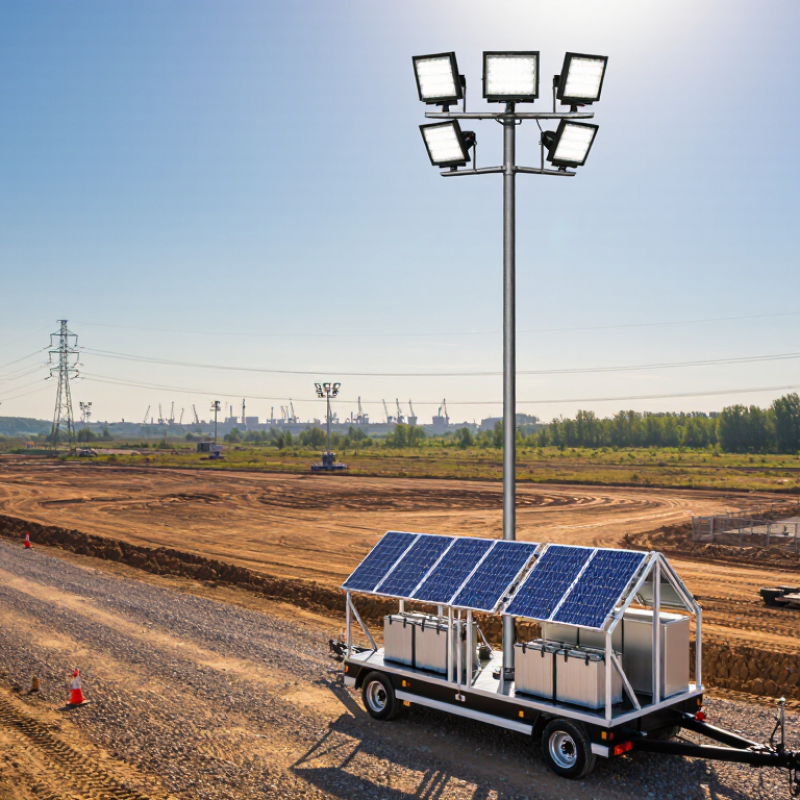
Solar light towers are mobile lighting systems powered by photovoltaic panels, batteries, and high-efficiency lamps. They provide illumination without a permanent electrical connection. During daylight, solar panels charge the battery. After sunset, stored energy powers the lamps for several hours. Many towers use adjustable masts, stabilizing legs, and automatic dusk sensors.
These towers support road repairs, construction zones, emergency response, agricultural work, and outdoor events. A four-lamp tower can spread light across a broad work area. It may also reduce fuel storage, engine noise, and routine maintenance. However, performance depends on sunlight, battery condition, dust, and temperature. A cloudy week can change the operating result. This detail is easy to underestimate.
Tips: Check the required lighting area before choosing a tower. Review panel size, battery capacity, mast height, and wind resistance. Place the unit where nearby buildings will not shade the panels. Clean dusty surfaces regularly, especially on construction sites. Do not rely on published runtime alone. Test the tower under realistic evening conditions. A model that works well in summer may need different positioning during winter. Operators should also inspect cables, locks, wheels, and emergency controls before each shift.
China’s Solar Light Tower Manufacturing Industry is supported by a deep photovoltaic supply chain. IRENA’s Renewable Capacity Statistics 2024 reports that China added about 216.9 GW of solar capacity in 2023. Its cumulative solar capacity reached approximately 609.5 GW. This scale supports faster sourcing of panels, lithium batteries, LED lamps, controllers, and galvanized masts for mobile light towers.
The IEA’s Solar PV Global Supply Chains report notes that China holds more than 80% of global solar manufacturing capacity. That advantage can shorten procurement cycles and reduce component costs. In practical production, reliable suppliers test battery protection, charging performance, mast stability, and lighting duration. A tower used beside a road needs more than bright LEDs. It needs stable wheels, sealed connectors, and a controller that survives dust and rain.
Quality still varies.
Some factories present excellent laboratory data but provide limited field records. That gap deserves attention. Buyers should request IEC-related test evidence, battery cycle results, lighting curves, and inspection reports before selecting China-based manufacturers or suppliers. The IEA Renewables 2024 report also highlights continuing growth in solar deployment, yet light tower performance depends on local weather and operating habits. A cloudy construction site can expose weak battery sizing quickly. Manufacturers improving thermal management, remote monitoring, and recyclable battery designs may gain stronger trust in overseas markets.
China’s rapidly expanding solar installation base supports the development of solar lighting equipment, including mobile solar light towers used for construction, emergency response, infrastructure projects, and outdoor events. The figures show annual newly installed photovoltaic capacity in China, measured in gigawatts.
Source: China National Energy Administration (NEA), annual national renewable energy development statistics. The data represents the wider solar energy market rather than individual manufacturers or brands.
China Top Solar Light Tower Manufacturers and Suppliers?
Leading Types of Solar Light Towers Made in China
Chinese manufacturers produce several practical solar light tower types for construction sites, road maintenance, emergency areas, and outdoor events. Mobile solar light towers usually combine foldable photovoltaic panels, LED lamps, batteries, and a trailer frame. Their wheels and adjustable masts support quick relocation. Some models use hydraulic lifting systems, while simpler units use manual poles. I have found that panel size and battery capacity strongly affect overnight performance.
Hybrid solar light towers add a backup generator for cloudy periods or demanding lighting schedules. All-in-one towers place the battery, controller, and lighting system inside one weather-resistant cabinet. High-mast versions provide wider coverage for large work areas. Compact telescopic towers suit narrow roads and temporary inspection points. The best type depends on required brightness, operating hours, terrain, and transport frequency. Bigger is not always better.
Tips: Ask suppliers for verified lighting data, battery cycle information, and protection ratings. Request a real load test, not only a product brochure. Check whether the mast remains stable during strong wind. Confirm charging performance in winter conditions. A common mistake is choosing by lamp wattage alone. That approach can hide weak batteries, limited panel output, or poor thermal design. Before ordering, inspect sample units and review maintenance access. Some specifications look impressive but need practical verification.
| Solar Light Tower Type | Typical Solar Array | Typical Battery System | LED Lighting Power | Mast Height | Typical Operating Time | Common Applications | Key Purchasing Considerations |
|---|---|---|---|---|---|---|---|
| Compact Portable Solar Light Tower | 100–300 Wp photovoltaic panels | 1–3 kWh lithium or LiFePO4 battery | 50–150 W | 3–6 m | Approximately 8–20 hours per charge | Small construction areas, pathways, events, emergency lighting | Foldable frame, transport weight, battery protection, setup time |
| Trailer-Mounted Solar Light Tower | 300–800 Wp photovoltaic panels | 2–10 kWh lithium or LiFePO4 battery | 100–400 W | 5–9 m | Approximately 8–24 hours per charge | Roadwork, mining sites, large construction projects, outdoor security | Trailer braking and stability, lifting mechanism, wind resistance, service access |
| Foldable-Panel Solar Light Tower | 200–600 Wp foldable or hinged panels | 2–6 kWh rechargeable battery | 80–300 W | 4–8 m | Approximately 10–24 hours per charge | Temporary work zones, disaster response, military and civil protection | Panel durability, folding locks, cable protection, deployment footprint |
| High-Mast Solar Light Tower | 400–1,000 Wp photovoltaic panels | 4–12 kWh battery storage | 200–600 W | 6–12 m | Approximately 8–18 hours per charge | Ports, logistics yards, sports grounds, industrial compounds | Foundation or ballast design, wind-load calculations, lighting distribution, maintenance height |
| Solar Light Tower with CCTV or Monitoring | 200–600 Wp photovoltaic panels | 2–8 kWh battery storage | 60–250 W | 4–9 m | Approximately 8–24 hours, depending on camera load | Perimeter security, remote sites, parking areas, utility projects | Camera resolution, network connectivity, data storage, cybersecurity, night-vision performance |
| Solar-Diesel Hybrid Light Tower | 300–800 Wp photovoltaic panels | 2–10 kWh battery storage | 100–400 W | 5–9 m | Solar operation supplemented by generator backup | Remote construction, mining, infrastructure and long-duration projects | Automatic changeover, fuel consumption, generator noise, emissions and maintenance requirements |
A reliable supplier should explain every major component, not only quote a bright lighting figure. Request datasheets for the solar panel, battery chemistry, LED module, controller, and mast. Check whether the stated illumination was measured in a real field test. A product can appear strong on paper but perform poorly during several cloudy nights.
Ask for a sample unit before placing a larger order. Inspect welds, powder coating, cable glands, fasteners, and the mast locking system. Test automatic dusk-to-dawn operation and measure runtime after limited sunlight. An IP rating should match a verifiable test report, not just a catalog statement. For coastal or dusty sites, ask about corrosion resistance and enclosure protection.
Supplier experience becomes clearer through factory records and customer references. Review production capacity, quality-control procedures, spare-part availability, and warranty terms in writing. Independent reports for batteries, electrical safety, and photometric performance add useful confidence. Communication matters too; delayed technical answers may become costly after shipment.
Do not trust polished samples completely. Batch consistency deserves attention. I have seen attractive prototypes hide weaker connectors or different battery cells in later units. Ask for serial-number tracking, pre-shipment inspection, packaging photos, and clear remedies for failed tests. A dependable partner welcomes detailed questions, even uncomfortable ones.
Buying solar light towers in China requires more than comparing prices. Start with the site’s actual working conditions. Record required illumination, operating hours, terrain, wind exposure, transport frequency, and charging limits. A tower for a warehouse differs from one used on remote roadwork.
Ask for a complete bill of materials. It should identify panels, batteries, lamps, controllers, cables, and mast sections. Do not guess.
Certification needs careful reading. Request current certificates and matching test reports, not brochure logos. Check model numbers, rated voltage, laboratory identity, issue dates, and testing scope.
CE may support European market access, but it does not replace every applicable requirement. For batteries, review transport test documents and safety data. For China sales, confirm whether CCC applies to the specific configuration.
ISO 9001 indicates process control, not automatic product quality. This distinction is often missed.
Quality checks should include a pre-shipment sample and independent inspection. Test light output after several cloudy charging cycles, not only on sunny afternoons. Measure battery runtime, mast locking strength, wheel stability, waterproofing, and emergency controls.
Ask for an IP test basis, spare-parts list, and warranty response times. Traceable serial numbers connect defects to production batches. A factory visit may reveal weak cable glands or rushed welding.
Yet one visit proves little. Even careful buyers can overestimate laboratory data. Keep acceptance criteria written, measurable, and linked to payment milestones. Records matter.


For those larger-sized parts, or smaller quantity runs, we have 2 independent powder coat booths and ovens. The quality, durability and affordability of today’s powder coating finishes make this the process of choice for world-class companies.
Powder coating advantages over other forms of coating are many. Materials used in the Powder coating process can be metals and non-metals that come in a multitude of thicknesses, textures, colors, etc. Another of Powder coating’s biggest advantages over conventional coatings is its ability to create finishes in many different textures. Powder Coating Booths allow us the ability to apply these advantages to large products.
Tri-State Fabricators runs a full-service conveyor line for painting. Wet painting can provide protection or decoration to many different part styles. From start to finish, every project is easier to undergo random and point-based inspection by our skilled painting team.
Advantages to our Wet Paint Line are these lines start with product prep and ends with a thorough inspection of a high quality finished product. Our ability to complete large and small projects with a superior finish and doing so in a timely and economical fashion. This passes along the savings in production to our customers. When powder coating ins not an option, our Wet Paint Line gets the job done right the first time.
When the parts get big and heavy we roll-out our custom paint racks and oversize booth. By utilizing our partnerships with all the major paint brands, we can match virtually any color with wet paint.
The advantages of having access to a Wet Paint Booth are many. Large projects of many different shapes can be loaded into the booth. The Wet Paint Booth offers an environment that is much more controlled than a typical parts painting operation.
Not only are they used because of their controlled environment, but they’re are also advantageous when it comes to applying paint to parts that are needed in industries that require specialty coatings such as medical, aerospace, etc.
Our military forces have some very high standards when it comes to the finish of their vehicles and equipment. From the first pre-treatment step to final coat, it takes a great deal of knowledge and experience to protect the men and women of our armed forces. They deserve only the best, and Tri-State Fabricators provides it.
All of our processes are closely monitored by our staff and management teams. Both of which are highly trained in the processes of metal fabrication and finishing. Tri-State Fabricators’ goal is to always fully satisfy each and every customer, including the military. We will always put a 110% into what we do.
Abrasive media blasting is an excellent way to remove old paint, rust, and increase the paint/powder adhesion. Glass beads produce a much smoother and brighter finish than angular abrasives; leaving the part clean yet without any dimensional change. Chemically inert and environmentally friendly, we can recycle our beads approximately 30 times; making them a more preferred method of metal cleaning or surface finishing.
Advantages to Glass Bead Blasting are many. Glass bead blast media is used when a project is needing rough surfaces need to become smooth for applications of coatings such as paint. It is typically used to clean paint and rust from a product surface without deforming the surface it is being used on. Overall, compared to many other blasting media, Glass Bead Blasting is a very economical choice and those savings are always passed on to our customers.
Tri-State Fabricators utilize a zinc phosphate wash to clean and etch the material to ensure the best paint adhesion possible. The unique design of our 3-stage wash system does the work like a 5-stage. From Cleaning and rinsing to conversion coating and post-treatment, Our Part Washing process is a complete service and works throughout the fabrication service and the finishing service.
Along with the previously mentioned benefits, Curing is a vital chemical reaction that leaves the product finish hard and relatively safe from mild abrasion and aggressive corrosion. This process can be done in more than one way; ambient air-dry or in curing ovens at temps that exceed 240°.
From fixing paint mistakes (someone else’s of course) to simply cleaning our paint line hooks, our burn-off oven is put to good use. After a quick burn-off, a little clean up, and a fresh coat of paint, your parts will look better than new.
Why does our Burn-Off Oven work so well? Because super heating the air around parts turns the materials into ashes. From paint and powder coatings to rubber and machining oils, high temps do the job without degrading the integrity of the part.
Masking is a vital part of producing high quality products. We have die-cut masking patterns to protect machined surfaces as well as a wide range of plugs and caps to protect threaded holes and bolts. We provide permanent and temporary masking.
Masking allows the selected sections of a product to be protected from a fabrication or finishing service. This can be with both chemicals when etching and tapes, paints when only finishing just a section of the product. Masking is great in aiding the customization process of a project.
Screen printing is a photographic process that transfers artwork onto a porous nylon screen which allows colored ink to flow through the screen and be deposited on an aluminum or plastic component. We can generally have just about any design created onto a screen for your parts.
Some of the advantages of Screen Printing are, brand recognition for your business displaying on your products, assembly instructions, product warnings/hazards, etc. Tri-State Fabricators produces Screen Printing of the highest quality so you know it’s durable.
Metal Finishing is the art of treating the exterior portion of product, often metal but can also be made of other materials, so that the surface is clean and free of any debris. Then the process of applying coats or either paint of powder coat takes place. This coating process improves the quality of the product in both appearance and resistance to wear and corrosion.
Tri-State Fabricators, Inc., understands that a project typically isn’t complete until a high-quality finish has been added to your product. This is why our painting and powder coating teams continuously inspect the products throughout the Metal Finishing process.

