

What Are the Top Soup Kettles for Global Buyers?

For global buyers, choosing the right Soup Kettles involves more than comparing capacity and price. A kettle may look impressive in a product photo, yet perform poorly during a crowded lunch service. Buyers must examine heating consistency, insulation, drainage, controls, cleaning access, and electrical compatibility. A 10-liter kettle suits a small café, while a 40-liter model may support a hotel buffet or institutional kitchen.

Thomas Keller, a respected chef and foodservice authority, once said, “A recipe has no soul. You, as the cook, must bring soul to the recipe.” The same idea applies to Soup Kettles. Equipment supports quality, but it cannot correct weak ingredients, careless temperature control, or poor kitchen planning. Reliable models should keep soup hot without scorching the bottom. They should also allow staff to stir, refill, and serve safely during busy periods.

Global buyers face different requirements. Voltage, plug standards, language settings, warranty coverage, and replacement-part availability can change the real purchasing cost. Stainless steel construction is usually practical, but not every stainless-steel body offers equal durability. Some hinges feel loose. Some controls are difficult to read through steam. These details matter.

This guide reviews the top Soup Kettles for international buyers, focusing on performance, energy use, capacity, maintenance, and supplier reliability. No model is perfect. The best choice depends on the menu, service volume, kitchen space, and local operating conditions. A careful buyer should test the kettle before committing to large-scale purchasing.
What Are the Top Soup Kettles for Global Buyers?

Soup Kettle Types: 5–20 L Countertop and 20–100 L Commercial Models

What Are the Top Soup Kettles for Global Buyers?

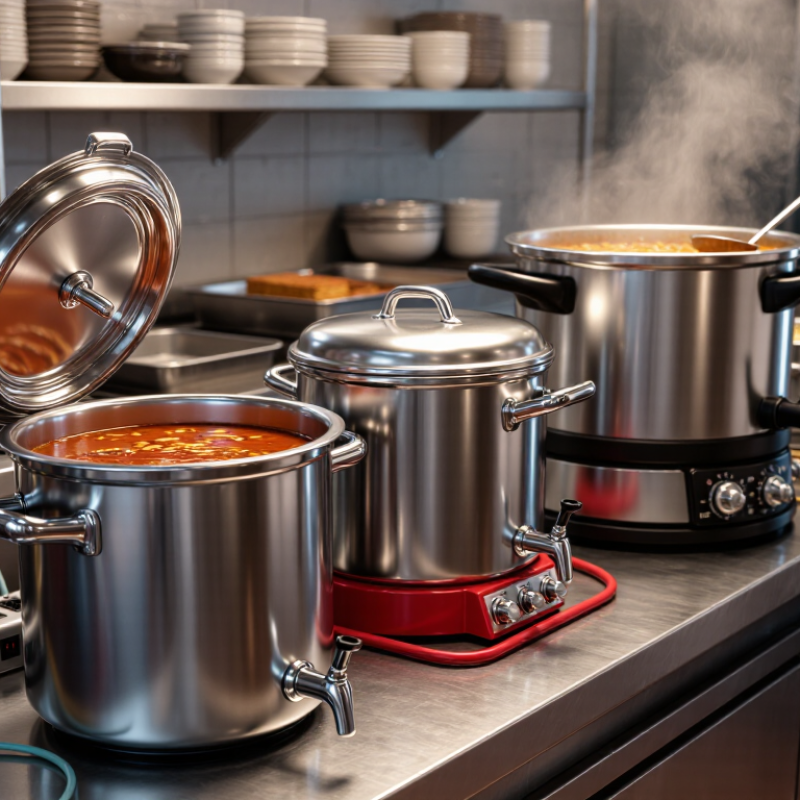
Soup kettles from 5 to 20 L suit cafés, hotel buffets, and small catering stations. A 5 L unit works well for limited menus or tasting portions. Larger 12–20 L kettles support steady service during busy lunch periods. Countertop models save floor space, but they need a stable, heat-resistant surface. Check the ladle clearance before ordering. A narrow opening can slow service and create messy spills.

Commercial kettles from 20 to 100 L are designed for higher-volume kitchens, canteens, and event caterers. Their larger capacity reduces refilling, yet a full 100 L vessel becomes difficult to move. Casters, drain valves, insulation, and adjustable temperature controls deserve close attention. Capacity labels can mislead. Usable volume is often lower than the advertised maximum, especially when safe stirring space is required. A 40 L kettle may be more practical than an overloaded 60 L model.

Tips: Match kettle size with hourly demand, not just kitchen size. Estimate portions, refill frequency, and staff movement around the unit. For countertop kettles, test the control panel while wearing heat-resistant gloves. For commercial models, confirm electrical requirements, cleaning access, and local installation standards. Stainless steel is durable, but poor welds or hidden corners can still trap residue. Ask for clear product specifications and service documentation. Even careful buyers sometimes focus too heavily on volume and overlook handling weight.

Heating Performance: 60–100°C Holding Range and ±1°C Temperature Control

What Are the Top Soup Kettles for Global Buyers?

Heating performance often separates a dependable soup kettle from a disappointing one. Look for a holding range between 60°C and 100°C, with temperature control close to ±1°C. This range supports gentle serving heat without constant boiling. A responsive thermostat should reduce overheating, especially during quiet service periods. However, the displayed temperature is not always the food temperature. Steam, thick soup, and uneven filling can create small differences. No kettle performs perfectly under every load. That detail deserves attention.

Tips: Test the temperature at several points inside the kettle. Check the center, surface, and area near the heating base. Use a calibrated thermometer during commissioning. Record readings after heating, refilling, and extended holding. These simple checks reveal whether the control system works consistently in real service.

Buyers should also examine heat recovery after adding chilled soup. A strong unit should return toward its set point without aggressive boiling. Insulation helps maintain heat while reducing unnecessary energy use. Clear controls make adjustments easier for international staff and busy kitchens. The ±1°C claim should be treated as a performance target, not an automatic promise. Ask for test conditions, load volume, and calibration information. Ambient temperature may also affect results. A kettle that performs well in a showroom can behave differently during a crowded buffet service.

Material Standards: 304 Stainless Steel, Double Walls, and Food-Grade Interiors

For global buyers, 304 stainless steel remains a practical baseline for soup kettles.

It typically contains about 18% chromium and 8% nickel, supporting corrosion resistance around salty broths and acidic ingredients. World Stainless reported approximately 58.4 million tonnes of crude stainless steel production in 2023, showing the material’s broad industrial importance. However, production volume does not prove equipment quality.

Look closely at the cooking interior. The U.S. FDA Food Code 2022 requires food-contact surfaces to be smooth, corrosion-resistant, and easily cleanable. Buyers should request food-grade interior documentation, weld inspection details, and surface-finish specifications.

Rough seams can trap soup residue. That is a small detail, but cleaning teams notice it daily.

Double walls improve thermal stability and reduce heat escaping from the kettle.

Performance depends on insulation thickness, lid fit, and heating control, not the phrase “double wall” alone. A 2023 U.S. Department of Energy report highlights insulation as a key factor in reducing heat transfer across equipment systems. The principle applies here, although kitchen conditions are less controlled.

Some sellers overstate efficiency. Ask for test temperatures, holding times, and energy measurements. A shiny surface is not enough.

Global Compliance: NSF/ANSI 4, CE, UL, and HACCP-Ready Design Criteria

What Are the Top Soup Kettles for Global Buyers?

For global buyers, a soup kettle should begin with compliance, not appearance. NSF/ANSI 4 helps assess commercial cooking equipment for sanitation and construction. Confirm that the exact kettle model falls within the standard’s applicable scope. Do not rely on a supplier’s general statement. Ask for current certificates, test reports, and the listed model number.

CE marking supports applicable European Union safety requirements, but it is not a universal quality certificate. Electrical ratings, technical files, and conformity documentation still require careful review. UL certification or listing may support electrical safety in North America, depending on the product and market. Check voltage, frequency, plug type, grounding, and local installation rules before purchase. Small mismatches can create costly delays.

HACCP-ready design should make daily controls practical. Look for smooth welds, rounded corners, removable components, and limited dirt traps. A visible temperature display helps staff record holding temperatures consistently. Drainage should be controlled and easy to clean. Keep food-contact materials documented. Test cleaning procedures with real operators, not only engineers.

I have seen attractive kettles fail because lids were awkward to remove. That matters.

Documentation needs traceability. Request material declarations, sanitation instructions, calibration guidance, and spare-part information. Confirm whether testing covers the heating system, controls, and complete assembled unit. A certificate may cover only one component. That detail is easy to miss.

Compliance reduces risk, but it cannot replace site-level food safety training and inspection.

Buyer Comparison: Capacity, 1–3 kW Power, Energy Use, Warranty, and Cost

What Are the Top Soup Kettles for Global Buyers?

Capacity should match service rhythm, not only the largest menu batch. A 10–12 litre kettle suits small cafés and tasting counters. Larger kitchens may need 20 litres or more. I have seen buyers choose oversized vessels, then pay for unnecessary heating and storage. That choice deserves a second look.

Power ratings usually range from 1 to 3 kW. A 3 kW model heats faster, but it can strain outlets in older kitchens. The U.S. Department of Energy recommends evaluating connected load and operating schedules together. For energy planning, a 2 kW kettle running eight hours with a 60% duty cycle uses about 9.6 kWh. At $0.15 per kWh, that equals $1.44 daily. ENERGY STAR commercial food-service guidance also highlights idle operation as a major efficiency concern. Keep the lid closed. Avoid constant reheating.

Warranty terms need careful comparison. Check heating-element coverage, parts availability, response time, and local service support. A 12-month warranty may be weaker than a 24-month warranty with expensive return shipping. The European Commission’s Joint Research Centre identifies duty cycles, standby losses, and maintenance as important catering-equipment cost factors. Total cost includes freight, voltage compatibility, import handling, cleaning labor, and replacement parts. I would not judge value from purchase price alone. That shortcut often fails.

What Are the Top Soup Kettles for Global Buyers? - Buyer Comparison: Capacity, 1–3 kW Power, Energy Use, Warranty, and Cost

Soup Kettle Type Typical Capacity Rated Power Approx. Energy Use Temperature Range Heating & Control Typical Warranty Estimated Purchase Cost Best Suited For
Compact countertop kettle 6–8 L 1.0–1.5 kW 0.7–1.2 kWh per operating hour* 30–110°C Thermostatic control; direct or water-bath heating 12 months US$90–180 Small cafés, tasting stations, offices, and low-volume service
Standard countertop kettle 10–12 L 1.5–2.0 kW 1.0–1.6 kWh per operating hour* 30–110°C Adjustable thermostat; insulated stainless-steel body 12–24 months US$140–280 Cafés, buffets, bakeries, and medium-volume food service
Large buffet kettle 16–20 L 2.0–3.0 kW 1.4–2.4 kWh per operating hour* 30–110°C Water-jacket heating; adjustable thermostat and indicator light 12–24 months US$220–450 Hotels, catering operations, canteens, and self-service buffets
Insulated commercial kettle 10–12 L 1.0–1.5 kW 0.6–1.1 kWh per operating hour* 35–95°C Insulated water-bath system; low-energy holding mode 12–24 months US$180–360 Long service periods where heat retention and lower holding costs matter
Heavy-duty stainless-steel kettle 16–20 L 2.0–3.0 kW 1.5–2.5 kWh per operating hour* 35–110°C Durable stainless-steel construction; overheat protection 12–24 months US$300–600 High-throughput restaurants, institutional kitchens, and frequent daily use
Dual-compartment soup kettle 2 × 4–6 L 1.5–2.5 kW total 1.0–2.0 kWh per operating hour* 30–110°C Two independently adjustable thermostatic zones 12–24 months US$240–520 Buffets and catering counters serving two soups or sauces at once

*Energy-use figures are practical operating estimates for maintaining hot food rather than continuously heating cold soup. Actual consumption varies with ambient temperature, lid use, fill level, thermostat cycling, insulation, and local electricity voltage. Purchase costs are indicative international market ranges in US dollars and may exclude freight, import duties, taxes, plugs, and regional certification.

Article Source:

Powder Coat Booths

For those larger-sized parts, or smaller quantity runs, we have 2 independent powder coat booths and ovens. The quality, durability and affordability of today’s powder coating finishes make this the process of choice for world-class companies.

Powder coating advantages over other forms of coating are many. Materials used in the Powder coating process can be metals and non-metals that come in a multitude of thicknesses, textures, colors, etc. Another of Powder coating’s biggest advantages over conventional coatings is its ability to create finishes in many different textures. Powder Coating Booths allow us the ability to apply these advantages to large products.

Wet Paint Line

Tri-State Fabricators runs a full-service conveyor line for painting. Wet painting can provide protection or decoration to many different part styles. From start to finish, every project is easier to undergo random and point-based inspection by our skilled painting team.

Advantages to our Wet Paint Line are these lines start with product prep and ends with a thorough inspection of a high quality finished product. Our ability to complete large and small projects with a superior finish and doing so in a timely and economical fashion. This passes along the savings in production to our customers. When powder coating ins not an option, our Wet Paint Line gets the job done right the first time.

Wet Paint Booths

When the parts get big and heavy we roll-out our custom paint racks and oversize booth. By utilizing our partnerships with all the major paint brands, we can match virtually any color with wet paint.

The advantages of having access to a Wet Paint Booth are many. Large projects of many different shapes can be loaded into the booth. The Wet Paint Booth offers an environment that is much more controlled than a typical parts painting operation.

Not only are they used because of their controlled environment, but they’re are also advantageous when it comes to applying paint to parts that are needed in industries that require specialty coatings such as medical, aerospace, etc.

Military CARC

Our military forces have some very high standards when it comes to the finish of their vehicles and equipment. From the first pre-treatment step to final coat, it takes a great deal of knowledge and experience to protect the men and women of our armed forces. They deserve only the best, and Tri-State Fabricators provides it.

All of our processes are closely monitored by our staff and management teams. Both of which are highly trained in the processes of metal fabrication and finishing. Tri-State Fabricators’ goal is to always fully satisfy each and every customer, including the military. We will always put a 110% into what we do.

Glass-Bead Blasting

Abrasive media blasting is an excellent way to remove old paint, rust, and increase the paint/powder adhesion. Glass beads produce a much smoother and brighter finish than angular abrasives; leaving the part clean yet without any dimensional change. Chemically inert and environmentally friendly, we can recycle our beads approximately 30 times; making them a more preferred method of metal cleaning or surface finishing.

Advantages to Glass Bead Blasting are many. Glass bead blast media is used when a project is needing rough surfaces need to become smooth for applications of coatings such as paint. It is typically used to clean paint and rust from a product surface without deforming the surface it is being used on. Overall, compared to many other blasting media, Glass Bead Blasting is a very economical choice and those savings are always passed on to our customers.

Part Washing

Tri-State Fabricators utilize a zinc phosphate wash to clean and etch the material to ensure the best paint adhesion possible. The unique design of our 3-stage wash system does the work like a 5-stage. From Cleaning and rinsing to conversion coating and post-treatment, Our Part Washing process is a complete service and works throughout the fabrication service and the finishing service.

Along with the previously mentioned benefits, Curing is a vital chemical reaction that leaves the product finish hard and relatively safe from mild abrasion and aggressive corrosion. This process can be done in more than one way; ambient air-dry or in curing ovens at temps that exceed 240°.

Burn-Off Oven

From fixing paint mistakes (someone else’s of course) to simply cleaning our paint line hooks, our burn-off oven is put to good use. After a quick burn-off, a little clean up, and a fresh coat of paint, your parts will look better than new.

Why does our Burn-Off Oven work so well? Because super heating the air around parts turns the materials into ashes. From paint and powder coatings to rubber and machining oils, high temps do the job without degrading the integrity of the part.

Masking

Masking is a vital part of producing high quality products. We have die-cut masking patterns to protect machined surfaces as well as a wide range of plugs and caps to protect threaded holes and bolts. We provide permanent and temporary masking.

Masking allows the selected sections of a product to be protected from a fabrication or finishing service. This can be with both chemicals when etching and tapes, paints when only finishing just a section of the product. Masking is great in aiding the customization process of a project.

Screen Printing

Screen printing is a photographic process that transfers artwork onto a porous nylon screen which allows colored ink to flow through the screen and be deposited on an aluminum or plastic component. We can generally have just about any design created onto a screen for your parts.

Some of the advantages of Screen Printing are, brand recognition for your business displaying on your products, assembly instructions, product warnings/hazards, etc. Tri-State Fabricators produces Screen Printing of the highest quality so you know it’s durable.

Metal Finishing

Metal Finishing is the art of treating the exterior portion of product, often metal but can also be made of other materials, so that the surface is clean and free of any debris. Then the process of applying coats or either paint of powder coat takes place. This coating process improves the quality of the product in both appearance and resistance to wear and corrosion.

Tri-State Fabricators, Inc., understands that a project typically isn’t complete until a high-quality finish has been added to your product. This is why our painting and powder coating teams continuously inspect the products throughout the Metal Finishing process.