

Choosing the right dyeing system affects shade consistency, production speed, water use, and the daily workload of a textile mill. A Package Dyeing Machine is designed to dye yarn wound onto perforated packages, allowing liquor to pass through the yarn under controlled conditions. The details matter. A tightly wound package can resist flow, while uneven winding may leave pale bands that appear only after drying.
Textile coloration author J. N. Chakraborty has written on the science and practice of textile coloration. No verified quotation from him about package dyeing is available here, so the following is a paraphrase, not a direct quote: “Consistent colour depends on controlled dyeing conditions and even liquor circulation.” That principle helps explain why machine design, package density, temperature control, and circulation settings deserve careful attention.
For mills handling yarn, package dyeing can support repeatable batches and reduce handling between dyeing and downstream processes. It is not an automatic fix. Results still depend on yarn type, preparation, recipe accuracy, and operator skill. A practical evaluation should compare sample shades, cycle times, energy use, and maintenance needs under real production conditions. Look closely. A well-chosen machine can improve consistency, but the winding process and process controls must work with it.
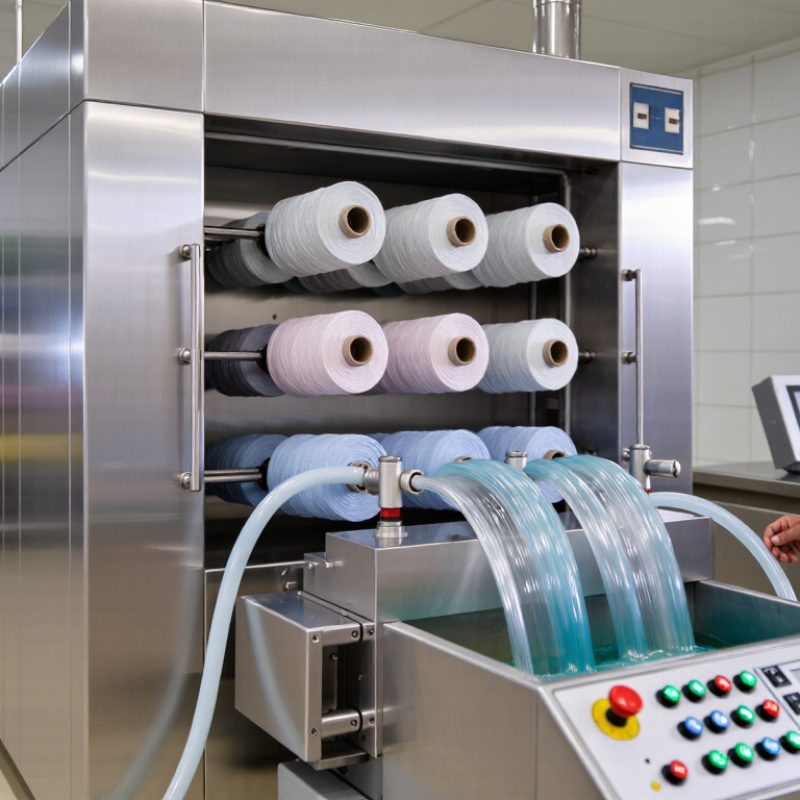
A package dyeing machine is a closed vessel that dyes yarn wound onto perforated tubes or carriers. Inside the vessel, a pump circulates heated dye liquor through the yarn packages, often alternating flow direction to improve penetration. Operators control temperature, pressure, circulation, and processing time. The result is a batch process suited to yarn that will later be knitted or woven. It is not a fabric-dyeing machine.
Textile Exchange’s Materials Market Report 2024 estimates that global fiber production reached 124 million tonnes in 2023. That scale makes consistent processing important, though the figure does not measure dyeing-machine performance. Package dyeing can support repeatable shade control across a batch, but results depend on winding density and liquor flow. Packages packed too tightly may develop pale patches. A machine cannot fix poor preparation.
Package dyeing colors yarn wound onto perforated tubes, or packages. Operators load them onto a spindle inside the vessel, then circulate dye liquor through the yarn. Flow may reverse direction to help dye penetrate evenly. Flow matters.
The cycle usually starts with wetting and pretreatment, which remove air and prepare the yarn. The machine then heats the liquor according to the fiber and dye recipe. Operators control temperature, pH, circulation, and dosing; salt or alkali may be needed for certain dye systems. After dyeing, rinsing and soaping remove unfixed color. Small details count. Uneven winding or trapped air can leave pale patches, even when the recipe looks right.
The Textile Exchange Materials Market Report 2024 estimates global fiber production reached 124 million tonnes in 2023, underscoring the scale of textile processing. The World Bank’s 2019 overview, How Much Do Our Wardrobes Cost to the Environment?, cites textile dyeing and treatment as responsible for about 20% of global wastewater. That broad estimate is not a package-machine performance figure. Still, it makes liquor control and rinse planning worth careful attention. I would not treat a single recipe as universal; yarn density and machine loading can change the result.
Package dyeing suits yarn wound onto perforated tubes or cones, where dye liquor can circulate through each package. Cotton, wool, polyester, nylon, and many blends may be processed this way, provided the recipe matches the fiber and equipment. It is useful when a mill needs consistent shades across multiple yarn packages. Density matters.
The winding stage is critical. Packages wound too tightly can resist liquor flow, leaving pale areas near the center; loose packages may distort during processing. Operators check package weight, winding hardness, and tube fit before loading the carrier. These details sound small, but they can affect shade uniformity across a batch. Not every lot behaves.
This method is a practical choice for repeat orders, varied yarn colors, and production runs where controlled circulation matters. It can also work well for delicate yarns that need even treatment without fabric-level handling. However, very bulky packages, uneven winding, or frequent changes in fiber type may require extra setup and testing. A small trial can reveal problems before a full production load, though it does add time. That trade-off is real.
A package dyeing machine processes yarn wound onto perforated tubes or carriers. Dye liquor circulates through the packages, helping color reach the yarn layers evenly. When winding density and flow are well controlled, the result can be consistent shades across a production batch. That matters.
The enclosed system supports repeatable recipes for temperature, circulation, and processing time. Operators can monitor these settings and adjust them for different yarn types and dye requirements. Packages also stay on their carriers during much of the process, reducing handling between steps. Less handling can mean fewer snags and less disruption to the yarn surface. Small details count.
The equipment suits mills that dye yarn in package form and need controlled batch processing. It can also help use water and dye liquor efficiently, though actual consumption depends on machine design, loading, and recipe. A package dyeing machine is not automatically the best choice for every operation. Poor winding or uneven package density can restrict liquor flow and create shade variation. A test batch is useful. Check the innermost layers, not just the outside.
Why Choose a Package Dyeing Machine?
What Factors Should Guide Machine Selection?
Selecting a package dyeing machine starts with the yarn, not the machine brochure. Check fiber type, yarn count, package density, and the shade range you produce most often. Uneven winding can restrict liquor flow, even in a well-designed vessel. That detail matters. Ask suppliers for trial results using packages close to your production conditions, then inspect shade variation from the package surface to its core.
Compare usable capacity with your actual batch sizes. A vessel that is too large may waste water, heat, and dye on frequent small runs; one that is too small can require costly extra batches. Review pump performance, flow reversal, temperature control, and pressure limits against your process needs. Operators should be able to load carriers safely and clean filters without awkward access. Consider automation, but verify that staff can adjust recipes and diagnose alarms. Fancy screens are not enough.
Examine service access, spare-part availability, and commissioning support. Ask how cleaning, maintenance, and calibration are documented. Calculate energy and water use per kilogram, not just the purchase price. Estimates can be difficult to compare and may not match real mill conditions. Request clear assumptions. Test them with a small production trial before committing.
| Selection Factor | Why It Matters | What to Check | Practical Selection Guidance |
|---|---|---|---|
| Fiber and yarn type | Different fibers require different dyeing conditions, chemical systems, and temperature profiles. | Confirm compatibility with the intended materials, such as cotton, wool, polyester, nylon, or blended yarns. | Choose a machine and process configuration suited to the full range of fibers you expect to dye; verify recipes and process limits with a qualified dyeing specialist. |
| Package construction and density | Uneven winding or excessive package density can restrict liquor flow and cause unlevel dyeing. | Review package dimensions, winding hardness, winding pattern, and the required perforated tube or carrier arrangement. | Use packages prepared consistently for dyeing, and confirm that the machine’s carriers support the package formats used in production. |
| Batch size and production mix | Machine capacity affects batch planning, labor use, energy consumption per kilogram, and the ability to handle small orders. | Compare usable batch capacity with typical and peak production needs, including minimum practical loads. | Select capacity around your normal batch size rather than only your largest order; consider multiple batch sizes if production varies significantly. |
| Liquor circulation and flow control | Consistent circulation through and around packages supports uniform heat transfer and dye distribution. | Ask about pump control, flow measurement, pressure monitoring, flow reversal, and the arrangement of package carriers. | Request process data or trials for representative yarn packages. Check that circulation can be adjusted for the material and package density. |
| Temperature and pressure capability | The required operating conditions depend on the fiber and dyeing process; some processes need higher temperatures than others. | Check the vessel’s rated pressure and temperature, operating limits, control accuracy, and applicable safety requirements. | Specify limits from your actual recipes and local regulations. Do not select a pressure rating based solely on a generic machine description. |
| Loading, unloading, and carrier handling | Handling time and ergonomics influence labor requirements, batch turnaround, and the risk of package damage. | Assess carrier weight, access, lifting method, loading height, and whether handling aids are needed. | Review the complete loading workflow at the intended production scale, including safe movement of wet and dry carriers. |
| Automation and recipe control | Repeatable dosing, temperature ramps, and process timing can improve consistency and reduce manual intervention. | Evaluate recipe storage, automated dosing options, sensor calibration, alarms, data records, and operator access controls. | Match automation to staff skills and process complexity. Confirm that recipes can be documented, backed up, and adjusted by authorized users. |
| Water, energy, and effluent | Heating, pumping, rinsing, and wastewater treatment contribute to operating cost and environmental impact. | Request utility requirements and assess liquor ratio, heat recovery options, rinse strategy, drainage, and wastewater compatibility. | Compare machines using the same batch, recipe, and load assumptions; actual consumption varies with process conditions and plant utilities. |
| Materials and chemical compatibility | Vessel, seals, pipework, and fittings must withstand the dyes, auxiliaries, temperatures, and cleaning chemicals used. | Review wetted materials, seal specifications, corrosion resistance, and the cleaning procedure recommended for your chemistry. | Provide the supplier with your chemical and process requirements, and confirm compatibility before finalizing the machine specification. |
| Maintenance, safety, and support | Accessible maintenance points, safeguards, and reliable technical support help reduce downtime and operational risk. | Check inspection access, spare-parts availability, pressure-vessel documentation, safety interlocks, training, and service response arrangements. | Review the maintenance schedule and safety documentation before purchase, and plan operator training and essential spare parts in advance. |
Note: Machine specifications and process results vary by design, fiber, package preparation, recipe, and operating conditions. Confirm critical requirements through technical documentation and production trials.


For those larger-sized parts, or smaller quantity runs, we have 2 independent powder coat booths and ovens. The quality, durability and affordability of today’s powder coating finishes make this the process of choice for world-class companies.
Powder coating advantages over other forms of coating are many. Materials used in the Powder coating process can be metals and non-metals that come in a multitude of thicknesses, textures, colors, etc. Another of Powder coating’s biggest advantages over conventional coatings is its ability to create finishes in many different textures. Powder Coating Booths allow us the ability to apply these advantages to large products.
Tri-State Fabricators runs a full-service conveyor line for painting. Wet painting can provide protection or decoration to many different part styles. From start to finish, every project is easier to undergo random and point-based inspection by our skilled painting team.
Advantages to our Wet Paint Line are these lines start with product prep and ends with a thorough inspection of a high quality finished product. Our ability to complete large and small projects with a superior finish and doing so in a timely and economical fashion. This passes along the savings in production to our customers. When powder coating ins not an option, our Wet Paint Line gets the job done right the first time.
When the parts get big and heavy we roll-out our custom paint racks and oversize booth. By utilizing our partnerships with all the major paint brands, we can match virtually any color with wet paint.
The advantages of having access to a Wet Paint Booth are many. Large projects of many different shapes can be loaded into the booth. The Wet Paint Booth offers an environment that is much more controlled than a typical parts painting operation.
Not only are they used because of their controlled environment, but they’re are also advantageous when it comes to applying paint to parts that are needed in industries that require specialty coatings such as medical, aerospace, etc.
Our military forces have some very high standards when it comes to the finish of their vehicles and equipment. From the first pre-treatment step to final coat, it takes a great deal of knowledge and experience to protect the men and women of our armed forces. They deserve only the best, and Tri-State Fabricators provides it.
All of our processes are closely monitored by our staff and management teams. Both of which are highly trained in the processes of metal fabrication and finishing. Tri-State Fabricators’ goal is to always fully satisfy each and every customer, including the military. We will always put a 110% into what we do.
Abrasive media blasting is an excellent way to remove old paint, rust, and increase the paint/powder adhesion. Glass beads produce a much smoother and brighter finish than angular abrasives; leaving the part clean yet without any dimensional change. Chemically inert and environmentally friendly, we can recycle our beads approximately 30 times; making them a more preferred method of metal cleaning or surface finishing.
Advantages to Glass Bead Blasting are many. Glass bead blast media is used when a project is needing rough surfaces need to become smooth for applications of coatings such as paint. It is typically used to clean paint and rust from a product surface without deforming the surface it is being used on. Overall, compared to many other blasting media, Glass Bead Blasting is a very economical choice and those savings are always passed on to our customers.
Tri-State Fabricators utilize a zinc phosphate wash to clean and etch the material to ensure the best paint adhesion possible. The unique design of our 3-stage wash system does the work like a 5-stage. From Cleaning and rinsing to conversion coating and post-treatment, Our Part Washing process is a complete service and works throughout the fabrication service and the finishing service.
Along with the previously mentioned benefits, Curing is a vital chemical reaction that leaves the product finish hard and relatively safe from mild abrasion and aggressive corrosion. This process can be done in more than one way; ambient air-dry or in curing ovens at temps that exceed 240°.
From fixing paint mistakes (someone else’s of course) to simply cleaning our paint line hooks, our burn-off oven is put to good use. After a quick burn-off, a little clean up, and a fresh coat of paint, your parts will look better than new.
Why does our Burn-Off Oven work so well? Because super heating the air around parts turns the materials into ashes. From paint and powder coatings to rubber and machining oils, high temps do the job without degrading the integrity of the part.
Masking is a vital part of producing high quality products. We have die-cut masking patterns to protect machined surfaces as well as a wide range of plugs and caps to protect threaded holes and bolts. We provide permanent and temporary masking.
Masking allows the selected sections of a product to be protected from a fabrication or finishing service. This can be with both chemicals when etching and tapes, paints when only finishing just a section of the product. Masking is great in aiding the customization process of a project.
Screen printing is a photographic process that transfers artwork onto a porous nylon screen which allows colored ink to flow through the screen and be deposited on an aluminum or plastic component. We can generally have just about any design created onto a screen for your parts.
Some of the advantages of Screen Printing are, brand recognition for your business displaying on your products, assembly instructions, product warnings/hazards, etc. Tri-State Fabricators produces Screen Printing of the highest quality so you know it’s durable.
Metal Finishing is the art of treating the exterior portion of product, often metal but can also be made of other materials, so that the surface is clean and free of any debris. Then the process of applying coats or either paint of powder coat takes place. This coating process improves the quality of the product in both appearance and resistance to wear and corrosion.
Tri-State Fabricators, Inc., understands that a project typically isn’t complete until a high-quality finish has been added to your product. This is why our painting and powder coating teams continuously inspect the products throughout the Metal Finishing process.