
Why Choose an S250 Air Compressor Rock Drill?

Choosing an S250 Air Compressor Rock Drill is a practical decision for demanding quarry, construction, and foundation work. The right equipment must match rock hardness, hole diameter, drilling depth, and daily operating hours. A powerful name alone does not prove suitability.

Field experience shows that drilling performance depends on the complete air system. Compressor output, working pressure, hose length, couplings, and filter condition all influence impact energy. A small pressure drop can leave visible signs: slower penetration, overheated fittings, and irregular dust discharge. The U.S. Department of Energy’s Improving Compressed Air System Performance report notes that compressed air may consume about 10% of industrial electricity. It also warns that leaks can waste 20% to 30% of compressor output. These figures make efficiency and maintenance important purchasing factors.

The S250 Air Compressor Rock Drill should therefore be assessed beyond its catalogue description. Operators should compare its required air volume with the compressor’s real output, not its advertised maximum. They should also inspect vibration control, lubrication access, spare-part availability, and service support. The Atlas Copco Compressed Air Manual emphasizes that pressure stability and air quality strongly affect pneumatic tool performance. That guidance applies directly to rock drilling conditions.

No machine is perfect. Mud, fractured rock, and poor hose layout can reduce productivity. A careful trial on the intended site remains valuable. Buyers who record penetration speed, fuel use, downtime, and operator feedback can make a more reliable choice. This evidence-based approach helps determine whether the S250 Air Compressor Rock Drill offers genuine value for a specific project, rather than simply appearing powerful on paper.
Why Choose an S250 Air Compressor Rock Drill?

What Is an S250 Air Compressor Rock Drill?

An S250 air compressor rock drill is a pneumatic drilling system designed for breaking and boring hard ground. The name does not always describe one universal specification. In many equipment catalogs, “S250” identifies a particular drill model, capacity class, or matched compressor configuration. Buyers should verify the technical sheet before comparing machines.

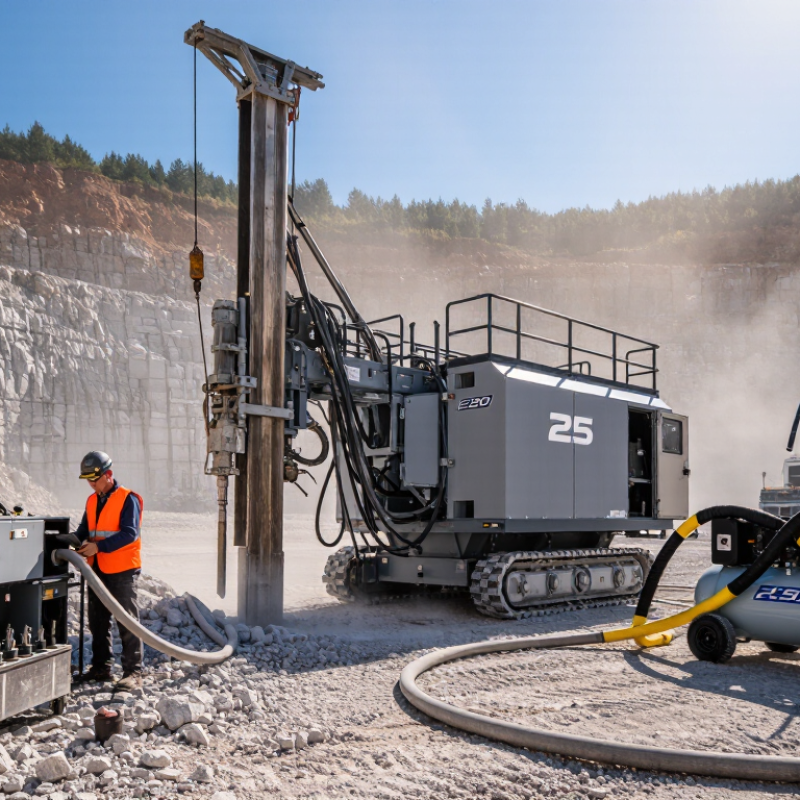
The compressor produces pressurized air and sends it through a reinforced hose to the rock drill. Inside the drill, compressed air drives the piston against the bit. The impact energy cracks rock, while air flow helps clear dust and loose fragments from the hole. This setup suits quarry work, foundation preparation, road construction, and controlled ground investigation.

A practical unit needs more than strong impact. Air pressure, air volume, bit diameter, hose length, and rock hardness must match. A small mismatch can cause slow drilling or excessive wear. The frame should remain stable on uneven ground. Operators also need hearing protection, eye protection, dust control, and regular hose inspections.

The label can be confusing. That matters.

Before operation, technicians should check oil levels, couplings, filters, and drain valves. Moisture in the air line may reduce performance and damage internal parts. Hard rock can also demand more compressor capacity than expected. Performance figures are useful, but field conditions often expose their limits. A careful assessment of geology and daily drilling depth gives a more reliable equipment choice.

How Does the S250 Rock Drilling System Work?

Why Choose an S250 Air Compressor Rock Drill?

An S250 air compressor rock drill system combines compressed air generation with percussive drilling. The compressor draws ambient air, compresses it, and sends it through reinforced hoses. At the drill, a control valve directs air to the piston. The piston strikes the bit repeatedly, while rotation helps the cutting edge break fresh rock. Exhaust air carries loose chips from the hole. This is the core operating cycle. It is force in motion.

In field work, matching air volume and working pressure to the drill is essential. Insufficient airflow can weaken impacts and leave cuttings inside the hole. Excessive pressure may increase wear, vibration, and operating risk. A trained operator checks filters, hose connections, lubrication, and moisture before drilling. Water separators also help protect pneumatic components in damp conditions. These details sound minor. They are not.

The S250 system can suit quarrying, foundation preparation, and controlled site drilling where mobility matters. Its pneumatic design supports steady impact energy across hard and layered rock. However, performance depends on bit condition, ground structure, hose length, and maintenance discipline. A clean test hole may not represent a full work shift. That is worth remembering. In practice, operators sometimes adjust pressure too quickly when progress slows. A better response is to inspect the bit, airflow, and hole clearance before changing settings.

What Performance Benefits Does the S250 Offer?

Why Choose an S250 Air Compressor Rock Drill?

What Performance Benefits Does the S250 Offer?

The S250 is designed for demanding drilling where pressure stability matters. In field use, steady airflow helps the rock drill maintain impact energy through changing ground conditions. That means cleaner holes, fewer pauses, and more predictable bit penetration. The U.S. Department of Energy reports that compressed-air leaks can waste 20–30% of compressor output. A well-maintained S250 system can therefore protect useful airflow instead of feeding invisible losses. Small details matter.

Its performance also depends on correct sizing and daily inspection. The S250 can support productive drilling when hoses, fittings, filters, and pressure settings match the application. The Compressed Air Challenge identifies pressure management and leak reduction as major efficiency priorities in industrial systems. Lower pressure losses may reduce fuel use and improve available power at the drill face. Operators often notice this as smoother hammering and fewer recovery delays. However, I would not promise the same result on every site. Wet rock, long hoses, clogged filters, and poor maintenance can quickly weaken performance. The DOE also emphasizes system-wide testing, not compressor selection alone. A pressure gauge, leak check, and clean intake filter can reveal more than a brochure.

Which Projects Are Best Suited to the S250?

Why Choose an S250 Air Compressor Rock Drill?

An S250 air compressor rock drill suits controlled drilling in hard, fractured ground. Think of quarry benches, foundation pads, utility trenches, and short tunnel sections. These projects often need accurate holes, steady penetration, and manageable equipment movement. A crew can reposition between holes without reshaping the entire work area. It is practical on uneven ground.

Project suitability depends on rock strength, hole diameter, depth, and required air pressure. The USGS Mineral Commodity Summaries 2024 reported roughly 2.5 billion metric tons of iron ore production worldwide in 2023. That scale reflects continuing demand for drilling across extraction and infrastructure projects. The Global Infrastructure Hub estimates global infrastructure investment needs could reach 94 trillion dollars by 2040. Smaller drilling systems may support early-stage works, repairs, and distributed construction sites.

Field teams should measure actual air demand before selecting an S250. Hose length matters. So does dust control. A 30-metre hose can behave differently from a 10-metre hose, especially around bends and couplings. Operators should inspect bit wear, compressor temperature, and penetration time during each shift. A clean production forecast can still be wrong. Wet rock, loose joints, or unexpected clay may slow drilling sharply. I would avoid specifying the S250 from a brochure alone; a short site trial usually reveals more than a perfect spreadsheet.

Why Choose an S250 Air Compressor Rock Drill?

Which projects are best suited to the S250? The chart compares typical drilling diameter ranges used in common rock-drilling applications. Compact air-powered rock-drilling systems are generally best suited to foundation anchoring, road construction, quarrying, and controlled blast-hole work rather than very deep water-well drilling.

Typical industry drilling ranges are shown for comparison. Actual performance depends on rock hardness, drilling depth, compressor output, tooling, and site conditions.

How Should Buyers Evaluate an S250 Rock Drill?

Why Choose an S250 Air Compressor Rock Drill?

How Should Buyers Evaluate an S250 Rock Drill?

An S250 rock drill should be judged by field performance, not its model label. Ask for verified impact energy, drilling speed, air consumption, and operating pressure. These figures should come from controlled tests, preferably using ISO 1217 measurement principles. A drill that penetrates quickly but consumes excessive air may increase compressor and fuel costs.

The U.S. Department of Energy reports that compressed-air leaks can waste 20–30% of compressor output. Inspect hoses, couplings, and valves before comparing machines.

Match the drill to the rock, hole diameter, and daily workload. Check its service weight, shank compatibility, vibration control, and lubrication method. In a dusty quarry, sealing quality matters. So does access to replacement seals and routine maintenance instructions.

OSHA estimates that about 2.3 million U.S. workers encounter respirable crystalline silica at work, so buyers should also evaluate wet drilling or effective dust-control options. Safety is part of productivity.

Ask for trial records from similar ground conditions. A polished brochure is not enough. Request measured results from hard rock, fractured rock, and inclined holes. I would also calculate output per operating hour, not only penetration speed.

That judgment can still be imperfect. Weather, operator skill, and worn tooling can change results. A practical trial often reveals more than a laboratory number.

Powder Coat Booths

For those larger-sized parts, or smaller quantity runs, we have 2 independent powder coat booths and ovens. The quality, durability and affordability of today’s powder coating finishes make this the process of choice for world-class companies.

Powder coating advantages over other forms of coating are many. Materials used in the Powder coating process can be metals and non-metals that come in a multitude of thicknesses, textures, colors, etc. Another of Powder coating’s biggest advantages over conventional coatings is its ability to create finishes in many different textures. Powder Coating Booths allow us the ability to apply these advantages to large products.

Wet Paint Line

Tri-State Fabricators runs a full-service conveyor line for painting. Wet painting can provide protection or decoration to many different part styles. From start to finish, every project is easier to undergo random and point-based inspection by our skilled painting team.

Advantages to our Wet Paint Line are these lines start with product prep and ends with a thorough inspection of a high quality finished product. Our ability to complete large and small projects with a superior finish and doing so in a timely and economical fashion. This passes along the savings in production to our customers. When powder coating ins not an option, our Wet Paint Line gets the job done right the first time.

Wet Paint Booths

When the parts get big and heavy we roll-out our custom paint racks and oversize booth. By utilizing our partnerships with all the major paint brands, we can match virtually any color with wet paint.

The advantages of having access to a Wet Paint Booth are many. Large projects of many different shapes can be loaded into the booth. The Wet Paint Booth offers an environment that is much more controlled than a typical parts painting operation.

Not only are they used because of their controlled environment, but they’re are also advantageous when it comes to applying paint to parts that are needed in industries that require specialty coatings such as medical, aerospace, etc.

Military CARC

Our military forces have some very high standards when it comes to the finish of their vehicles and equipment. From the first pre-treatment step to final coat, it takes a great deal of knowledge and experience to protect the men and women of our armed forces. They deserve only the best, and Tri-State Fabricators provides it.

All of our processes are closely monitored by our staff and management teams. Both of which are highly trained in the processes of metal fabrication and finishing. Tri-State Fabricators’ goal is to always fully satisfy each and every customer, including the military. We will always put a 110% into what we do.

Glass-Bead Blasting

Abrasive media blasting is an excellent way to remove old paint, rust, and increase the paint/powder adhesion. Glass beads produce a much smoother and brighter finish than angular abrasives; leaving the part clean yet without any dimensional change. Chemically inert and environmentally friendly, we can recycle our beads approximately 30 times; making them a more preferred method of metal cleaning or surface finishing.

Advantages to Glass Bead Blasting are many. Glass bead blast media is used when a project is needing rough surfaces need to become smooth for applications of coatings such as paint. It is typically used to clean paint and rust from a product surface without deforming the surface it is being used on. Overall, compared to many other blasting media, Glass Bead Blasting is a very economical choice and those savings are always passed on to our customers.

Part Washing

Tri-State Fabricators utilize a zinc phosphate wash to clean and etch the material to ensure the best paint adhesion possible. The unique design of our 3-stage wash system does the work like a 5-stage. From Cleaning and rinsing to conversion coating and post-treatment, Our Part Washing process is a complete service and works throughout the fabrication service and the finishing service.

Along with the previously mentioned benefits, Curing is a vital chemical reaction that leaves the product finish hard and relatively safe from mild abrasion and aggressive corrosion. This process can be done in more than one way; ambient air-dry or in curing ovens at temps that exceed 240°.

Burn-Off Oven

From fixing paint mistakes (someone else’s of course) to simply cleaning our paint line hooks, our burn-off oven is put to good use. After a quick burn-off, a little clean up, and a fresh coat of paint, your parts will look better than new.

Why does our Burn-Off Oven work so well? Because super heating the air around parts turns the materials into ashes. From paint and powder coatings to rubber and machining oils, high temps do the job without degrading the integrity of the part.

Masking

Masking is a vital part of producing high quality products. We have die-cut masking patterns to protect machined surfaces as well as a wide range of plugs and caps to protect threaded holes and bolts. We provide permanent and temporary masking.

Masking allows the selected sections of a product to be protected from a fabrication or finishing service. This can be with both chemicals when etching and tapes, paints when only finishing just a section of the product. Masking is great in aiding the customization process of a project.

Screen Printing

Screen printing is a photographic process that transfers artwork onto a porous nylon screen which allows colored ink to flow through the screen and be deposited on an aluminum or plastic component. We can generally have just about any design created onto a screen for your parts.

Some of the advantages of Screen Printing are, brand recognition for your business displaying on your products, assembly instructions, product warnings/hazards, etc. Tri-State Fabricators produces Screen Printing of the highest quality so you know it’s durable.

Metal Finishing

Metal Finishing is the art of treating the exterior portion of product, often metal but can also be made of other materials, so that the surface is clean and free of any debris. Then the process of applying coats or either paint of powder coat takes place. This coating process improves the quality of the product in both appearance and resistance to wear and corrosion.

Tri-State Fabricators, Inc., understands that a project typically isn’t complete until a high-quality finish has been added to your product. This is why our painting and powder coating teams continuously inspect the products throughout the Metal Finishing process.